Company management hierarchy structure managers leaders employee
Try Before you Buy Download Free Sample Product
Audience
Editable
of Time
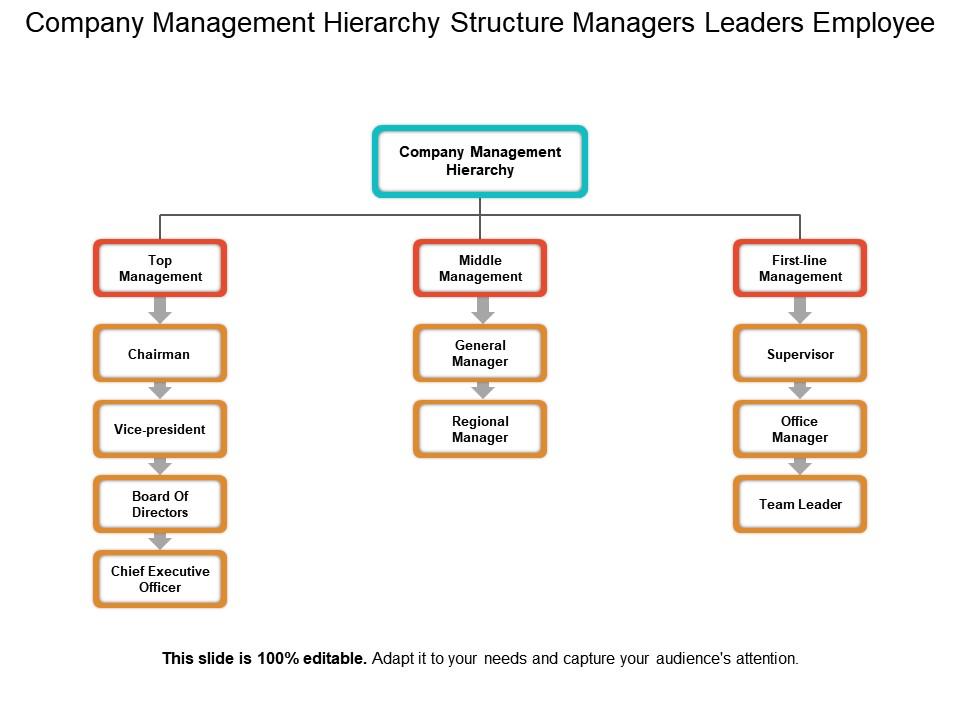
Demonstrate your organizational arrangement with this Company Management Hierarchy Structure Managers Leaders Employee template. This company position infographic contains the information of employees who come under the top, middle and first-line management. Take advantage of this company structure PowerPoint presentation and showcase the types of business structures such as tall, flat structure, etc. Further, this hierarchy visual can be employed to portray the authority, responsibility, and accountability of employees present at various lines of management. Take the assistance of this layout and reveal the kinds of departmentalization such as functional, product, geographic, etc. You can identify the best structure according to your product line or management style with this command chain background image. As this visual is 100% editable, you can easily add or replace new content. Download this divisional structure slideshow and create a wonderful impression on your management and employees.
People who downloaded this PowerPoint presentation also viewed the following :
Company management hierarchy structure managers leaders employee with all 5 slides:
Handle encumbrances with our Company Management Hierarchy Structure Managers Leaders Employee. Don't allow them to hamper your effort.
FAQs for Company management hierarchy structure
Honestly, you need clear reporting lines first - who reports to who, what decisions people can make solo. Don't go too flat or you'll lose coordination, but too many layers and everything crawls. Match it to your company size too. Startups can wing it more, but bigger places need actual processes (learned that the hard way). I'd start by mapping who currently decides what and see if it actually makes sense. Also span of control matters - nobody should manage like 15 people. Communication channels are huge too, otherwise good luck getting anything done.
Look, how your company's set up totally changes how people actually talk to each other. Flat structures? Way faster communication since you're not going through like five different managers. But hierarchical ones create those annoying silos - you've probably dealt with needing three approvals just to collaborate with another team. Super frustrating, right? Rigid structures kill cross-team projects before they even start. Flexible setups though? People actually reach out and work together. So yeah, when you're dealing with team stuff, just think about whether your structure's helping or basically cockblocking all the communication you need.
Honestly, flat structures are pretty sweet for quick decisions - you don't have to go through like five managers to get anything done. Communication flows way better too. Your team gets more freedom to actually do their jobs, which usually makes people way more engaged. But here's the thing - it gets messy fast when you're growing. Without clear hierarchy, people start stepping on each other's toes and nobody knows who's supposed to do what. Oh, and good luck with promotions when there's basically nowhere to move up to. If you're thinking about it, definitely nail down who does what first before you axe those middle managers.
So basically how you set up your org chart totally shapes how people actually work together day-to-day. Flat structures? Way more collaboration and quick decisions since you don't have like 5 approval layers. Hierarchical setups create more formal, process-heavy cultures - which honestly works great for some companies. The reporting lines you choose control who talks to who and where the real influence sits. I've literally watched places accidentally crush innovation because they had too many gatekeepers blocking everything. My point is - think hard about your structure because it'll either help build the culture you want or completely sabotage it.
Honestly, there's no one-size-fits-all answer here. Small startups usually go flat because you need that speed and flexibility. Big corporations? They lean hierarchical to handle all the complexity, though some tech giants are totally breaking that mold. Manufacturing companies love functional structures - keeps the processes smooth. Creative agencies often do matrix setups so they can share talent across different projects. You'll want to think about your company size and how fast you need to pivot when things change. Figure out what coordination headaches you're dealing with first, then pick whatever structure actually fixes those problems.
Honestly, tech has blown up those old-school org charts completely. Remote teams can work together from anywhere now, so you don't need those rigid department boxes anymore. Info moves so fast these days - maybe too fast sometimes, if I'm being real. The cool part is how small teams can do their own thing while still being plugged into the main mission. Digital tools make all this possible. When you're thinking about restructuring, just check if your current tech actually works with what you want to build or if it's fighting you. Makes a huge difference.
Honestly, you gotta flatten that hierarchy first - rigid top-down stuff just doesn't cut it anymore. Matrix structures work surprisingly well even though they seem chaotic at first. People report to both regional and functional managers, which sounds confusing but actually gives you way more flexibility. Push decision-making down to your regional teams so they're not constantly waiting for HQ approval. Oh, and invest in solid communication systems between locations - cultural gaps will kill you otherwise. Figure out what decisions can stay local versus what needs central coordination. Cross-functional teams are your friend here.
Most early startups just go flat - everyone reports directly to the founder(s). Works great when you're under 20 people and need to move fast. Some do functional instead, grouping people into engineering, marketing, sales, etc. But real talk? Most early-stage companies are way too busy trying to survive to stress about org charts. I've seen founders literally drawing their structure on napkins lol. Once you hit 50+ employees though, you'll need more layers or things get messy. My take: start dead simple and restructure as you grow. Don't overthink it while you're still figuring out if people actually want your product.
Honestly, your org structure is pretty much everything when it comes to decision speed. Flat orgs move fast because there's no endless chain of approvals - people just make calls and run with them. Hierarchical places? Decisions crawl upward through layers, which sucks for urgency but I guess gives you more oversight. The real problem happens when your structure fights against what you actually need to get done. Like when something urgent sits on someone's desk for days waiting for a signature. Check where things are getting stuck right now - maybe shuffling some reporting relationships could unstick the whole mess.
First things first - figure out exactly what you're trying to fix. Better teamwork? Quicker decisions? Saving money? Map out how things work now before changing anything (sounds obvious but people skip this constantly). Talk to everyone involved, especially the people actually doing the work - not just the bosses who think they know what's happening. Don't shock everyone with huge changes overnight. Test stuff gradually instead. Oh, and communicate like crazy throughout because people will make up their own stories if you don't. Write everything down so you'll know if it actually worked later.
Look, when everyone knows exactly who does what, work just flows better. No more awkward "wait, is this my thing or yours?" moments. People can actually make decisions without second-guessing themselves all the time. Plus employees see where they can grow - like, there's an actual ladder to climb instead of just hoping someone notices their hard work someday. The trick though? Your structure has to match reality, not just some fancy org chart that executives love but makes zero sense for day-to-day stuff. Trust me, I've seen companies mess this up badly.
Honestly, start with the numbers - track how fast decisions get made and whether teams are actually talking to each other. Your employees will be brutally honest in surveys about where things get stuck, so definitely do those. One thing that always blows my mind is mapping out who actually talks to who versus who's supposed to. The gap is usually huge! Check if your managers are drowning or basically twiddling their thumbs too. Mix the hard data with what people are telling you. Maybe throw out a quick survey next quarter? That'll give you something solid to work with.
So hierarchical is super simple - one boss, clear decisions, done. Matrix gets weird because suddenly you've got two managers pulling you in different directions. Honestly, matrix sounds like a headache but it actually works better for complex stuff. Routine projects? Go hierarchical. Need people from marketing, tech, finance all working together? Matrix is your friend. Just be ready for those awkward moments when both bosses want you prioritizing their thing first - happens more than you'd think. Depends on how messy your projects usually get.
Look, it really depends on how big your company is. Small teams can get away with having the boss make most calls, but once you hit a certain size, you're gonna create massive bottlenecks. What industry are you in? Because if it's heavily regulated, you might not have much choice but to keep things centralized. The real question is where your smart people are sitting. If all the expertise is at the top, centralize. If it's spread out, push decisions down. Most companies I've seen do a mix honestly - some stuff stays with leadership, other decisions get delegated. Speed vs control, classic dilemma. Map out which decisions actually need executive sign-off and which don't.
Don't just copy what other companies are doing - figure out what YOUR strategy actually needs first. Want speed and innovation? Flatten everything and get cross-functional teams talking. Planning to scale fast? You'll need more centralized processes and clear reporting lines. Most companies do this completely backwards, which is why everything feels so clunky later. Map out where you need quick decisions versus tight control, then build around that. Match your structure to how fast decisions need to move and where resources should flow. It's really about aligning your org chart with your actual priorities.
-
Great quality slides in rapid time.
-
Very well designed and informative templates.