

Company Revenue Breakdown By Product Categories




Try Before you Buy Download Free Sample Product
 Impress Your
 Audience
 100%
100% Editable
 Save Hours
 of Time


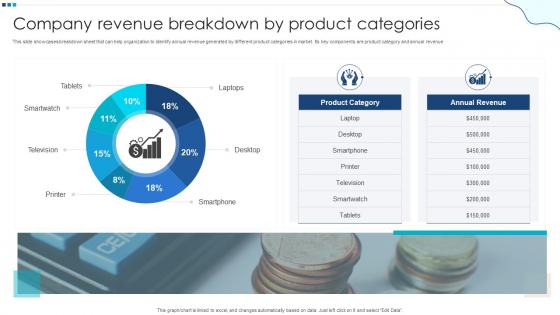
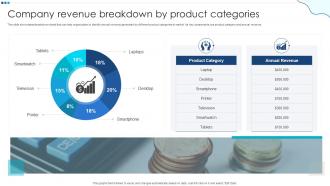
This slide showcases breakdown sheet that can help organization to identify annual revenue generated by different product categories in market. Its key components are product category and annual revenue
People who downloaded this PowerPoint presentation also viewed the following :
Company Revenue Breakdown By Product Categories with all 7 slides:
Use our Company Revenue Breakdown By Product Categories to effectively help you save your valuable time. They are readymade to fit into any presentation structure.





FAQs for Company Revenue Breakdown
Revenue breakdown components include product sales, service revenues, subscription fees, licensing income, and ancillary revenue streams like partnerships or advertising. These elements enable businesses to identify their most profitable segments, optimize resource allocation, and diversify income sources, with many organizations finding that detailed revenue analysis streamlines strategic planning and enhances competitive positioning.
Revenue breakdown enables companies to identify profitable segments by analyzing income sources across product lines, customer demographics, geographic regions, and sales channels. Through detailed segmentation analysis, businesses can pinpoint high-margin offerings, optimize resource allocation toward top-performing areas, and eliminate underperforming segments, ultimately delivering enhanced profitability and strategic competitive advantage.
Businesses should focus on revenue per product line, customer segment profitability, geographic performance, seasonal trends, and growth rates by category when analyzing revenue breakdown. These metrics enable organizations to identify high-performing areas, optimize resource allocation, and strategic planning decisions, with many companies finding that detailed revenue analysis delivers enhanced operational efficiency and competitive advantage.
Fixed revenues provide predictable income streams through subscriptions, contracts, and recurring fees, while variable revenues fluctuate based on sales volume, seasonal demand, and market conditions. This combination enables organizations to maintain baseline operational stability through fixed components while capturing growth opportunities through variable streams, with many companies finding that balancing both delivers sustainable cash flow and competitive flexibility.
A detailed revenue breakdown enhances investor confidence by demonstrating transparency, predictability, and growth potential across different segments, products, and markets. This granular visibility enables investors to assess risk diversification, identify sustainable revenue streams, and evaluate management's strategic execution, ultimately delivering greater trust and potentially higher valuations in an increasingly competitive investment landscape.
Seasonality impacts revenue breakdown by creating fluctuations in product lines, service demand, and customer segments throughout different periods. Retail companies experience higher consumer goods revenue during holidays, while hospitality businesses see increased bookings during summer months, ultimately requiring strategic resource allocation and flexible financial planning to maintain consistent profitability across varying seasonal cycles.
Customer segmentation enables organizations to identify which customer groups generate the highest revenue, their purchasing patterns, and profitability margins across different demographics, behaviors, and preferences. Through detailed segmentation analysis, businesses can optimize pricing strategies, tailor marketing investments, and allocate resources more effectively, with many companies finding that focused segmentation reveals previously hidden revenue opportunities and enhances overall financial performance.
Revenue breakdowns enable businesses to identify high-performing segments, underperforming areas, and seasonal patterns, informing strategic resource allocation through data-driven insights. By analyzing revenue sources across products, regions, and customer segments, companies can prioritize investments in profitable areas, streamline operations in declining segments, and allocate budgets more effectively, ultimately delivering improved financial performance and competitive advantage.
During economic downturns, businesses should monitor declining recurring revenue streams, increasing dependency on single revenue sources, shrinking high-margin service segments, and growing proportion of low-margin survival offerings. These shifts signal vulnerability, with many organizations finding that diversified revenue portfolios and maintained premium service lines ultimately deliver greater resilience and faster recovery positioning.
Technology and analytics software enhance revenue breakdown accuracy by automating data collection, eliminating manual errors, and providing real-time tracking across multiple revenue streams. These platforms streamline financial reporting through advanced algorithms, predictive modeling, and integrated dashboards, with many organizations finding that automated systems deliver significantly faster reconciliation and more precise forecasting capabilities.
Common pitfalls include overly optimistic projections, insufficient market research, neglecting seasonal variations, poor customer segmentation, and inadequate contingency planning. These oversights can mislead stakeholders and damage credibility, with many organizations finding that conservative estimates, thorough validation, and scenario-based modeling ultimately deliver more accurate forecasts and sustainable growth strategies.
Companies should revisit their revenue breakdown quarterly for operational adjustments and annually for comprehensive strategic reviews, with monthly assessments during periods of significant growth or market changes. This regular analysis enables organizations to identify emerging revenue streams, optimize resource allocation, and adapt pricing strategies, with many businesses finding that consistent monitoring ultimately delivers improved forecasting accuracy and competitive positioning in increasingly dynamic markets.
Revenue breakdown varies significantly across industries due to different business models, cost structures, and operational requirements. Manufacturing companies typically see higher material and production costs, while service industries like consulting allocate more to personnel expenses, and technology firms often emphasize research and development investments, ultimately reflecting each sector's unique value creation approaches.
High reliance on a single revenue stream creates significant business vulnerability, including increased financial risk, limited growth opportunities, reduced market adaptability, and potential cash flow instability during disruptions. While this concentration can initially streamline operations and expertise, companies across industries like retail and manufacturing increasingly diversify their revenue portfolios to enhance resilience and competitive positioning.
Non-profit organizations can utilize revenue breakdowns by analyzing donor patterns, grant cycles, program-specific funding, and administrative cost ratios to identify diversification opportunities and optimize resource allocation. This strategic approach enables organizations to strengthen relationships with major donors, develop targeted fundraising campaigns, and demonstrate financial transparency to stakeholders, ultimately enhancing sustainability and competitive positioning for future funding opportunities.
-
I want to thank SlideTeam for the work that they do, especially their customer service.
-
One-stop solution for all presentation needs. Great products with easy customization.