


Compensation Benefit Powerpoint Presentation Slides




Try Before you Buy Download Free Sample Product
 Impress Your
 Audience
 100%
100% Editable
 Save Hours
 of Time


Our Compensation Benefit Powerpoint Presentation Slides are topically designed to provide an attractive backdrop to any subject. Use them to look like a presentation pro.
People who downloaded this PowerPoint presentation also viewed the following :
Content of this Powerpoint Presentation
Slide 1: This slide introduces Compensation Benefit. State Your Company Name and begin.
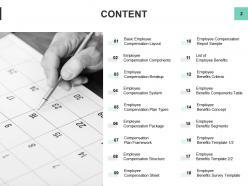
Slide 2: This slide shows Content of the presentation.
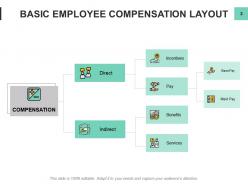
Slide 3: This slide shows Basic Employee Compensation Layout.
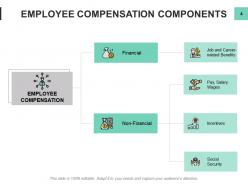
Slide 4: This slide presents Employee Compensation Components describing- Pay, Salary, Wages, Incentives, Social Security, Job and Career-related Benefits.
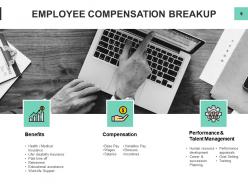
Slide 5: This slide displays Employee Compensation Breakup describing- Benefits, Compensation, Performance & Talent Management.
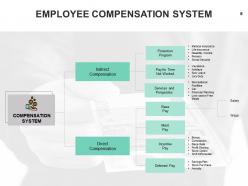
Slide 6: This slide represents Employee Compensation System describing- Protection Program, Pay for Time Not Worked, Services and Perquisites, Base Pay, Merit Pay, Incentive Pay, Deferred Pay.
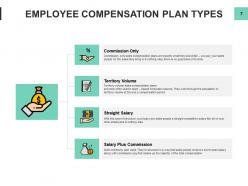
Slide 7: This slide showcases Employee Compensation Plan Types as Territory Volume, Straight Salary, Salary Plus Commission, Commission Only.
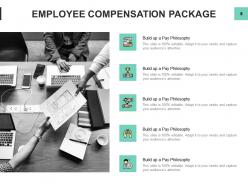
Slide 8: This slide shows Employee Compensation Package describing- Build up a Pay Philosophy, Set Different Salary Grades, Determine if Salaries are Competitive, Pay Raises, Creating Employee Bonus & Incentive Programs.
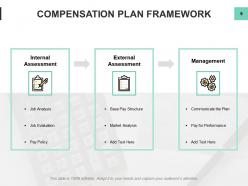
Slide 9: This slide presents Compensation Plan Framework with Internal Assessment, External Assessment, Management.
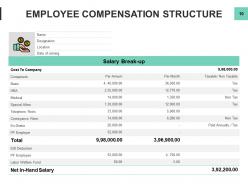
Slide 10: This slide displays Employee Compensation Structure describing salary break-up.
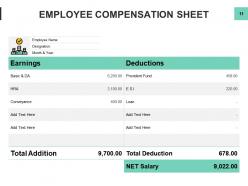
Slide 11: This slide represents Employee Compensation Sheet showing earnings, deductions and net salary.
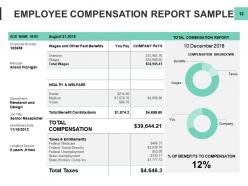
Slide 12: This slide showcases Employee Compensation Report Sample.
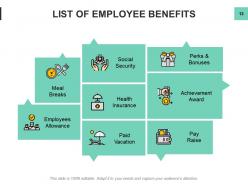
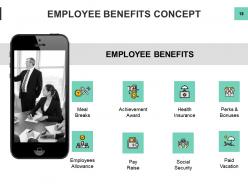
Slide 13: This slide shows List of Employee Benefits describing- Meal Breaks, Social Security, Perks & Bonuses, Pay Raise, Employees Allowance, Health Insurance, Paid Vacation, Achievement Award.
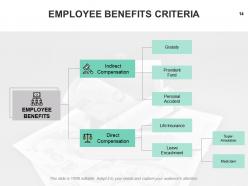
Slide 14: This slide presents Employee Benefits Criteria in hierarchy form.
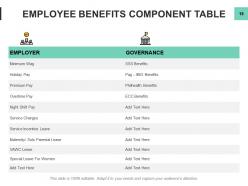
Slide 15: This slide displays Employee Benefits Component Table describing benefits provided by employer and government.
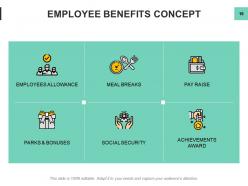
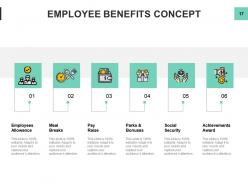
Slide 16: This slide represents Employee Benefits Concept with- Meal Breaks, Social Security, Perks & Bonuses, Pay Raise, Employees Allowance, Achievement Award.
Slide 17: This is another slide on Employee Benefits Concept.
Slide 18: This is another slide on Employee Benefits Concept.
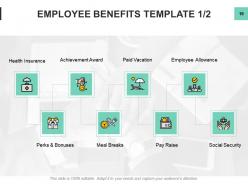
Slide 19: This slide shows Employee Benefits Template. You can add or edit data as per requirements.
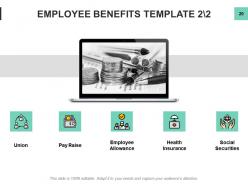
Slide 20: This is another slide presenting Employee Benefits Template.
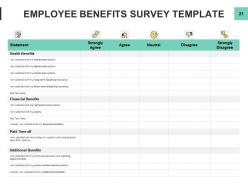
Slide 21: This slide represents Employee Benefits Survey Template with scale range from strongly agree to strongly disagree.
Slide 22: This is Our Mission slide with related imagery and text.
Slide 23: This is Our Team slide with names and designation.
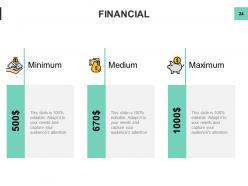
Slide 24: This is a Financial slide. Show your finance related stuff here.
Slide 25: This is About Us slide to show company specifications etc.
Slide 26: This slide is titled as Post It Notes. Post your important notes here.
Slide 27: This is a Venn slide with text boxes.
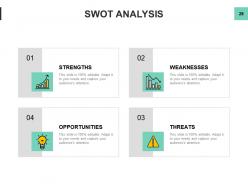
Slide 28: This slide shows Swot Analysis describing- Strengths, Weaknesses, Opportunities and Threats.
Slide 29: This is a Quotes slide to convey message, beliefs etc.
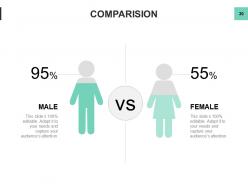
Slide 30: This is a Comparison slide to state comparison between commodities, entities etc.
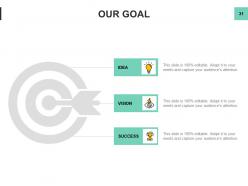
Slide 31: This is Our Goal slide. Show your firm's goals here.
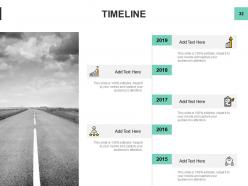
Slide 32: This is a Timeline slide to show information related with time period.
Slide 33: This is a Bulb or Idea slide to state a new idea or highlight information, specifications etc.
Slide 34: This is a Thank You slide with address, contact numbers and email address.
Compensation Benefit Powerpoint Presentation Slides with all 34 slides:
Use our Compensation Benefit Powerpoint Presentation Slides to effectively help you save your valuable time. They are readymade to fit into any presentation structure.


FAQs for Compensation Benefit
A comprehensive compensation benefits package includes base salary, health insurance, retirement plans, paid time off, performance bonuses, and professional development opportunities. These components work together by attracting top talent, enhancing employee retention, and boosting productivity, with many organizations finding that strategic compensation packages ultimately deliver competitive advantage and improved workforce satisfaction.
Compensation benefits vary significantly across industries based on talent competition, regulatory requirements, and operational demands, with technology companies offering equity packages and flexible work arrangements, while healthcare organizations emphasize comprehensive insurance and retirement plans. Manufacturing and finance sectors typically provide structured benefits with strong pension systems, whereas startups focus on growth-oriented incentives, ultimately reflecting each industry's unique workforce needs and competitive landscape.
Performance bonuses significantly enhance employee motivation by directly linking compensation to achievements, creating clear incentives for exceeding targets, and recognizing exceptional contributions. These strategic rewards drive higher engagement, productivity, and loyalty across organizations, with many companies finding that well-structured bonus programs reduce turnover while attracting top talent in competitive markets.
Organizations effectively communicate compensation benefits through comprehensive total rewards statements, regular one-on-one discussions with managers, interactive digital platforms, and transparent benefits guides that break down complex packages into understandable components. Many companies find that combining personalized benefits calculators with quarterly communications and peer benchmarking data enhances employee understanding and appreciation, ultimately improving retention and engagement across all organizational levels.
Legal requirements for compensation benefits vary significantly across regions, encompassing mandatory health insurance, retirement contributions, paid leave entitlements, overtime regulations, and statutory bonuses or allowances. While European markets typically mandate extensive social benefits and the US focuses on healthcare compliance through frameworks like COBRA, many multinational organizations find that standardizing above minimum requirements streamlines administration and enhances global talent retention.
Non-monetary benefits significantly enhance employee satisfaction by reducing stress, improving mental health, and increasing overall job engagement and productivity. Companies offering flexible schedules, remote work options, and wellness programs often experience lower turnover rates, higher employee loyalty, and improved performance, with many organizations finding that these benefits deliver competitive advantages in talent acquisition and retention.
Current compensation trends include flexible work arrangements, mental health support, personalized benefits packages, student loan assistance, and enhanced parental leave policies. These evolving benefits help organizations attract top talent, improve employee retention, and maintain competitive advantage, with many companies finding that comprehensive, flexible compensation strategies significantly enhance workforce satisfaction and organizational performance.
Companies can tailor benefits packages by offering flexible work arrangements, comprehensive healthcare including mental health support, childcare assistance, professional development opportunities, and culturally inclusive policies. Through strategic customization, organizations enhance their employer brand while addressing varied employee needs, with many finding that diverse benefits significantly improve recruitment outcomes and workplace satisfaction across different demographics.
Compensation benefits effectiveness metrics include employee retention rates, recruitment success rates, total rewards ROI, employee satisfaction scores, and healthcare cost management ratios. These measurements enable organizations to assess program impact through reduced turnover, faster hiring cycles, and enhanced employee engagement, with many companies finding that strategic benefits tracking ultimately delivers improved talent acquisition outcomes and competitive positioning advantages.
Compensation benefits significantly influence organizational culture by shaping employee values, behaviors, and expectations through strategic reward systems, recognition programs, and work-life balance initiatives. These benefits create cultural foundations that emphasize performance, collaboration, and employee wellbeing, with many organizations finding that comprehensive benefit packages foster loyalty, attract top talent, and ultimately build competitive workplace environments.
Companies face challenges including budget constraints, ensuring pay equity across diverse roles, navigating complex regulatory compliance, managing employee expectations, and integrating benefits with existing HR systems. While these obstacles require strategic planning, organizations increasingly find that transparent communication, phased implementation approaches, and leveraging technology streamline the process, ultimately delivering improved employee satisfaction and competitive talent acquisition advantages.
Compensation benefits significantly enhance employee productivity and engagement by reducing financial stress, improving work-life balance, and demonstrating organizational investment in workforce wellbeing. Companies offering comprehensive packages, including healthcare, retirement plans, and flexible work arrangements, typically experience higher retention rates, increased motivation, and stronger performance outcomes, ultimately delivering competitive advantage through enhanced talent management.
Remote work significantly impacts compensation benefits by requiring geographic pay adjustments, enhanced technology stipends, flexible health coverage, and expanded wellness programs. Organizations increasingly offer location-independent salaries, home office allowances, and digital-first benefits platforms, while many companies find that strategic remote compensation packages attract top talent, reduce overhead costs, and ultimately deliver competitive advantage in an increasingly distributed workforce landscape.
Technology streamlines compensation benefits management through automated payroll processing, integrated HRIS platforms, self-service employee portals, real-time analytics dashboards, and cloud-based benefits administration systems. These solutions enhance operational efficiency by reducing manual errors, accelerating benefit enrollments, and providing transparent tracking, with many organizations finding significantly lower administrative costs and improved employee satisfaction.
Best practices for annual compensation benefits revision include conducting comprehensive market salary surveys, analyzing internal equity across roles, reviewing performance metrics and business outcomes, assessing employee feedback through surveys, and evaluating budget constraints against strategic goals. Organizations increasingly find that combining data-driven benchmarking with employee input enables more competitive packages, ultimately improving retention rates and attracting top talent.
-
Top Quality presentations that are easily editable.
-
The content is very helpful from business point of view.
-
Graphics are very appealing to eyes.
-
Use of different colors is good. It's simple and attractive.
-
Use of icon with content is very relateable, informative and appealing.