Competitive positioning chart of software company

Competitive positioning chart of software company
Slide 1 of 2
Favourites Favourites

Try Before you Buy Download Free Sample Product

Audience Impress Your
Audience
Editable 100%
Editable
Time Save Hours
of Time
The Biggest Sale is ending soon in
0
0
:
0
0
:
0
0
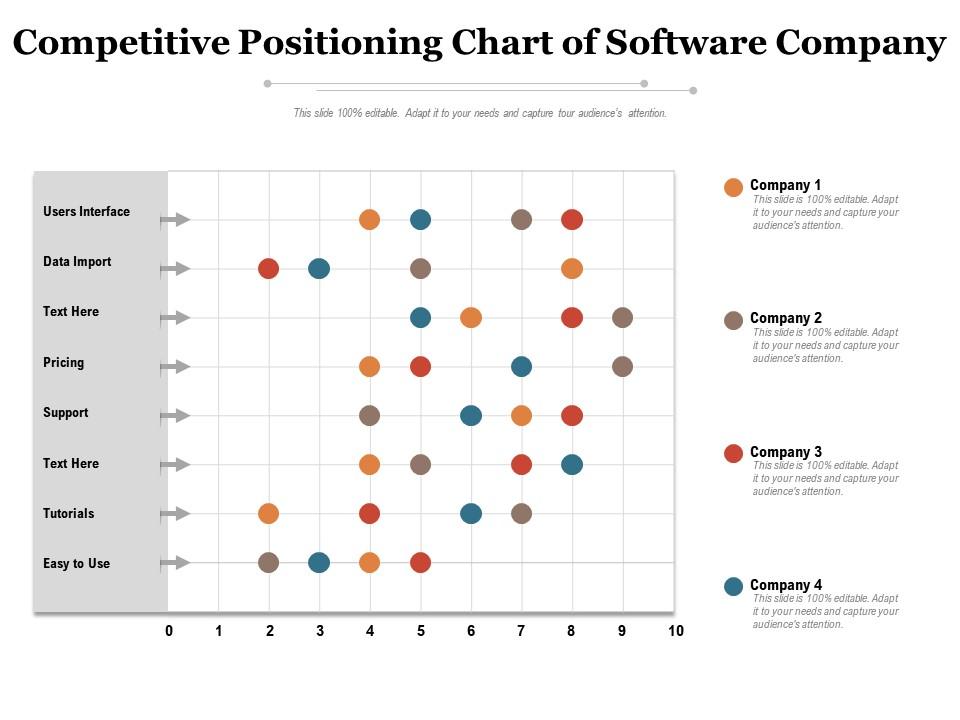
Presenting this set of slides with name Competitive Positioning Chart Of Software Company. The topics discussed in these slides are Competitive, Positioning, Chart Software, Company. This is a completely editable PowerPoint presentation and is available for immediate download. Download now and impress your audience.

People who downloaded this PowerPoint presentation also viewed the following :

FAQs for Competitive positioning chart

Companies should consider market differentiation, target audience needs, competitor strengths and weaknesses, unique value propositions, and pricing strategies when identifying competitive positioning. Through comprehensive market analysis, organizations can assess their capabilities against competitors while understanding customer preferences, ultimately enabling them to carve distinct market niches that deliver sustainable competitive advantage and enhanced customer loyalty.

Businesses can effectively analyze competitors through market research, SWOT analysis, pricing comparisons, customer feedback evaluation, and digital presence assessment. These strategic approaches enable organizations to identify market gaps, differentiate their offerings, and develop targeted positioning strategies, with many companies finding that comprehensive competitor analysis ultimately delivers enhanced market share and sustainable competitive advantages.

Customer perception fundamentally determines competitive positioning by shaping how audiences view your brand relative to competitors through price sensitivity, quality expectations, service experiences, and brand reputation. Companies increasingly leverage customer feedback, market research, and brand messaging to influence these perceptions, with successful organizations finding that strategic positioning aligned with customer values delivers enhanced market share, premium pricing opportunities, and sustained competitive advantage.

Companies can differentiate themselves through innovative product features, superior customer service, competitive pricing strategies, unique brand positioning, and operational excellence. These approaches enable businesses to capture market share by delivering enhanced value propositions, streamlined customer experiences, and strategic advantages, with many organizations finding that combining multiple differentiation methods ultimately strengthens their competitive positioning.

Effective storytelling enhances competitive positioning by creating emotional connections, differentiating brand values, and building memorable customer experiences that transcend price-based competition. Through authentic narratives, companies like Patagonia and Nike establish distinct market identities, foster customer loyalty, and communicate unique value propositions, ultimately delivering sustainable competitive advantage in increasingly crowded marketplaces.

Organizations can measure competitive positioning success through market share growth, brand perception scores, customer acquisition costs, pricing power metrics, and competitive win rates. These indicators help businesses track whether their positioning strategies are effectively differentiating them in the marketplace, with many companies finding that consistent measurement across these areas ultimately delivers stronger market presence and sustainable competitive advantage.

Competitive positioning directly influences pricing strategies by determining whether businesses can command premium prices, match competitor rates, or compete on value propositions through cost leadership approaches. Companies with strong differentiation in quality or innovation, like luxury brands or specialized B2B services, leverage superior positioning to maintain higher margins, while those in commoditized markets often adopt competitive pricing to retain market share.

Common pitfalls include being too generic without differentiation, focusing solely on features rather than customer benefits, ignoring competitor strengths, and creating unrealistic claims that can't be substantiated. These missteps often lead to positioning statements that fail to resonate with target audiences, with many organizations finding that overly complex messaging dilutes their competitive advantage and confuses potential customers.

Companies leverage social media to reinforce competitive positioning by showcasing unique value propositions, engaging directly with target audiences, and demonstrating thought leadership through strategic content. Through platforms like LinkedIn, Twitter, and Instagram, businesses can highlight differentiators, share customer success stories, and build brand authority, with many organizations finding that consistent social engagement significantly enhances market perception and competitive advantage.

Innovation serves as the primary driver for sustaining competitive positioning by enabling continuous product development, process optimization, market adaptation, and customer value enhancement. Through strategic innovation initiatives, organizations revolutionize their offerings, streamline operations, and anticipate market shifts, with many industry leaders finding that consistent innovation cycles ultimately deliver sustained market differentiation and long-term competitive advantage.

Businesses can adapt their competitive positioning through continuous market monitoring, strategic pivoting of value propositions, redefining target segments, and leveraging emerging technologies or trends. Companies like Netflix transitioning from DVD rentals to streaming, or retailers embracing e-commerce during digital shifts, demonstrate how agile positioning strategies enable sustained market relevance and competitive advantage.

Startups can carve out niches through focused differentiation, hyper-targeted customer segments, innovative service delivery models, strategic partnerships, and agile response capabilities. By identifying underserved micro-markets within saturated industries, many emerging companies streamline operations, enhance customer experiences, and deliver specialized solutions, ultimately establishing competitive advantages that larger competitors often overlook.

Visual branding elements enhance competitive positioning by creating distinctive identity, improving brand recognition, communicating value propositions, establishing emotional connections, and differentiating from competitors. Through strategic use of logos, color schemes, and design consistency, companies across retail, technology, and financial services build memorable brand experiences that drive customer loyalty, ultimately delivering market differentiation and sustainable competitive advantage.

Competitive positioning directly influences customer loyalty by creating distinct value propositions that resonate with target audiences, differentiate offerings from competitors, and establish emotional connections through consistent brand messaging. Strong positioning enables businesses to build deeper customer relationships, reduce price sensitivity, and increase retention rates, with companies in sectors like retail and financial services finding that clear positioning strategies deliver sustainable competitive advantages and higher lifetime customer value.

Customer feedback enables businesses to refine their competitive positioning by identifying unmet needs, revealing perception gaps, and uncovering differentiation opportunities that competitors may overlook. Through systematic analysis of reviews, surveys, and social listening, companies like retail brands and financial services can pivot messaging, enhance product features, and ultimately deliver more targeted value propositions that resonate with their specific market segments.

Ratings and Reviews

0% of 100
Write a review
Most Relevant Reviews

No Reviews