Conducting Cyber Security Gap Analysis Of Organization Implementing Security Awareness Training
Try Before you Buy Download Free Sample Product
Audience
Editable
of Time
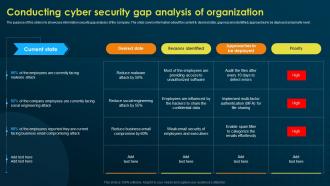
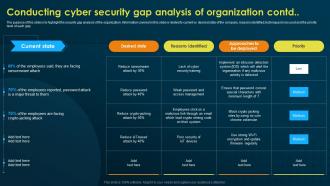
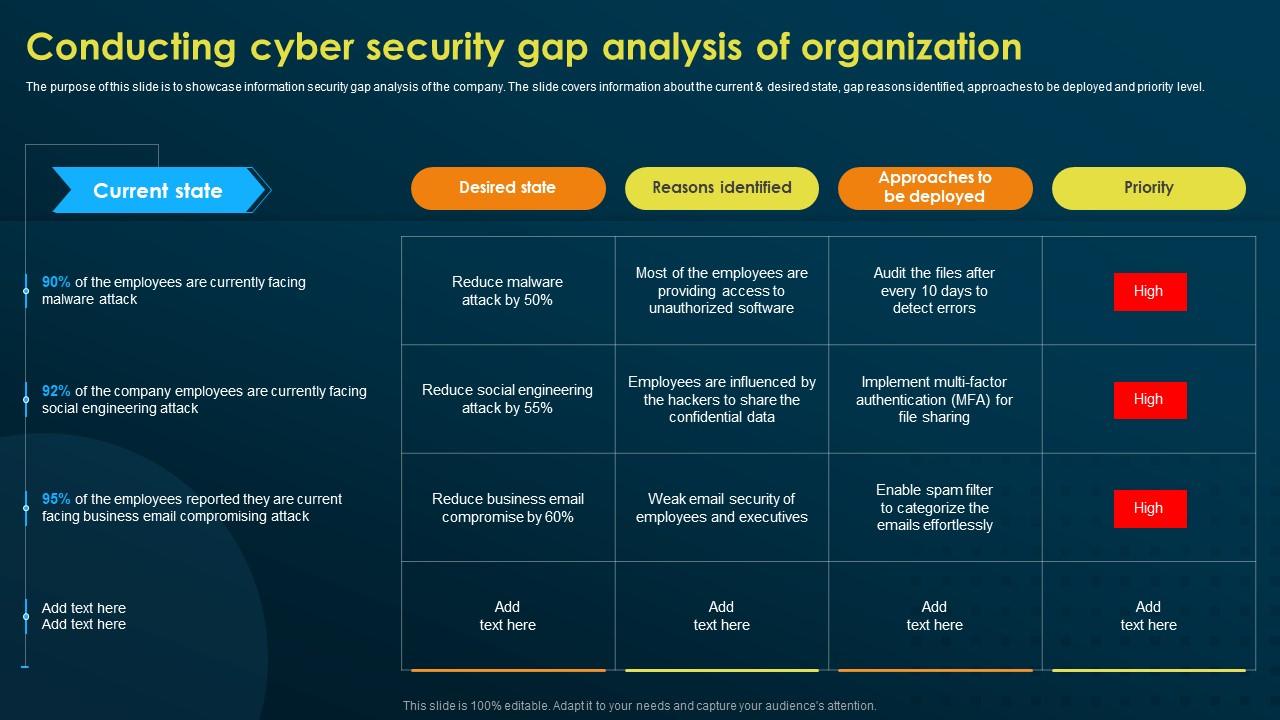
The purpose of this slide is to showcase information security gap analysis of the company. The slide covers information about the current and desired state, gap reasons identified, approaches to be deployed and priority level.
People who downloaded this PowerPoint presentation also viewed the following :
Conducting Cyber Security Gap Analysis Of Organization Implementing Security Awareness Training with all 7 slides:
Use our Conducting Cyber Security Gap Analysis Of Organization Implementing Security Awareness Training to effectively help you save your valuable time. They are readymade to fit into any presentation structure.
FAQs for Conducting Cyber Security Gap Analysis Of Organization Implementing
A comprehensive cyber security gap analysis includes current security posture assessment, threat landscape evaluation, compliance requirements review, risk identification and prioritization, and remediation roadmap development. These components work together by identifying vulnerabilities, mapping regulatory obligations, and establishing strategic implementation timelines, with many organizations finding that this systematic approach ultimately delivers enhanced protection and operational resilience.
Organizations identify critical assets through comprehensive inventory assessments, data classification systems, business impact analyses, threat modeling exercises, and stakeholder consultations across departments. These methodologies enable companies to prioritize protection efforts by evaluating asset criticality, regulatory requirements, and potential business disruption, with many financial services and healthcare institutions finding that systematic asset identification significantly enhances their security posture and compliance outcomes.
Cyber security gap analyses typically uncover vulnerabilities including outdated software patches, weak authentication protocols, inadequate employee training, insufficient network segmentation, and poor data encryption practices. These assessments enable organizations to identify critical security blind spots across their infrastructure, with many financial institutions and healthcare providers finding that addressing these gaps significantly reduces breach risks while enhancing regulatory compliance and operational resilience.
Organizations can prioritize cyber security gap analysis findings by assessing risk severity, potential business impact, regulatory compliance requirements, and implementation feasibility. Through risk scoring matrices and threat modeling, companies evaluate vulnerabilities affecting critical assets first, followed by high-probability threats, with many finding that addressing compliance gaps and quick wins simultaneously delivers immediate protection while building momentum for comprehensive security improvements.
Regulatory compliance serves as a critical baseline framework in cybersecurity gap analysis, providing mandatory security standards, data protection requirements, audit protocols, and incident response procedures that organizations must meet. Through compliance mapping against regulations like GDPR, HIPAA, or SOX, financial institutions, healthcare providers, and retail companies identify specific vulnerabilities while ensuring legal adherence, ultimately delivering risk mitigation and operational resilience.
Gap analysis strengthens cybersecurity risk management by identifying vulnerabilities in current security postures, mapping compliance requirements, and prioritizing remediation efforts based on threat severity. Through systematic assessment, organizations can allocate resources more strategically, implement targeted security controls, and develop comprehensive incident response plans, ultimately reducing exposure windows and enhancing their overall security resilience.
Recommended tools include vulnerability scanners like Nessus and Qualys, compliance frameworks such as NIST and ISO 27001, risk assessment platforms, and security maturity models like CMMI. These methodologies streamline identification of security weaknesses, regulatory compliance gaps, and operational vulnerabilities, with many organizations finding that comprehensive assessments ultimately deliver enhanced protection and strategic security investments.
Organizations should perform cybersecurity gap analyses quarterly for comprehensive reviews, with annual deep-dive assessments and immediate analyses following security incidents, regulatory changes, or major system updates. Financial institutions and healthcare organizations increasingly conduct monthly reviews given heightened threats, while manufacturing and retail sectors find quarterly assessments balance thoroughness with resource allocation, ultimately ensuring continuous protection and regulatory compliance.
Cyber security gap analysis and incident response planning work synergistically, with gap analysis identifying vulnerabilities in current security posture while incident response planning addresses how organizations handle breaches when they occur. Through comprehensive gap analysis, companies can strengthen their incident response capabilities by identifying missing detection tools, response procedures, and recovery protocols, ultimately enabling faster containment and minimized business impact during security incidents.
Businesses secure stakeholder buy-in by presenting findings through clear risk-to-business impact mapping, quantified cost analysis of vulnerabilities, and prioritized remediation roadmaps with defined timelines. Through executive dashboards and sector-specific threat scenarios, organizations demonstrate how addressing gaps enhances competitive advantage, reduces operational risk, and strengthens customer trust, ultimately delivering measurable ROI and regulatory compliance.
Key metrics include mean time to remediation, percentage of vulnerabilities closed within SLA timelines, residual risk scores, compliance posture improvements, and security incident reduction rates. These measurements enable organizations to demonstrate tangible progress through quantified risk reduction, enhanced regulatory compliance, and strengthened security frameworks, with many enterprises finding that consistent tracking ultimately delivers measurable ROI and competitive advantage.
Cybersecurity gap analysis differs significantly across industries due to unique regulatory requirements, threat landscapes, and data sensitivity levels. Financial institutions focus on transaction security, fraud prevention, and compliance with regulations like PCI-DSS, while healthcare organizations prioritize patient data protection, medical device security, and HIPAA compliance, with both sectors ultimately requiring tailored risk assessments and industry-specific security frameworks.
Assessing third-party cybersecurity in gap analyses presents challenges including limited visibility into vendor security practices, inconsistent security standards across suppliers, inadequate documentation of controls, and varying compliance frameworks. These complexities require organizations to implement comprehensive vendor risk assessment programs, standardized security questionnaires, and continuous monitoring protocols, with many enterprises finding that strategic third-party security integration ultimately delivers enhanced supply chain resilience and competitive advantage.
Emerging threats for cybersecurity gap analysis include AI-powered attacks, supply chain vulnerabilities, cloud misconfigurations, IoT device exploits, and ransomware-as-a-service platforms. These evolving risks require organizations to assess defense capabilities against deepfakes targeting executives, third-party vendor breaches, and automated phishing campaigns, with many financial institutions and healthcare systems finding that traditional security frameworks need strategic enhancement.
Organizations leverage benchmarking against industry standards during gap analysis by comparing current security postures against frameworks like NIST, ISO 27001, and CIS Controls, identifying specific compliance gaps and prioritization opportunities. This strategic comparison enables financial services, healthcare, and manufacturing companies to allocate resources more effectively, accelerate remediation efforts, and ultimately achieve stronger security alignment while reducing regulatory risks.
-
Delighted to see unique and eye-catching PowerPoint designs that are so easy to customize.
-
Professional and unique presentations.