Construction Project Risk Assessment Matrix
Try Before you Buy Download Free Sample Product
Audience
Editable
of Time
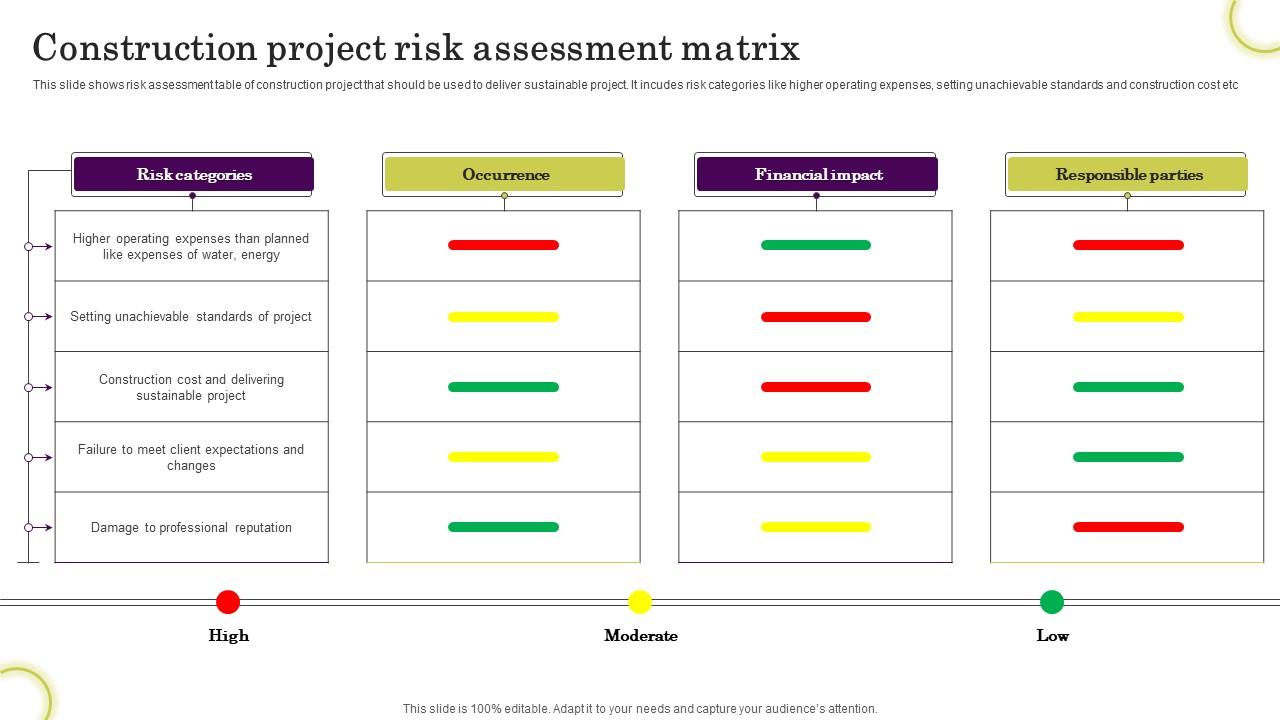
This slide shows risk assessment table of construction project that should be used to deliver sustainable project. It incudes risk categories like higher operating expenses, setting unachievable standards and construction cost etc
People who downloaded this PowerPoint presentation also viewed the following :
Construction Project Risk Assessment Matrix with all 6 slides:
Use our Construction Project Risk Assessment Matrix to effectively help you save your valuable time. They are readymade to fit into any presentation structure.
FAQs for Construction Project
Key components of a comprehensive construction risk assessment include hazard identification, risk analysis, safety protocols, environmental impact evaluation, and regulatory compliance measures. These components work together by systematically identifying potential dangers, evaluating their likelihood and severity, and implementing targeted mitigation strategies, with many construction firms finding that thorough assessments ultimately reduce project delays, minimize liability costs, and enhance worker safety outcomes.
Risk assessment methodologies differ significantly between residential and commercial construction, with residential projects focusing on standard safety protocols, weather delays, and material quality issues, while commercial projects require complex stakeholder analysis, regulatory compliance frameworks, and extensive financial risk modeling. Commercial assessments typically involve multiple risk categories including environmental impact, zoning challenges, and larger-scale coordination issues, ultimately delivering more comprehensive risk mitigation strategies.
Site safety serves as a foundational element in construction risk assessment, directly influencing project timelines, costs, regulatory compliance, and worker protection protocols. Through comprehensive safety evaluations, construction managers identify potential hazards, implement preventive measures, and ensure adherence to OSHA standards, ultimately reducing liability exposure, minimizing project delays, and enhancing overall operational efficiency.
BIM enhances construction risk assessments by enabling 3D visualization of potential hazards, automating clash detection between building systems, and facilitating real-time collaboration among project stakeholders. Through predictive modeling and data integration, construction companies can identify structural conflicts, safety risks, and scheduling bottlenecks before breaking ground, ultimately reducing costly delays and improving project outcomes.
Environmental risks in construction include weather-related delays, soil contamination, flooding, extreme temperatures, and natural disasters like earthquakes or hurricanes. These factors significantly impact project timelines, worker safety, and material integrity, with many construction companies finding that proactive environmental assessments streamline project planning, minimize costly delays, and ultimately deliver safer, more predictable outcomes.
Project managers can effectively communicate risk assessment findings by using visual dashboards, regular stakeholder meetings, standardized risk registers, clear impact-probability matrices, and tailored reports for different audience levels. Through strategic presentation methods, construction teams enhance transparency, accelerate decision-making, and improve resource allocation, while ensuring all stakeholders understand potential project impacts, ultimately delivering better project outcomes and stronger stakeholder confidence.
Regulatory compliance and legal considerations significantly impact construction risk assessments by establishing mandatory safety standards, environmental requirements, and liability frameworks that must be integrated into project planning. These regulations drive comprehensive risk evaluation processes, with construction companies finding that proactive compliance assessment reduces potential delays, costly penalties, and legal disputes, ultimately delivering enhanced project predictability and stakeholder confidence.
Best practices for continually updating construction risk assessments include establishing regular review schedules, implementing real-time monitoring systems, conducting phase-gate evaluations, maintaining stakeholder feedback loops, and documenting lessons learned from incidents. These approaches streamline project oversight by identifying emerging hazards early, adapting safety protocols dynamically, and enhancing decision-making accuracy, with many construction firms finding that systematic updates reduce project delays and insurance costs significantly.
Historical project data informs future construction risk assessments by identifying recurring failure patterns, quantifying actual versus estimated costs, and revealing site-specific challenges across different project types. Through data analytics, construction firms can predict potential delays, budget overruns, and safety incidents more accurately, while benchmarking performance against similar projects, ultimately enabling more precise risk mitigation strategies and competitive bidding advantages.
Effective risk mitigation strategies include comprehensive insurance coverage, detailed contingency planning, regular safety protocols, strategic subcontractor partnerships, and proactive quality control measures. These approaches streamline project delivery by minimizing delays, reducing cost overruns, and ensuring regulatory compliance, with many construction firms finding that integrated risk management ultimately delivers enhanced profitability and competitive advantage.
Subcontractor management significantly impacts risk assessment by introducing variables in quality standards, safety protocols, financial stability, and project timelines that must be thoroughly evaluated. Construction companies enhance their assessment processes by implementing rigorous vetting procedures, continuous performance monitoring, and comprehensive insurance verification, ultimately delivering reduced project risks and improved overall outcomes.
Construction risk assessment tools include building information modeling (BIM) software, project management platforms like Procore and Autodesk Construction Cloud, AI-powered predictive analytics systems, drone inspection technologies, and IoT sensor networks. These technologies streamline risk identification by automating hazard detection, enabling real-time monitoring, and providing comprehensive data analytics, with many construction firms finding that integrated digital platforms ultimately deliver enhanced safety protocols and reduced project delays.
A safety-focused culture significantly enhances risk assessment outcomes by encouraging open communication about hazards, promoting proactive identification of potential issues, and fostering accountability across all team levels. Teams with strong safety cultures experience fewer incidents, more accurate hazard reporting, and improved compliance with safety protocols, ultimately delivering reduced liability, lower insurance costs, and enhanced project efficiency while protecting workers and maintaining operational continuity.
When significant risks are identified, immediate steps include implementing interim control measures, conducting detailed root cause analysis, developing comprehensive mitigation strategies, and establishing enhanced monitoring protocols. Construction teams should reassess project timelines, reallocate resources accordingly, communicate findings to stakeholders promptly, and document corrective actions, ultimately ensuring operational continuity while minimizing potential impacts on safety and project delivery.
Economic factors significantly influence construction risk assessments through material cost volatility, labor market fluctuations, interest rate changes, and currency exchange variations that directly impact project budgets and timelines. Construction firms increasingly incorporate economic modeling and contingency planning into their risk frameworks, with many finding that proactive economic analysis enables better resource allocation, contract structuring, and ultimately delivers more predictable project outcomes in volatile markets.
-
No second thoughts when I’m looking for excellent templates. SlideTeam is definitely my go-to website for well-designed slides.
-
My search for complete decks ended with SlideTeam. Such a surplus collection of HD PowerPoints. Moreover, their standard and widescreen formats have helped me in delivering bullseye presentations.