Construction waste management plan inert ppt powerpoint presentation styles slideshow
Try Before you Buy Download Free Sample Product
Audience
Editable
of Time
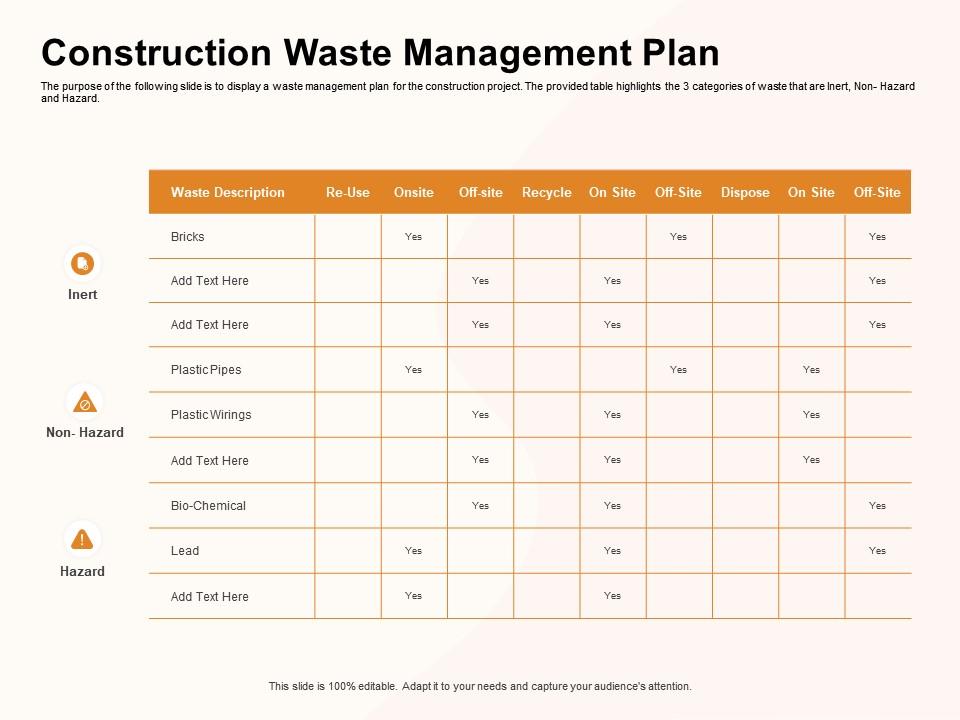
The purpose of the following slide is to display a waste management plan for the construction project. The provided table highlights the 3 categories of waste that are Inert, Non- Hazard and Hazard.
People who downloaded this PowerPoint presentation also viewed the following :
Construction waste management plan inert ppt powerpoint presentation styles slideshow with all 2 slides:
Use our Construction Waste Management Plan Inert Ppt Powerpoint Presentation Styles Slideshow to effectively help you save your valuable time. They are readymade to fit into any presentation structure.
FAQs for Construction waste management plan inert ppt powerpoint
Primary construction waste types include concrete and masonry debris, wood scraps, drywall remnants, metal fragments, and packaging materials from supplies and equipment. These materials represent significant disposal costs and environmental challenges, with many construction companies finding that strategic waste sorting and recycling programs can reduce landfill fees by 30-50% while enhancing their sustainability credentials.
Construction companies can effectively measure waste production through digital tracking systems, waste audits, material quantity surveys, photographic documentation, and automated monitoring sensors. These methods enable precise measurement by categorizing waste types, recording disposal volumes, and analyzing material usage patterns, with many construction firms finding that systematic tracking reduces costs, improves resource allocation, and enhances environmental compliance while delivering competitive advantages.
Recycling serves as a cornerstone of construction waste management by diverting materials from landfills, reducing disposal costs, and creating revenue streams through material resale. Through strategic recycling programs, construction companies recover concrete, steel, wood, and drywall for new projects, ultimately delivering cost savings and environmental compliance while enhancing their competitive positioning.
Reducing material waste during design involves standardizing dimensions, optimizing material specifications, conducting detailed quantity takeoffs, implementing modular design approaches, and integrating Building Information Modeling for accurate planning. These practices enable architects and engineers to minimize over-ordering, reduce offcuts, and streamline construction processes, with many construction firms finding that strategic design decisions ultimately deliver significant cost savings and enhanced project efficiency.
BIM enhances construction waste management by enabling precise material quantification, optimizing design for waste reduction, and facilitating real-time tracking throughout project lifecycles. Through 3D modeling and data analytics, construction companies streamline resource allocation, minimize over-ordering, and improve recycling processes, with many firms finding that integrated BIM systems reduce project waste by 20-30% while delivering significant cost savings.
Improper construction waste disposal causes soil and water contamination, air pollution from burning materials, greenhouse gas emissions from decomposing organic waste, and habitat destruction through illegal dumping. These environmental damages result in costly remediation efforts, regulatory penalties, and reputational risks, with many construction companies finding that strategic waste management delivers both environmental compliance and operational cost savings.
Regulations and codes significantly influence construction waste management by mandating diversion targets, requiring waste management plans, establishing disposal restrictions, and setting recycling standards that drive operational compliance. These frameworks enable construction companies to streamline waste sorting processes, reduce landfill costs, and enhance environmental reporting, with many contractors finding that regulatory alignment ultimately delivers competitive advantages and project efficiency improvements.
Economic benefits of construction waste reduction include lower disposal costs, reduced material expenses through reuse, decreased labor costs for waste handling, minimized regulatory fines, and enhanced project profit margins. These techniques streamline operations by optimizing resource allocation, improving site efficiency, and reducing transportation expenses, with many construction companies finding that strategic waste management delivers competitive advantage and significantly improved bottom-line results.
Construction firms can foster sustainability culture through comprehensive training programs, clear waste reduction targets, employee incentive systems, and regular environmental awareness workshops. By implementing collaborative sustainability committees, recognizing eco-friendly initiatives, and integrating green practices into daily operations, companies create engaged workforces committed to waste minimization, ultimately delivering reduced environmental impact and enhanced corporate reputation in an increasingly environmentally conscious industry.
Innovative materials include recycled steel, bamboo composites, cross-laminated timber, 3D-printed concrete, and modular prefabricated components. These sustainable alternatives streamline construction processes by reducing on-site waste generation, minimizing material transportation requirements, and enabling precise manufacturing specifications, with many construction companies finding that strategic material selection delivers significant cost savings while enhancing environmental compliance.
Collaboration with local waste management facilities enhances construction waste management by streamlining collection schedules, providing specialized recycling services, and ensuring regulatory compliance. These partnerships enable construction companies to access advanced sorting technologies, reduce transportation costs, and achieve higher diversion rates, with many projects finding that local facilities offer tailored solutions for concrete, metal, and wood waste processing.
Training programs include waste sorting workshops, material optimization seminars, recycling protocol sessions, and cost-benefit analysis presentations. These educational initiatives streamline project efficiency by reducing disposal costs, enhancing resource allocation, and improving regulatory compliance, with many construction firms finding that well-trained subcontractors ultimately deliver faster project timelines and significant waste reduction outcomes.
Deconstruction systematically disassembles buildings to recover reusable materials like timber, fixtures, and architectural elements, while traditional demolition simply destroys structures. This approach enables construction companies to reduce landfill waste by 75-90%, generate revenue through material resale, and meet sustainability requirements, with many developers finding that recovered materials significantly lower project costs while enhancing environmental credentials.
Modular construction strategies contribute to waste minimization through precise off-site manufacturing, standardized component sizing, controlled material ordering, and systematic assembly processes. These approaches streamline resource allocation by reducing on-site cutting waste, enabling bulk purchasing efficiencies, and facilitating component reuse across projects, with many construction companies finding significantly lower material costs and enhanced project timelines.
Construction companies face challenges including inadequate planning and forecasting, limited on-site storage space, inconsistent waste segregation protocols, regulatory compliance complexities, and insufficient staff training on proper disposal methods. These obstacles often result in increased project costs, environmental penalties, and missed sustainability targets, with many companies finding that strategic waste management planning and employee education ultimately deliver significant cost savings and competitive advantages in an increasingly environmentally-conscious market.
-
Very unique, user-friendly presentation interface.
-
Perfect template with attractive color combination.
-
Very well designed and informative templates.
-
Perfect template with attractive color combination.
-
Good research work and creative work done on every template.