Content marketing channel engagement plan with desired action

Content marketing channel engagement plan with desired action
Slide 1 of 2
Favourites Favourites

Try Before you Buy Download Free Sample Product

Audience Impress Your
Audience
Editable 100%
Editable
Time Save Hours
of Time
The Biggest Sale is ending soon in
0
0
:
0
0
:
0
0
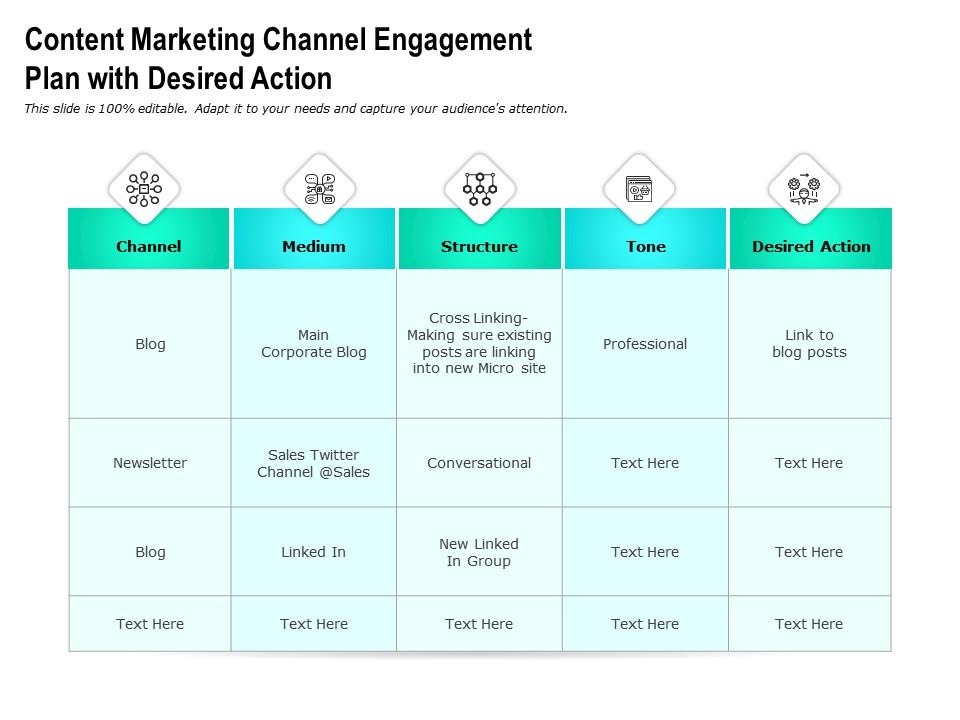
Presenting this set of slides with name Content Marketing Channel Engagement Plan With Desired Action. The topics discussed in these slides are Corporate, Sales, Structure. This is a completely editable PowerPoint presentation and is available for immediate download. Download now and impress your audience.

FAQs for Content marketing channel engagement plan

Key components of an effective content marketing strategy include audience research, content planning, consistent publishing schedules, multi-channel distribution, and performance analytics. These elements work together by identifying target demographics, creating valuable educational content, and measuring engagement across platforms, with many organizations finding that strategic content ultimately drives brand awareness, lead generation, and customer retention in increasingly competitive markets.

Businesses can define their target audience through demographic analysis, behavioral data assessment, customer surveys, social media insights, and competitor research. These strategic approaches enable organizations to create highly relevant content by understanding audience preferences, pain points, and consumption patterns, ultimately delivering personalized experiences that drive engagement and competitive advantage.

Key content marketing metrics include website traffic, engagement rates, lead generation, conversion rates, and brand awareness indicators. These metrics work together by tracking audience attraction, interaction depth, and business outcomes, with many organizations finding that combining reach metrics with revenue attribution ultimately delivers comprehensive performance insights and demonstrates content's strategic ROI impact.

Storytelling transforms content marketing by creating emotional connections, establishing brand authenticity, and making complex information memorable through relatable narratives. Companies across retail, healthcare, and financial services leverage customer success stories, behind-the-scenes content, and problem-solution journeys to enhance engagement, build trust, and ultimately drive conversions while differentiating themselves competitively.

SEO best practices fundamentally shape content marketing strategy by guiding keyword research, content structure, technical optimization, and user experience design. These practices enable businesses to create discoverable, valuable content that ranks higher in search results, drives organic traffic, and converts visitors into customers, with many organizations finding that strategic SEO integration significantly enhances their content's reach and competitive advantage.

Businesses can repurpose existing content by transforming blog posts into infographics, converting webinars into podcast episodes, breaking down whitepapers into social media series, and adapting case studies into video testimonials. This strategic approach streamlines content creation while expanding reach across multiple channels, with many organizations finding that repurposing delivers enhanced engagement and cost-effective marketing outcomes.

Incorporating visual elements into content marketing delivers enhanced engagement, improved comprehension, increased social sharing, stronger brand recall, and higher conversion rates. Through infographics, videos, and interactive presentations, organizations across retail, healthcare, and technology sectors streamline complex messaging while boosting audience retention, with many companies finding that visual content generates significantly more leads than text-only approaches.

Companies should publish content consistently based on their audience's platform preferences and consumption patterns, typically ranging from daily social media posts to weekly blog articles or monthly comprehensive resources. The key lies in maintaining quality over quantity while establishing predictable schedules, with many successful brands finding that regular, valuable content builds stronger audience relationships than sporadic high-volume publishing.

Effective content distribution channels include social media platforms, email marketing, search engine optimization, industry publications, and webinar platforms. These channels enable organizations to reach targeted segments through personalized messaging, thought leadership positioning, and interactive engagement, with many companies finding that strategic channel combinations significantly enhance audience reach, brand visibility, and lead generation outcomes.

User-generated content integrates into content marketing strategies by amplifying authentic brand advocacy, diversifying content streams, and reducing production costs while building community engagement. Through strategic curation and incentivization programs, brands like Starbucks and Nike seamlessly blend customer testimonials, reviews, and social posts with owned content, ultimately delivering enhanced credibility and stronger audience connections.

Brands face challenges including varying brand voices across teams, inconsistent visual elements, conflicting messaging strategies, resource allocation difficulties, and maintaining quality standards at scale. These inconsistencies often arise when multiple departments create content independently, with many organizations finding that establishing clear style guides, centralized approval processes, and regular team training ultimately delivers stronger brand recognition and customer trust.

Brands can effectively utilize social media by creating platform-specific content, engaging directly with audiences, leveraging user-generated content, and maintaining consistent posting schedules across channels. Through strategic social media integration, companies in retail, hospitality, and technology streamline customer interactions, enhance brand visibility, and accelerate conversion rates, ultimately delivering measurable engagement growth and competitive market positioning.

Strategies include establishing shared content calendars, implementing collaborative project management tools, conducting regular cross-team brainstorming sessions, creating unified brand guidelines, and setting joint KPIs for content performance. These approaches streamline workflow coordination, enhance creative alignment, and ensure consistent messaging, with many organizations finding that structured collaboration frameworks ultimately deliver faster content production and stronger campaign results.

A/B testing improves content marketing outcomes by comparing different versions of headlines, formats, calls-to-action, and distribution channels to identify what resonates most with target audiences. Through systematic testing, marketers can optimize email subject lines, social media posts, and blog content, while measuring engagement rates, conversion metrics, and click-through performance, ultimately delivering higher ROI and more effective campaigns.

Emerging trends include AI-powered personalization, interactive content formats, voice search optimization, micro-video storytelling, and community-driven content creation. These approaches enhance audience engagement by delivering targeted experiences, fostering authentic connections, and adapting to evolving consumption patterns, with many organizations finding that strategic integration of multiple formats ultimately drives stronger brand loyalty and competitive advantage.

Ratings and Reviews

0% of 100
Review Form
Write a review
Most Relevant Reviews

No Reviews