Cost reduction budget strategy for marketing initiatives
Try Before you Buy Download Free Sample Product
Audience
Editable
of Time
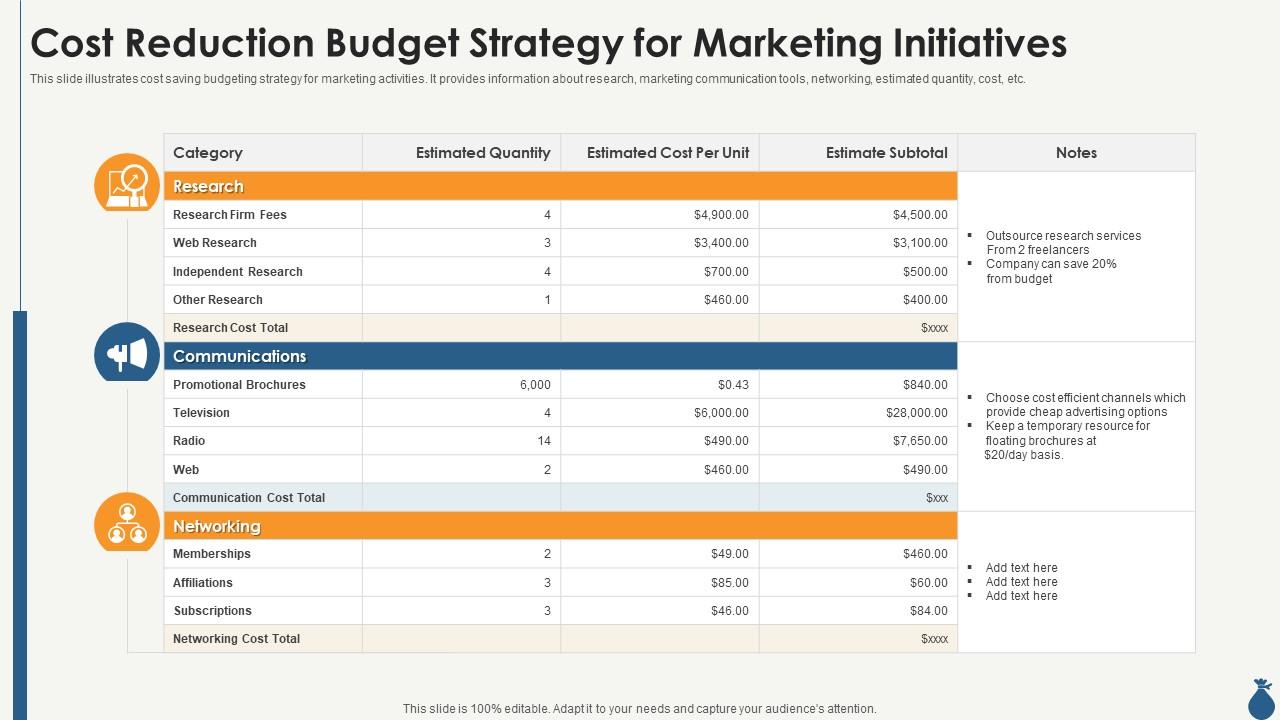
This slide illustrates cost saving budgeting strategy for marketing activities. It provides information about research, marketing communication tools, networking, estimated quantity, cost, etc.
People who downloaded this PowerPoint presentation also viewed the following :
Cost reduction budget strategy for marketing initiatives with all 6 slides:
Use our Cost Reduction Budget Strategy For Marketing Initiatives to effectively help you save your valuable time. They are readymade to fit into any presentation structure.
FAQs for Cost reduction budget strategy
Honestly, just start by figuring out where all your money's actually disappearing to first. Pick your three biggest expense buckets and really dig into those - that's where you'll see the most impact anyway. Your team probably has tons of ideas for cuts since they deal with this stuff every day, so definitely ask them. Sometimes you're just being super inefficient without even knowing it (been there). Try renegotiating with vendors too - worst they can say is no, right? And if there's anything you can automate that's eating up time and money, do it. But yeah, cost analysis first, then prioritize from there.
Map out your whole value chain first and split costs into stuff that actually adds value vs. waste. Hit the waste hard - redundant processes, too much inventory, those annoying approval chains that take forever. Your vendor contracts probably need a serious look too. Here's what I've learned: customers care about totally different things than what we assume they do. Track your quality metrics while cutting costs so you don't accidentally screw something up. Oh, and definitely pilot this in just one department before you go crazy company-wide.
Tech's honestly a game-changer for cutting costs. Start with your most annoying manual tasks - there's probably software that handles it. AI can do customer service now, cloud hosting slashes IT bills, and analytics shows you where money's disappearing (sometimes in weird places you'd never think of). Even basic stuff like automated scheduling saves hours. The ROI usually surprises people once they actually track it. Don't overthink it though. Pick one process that drives you crazy and automate that first. Small wins build up fast.
Look, good training saves you serious money in ways you might not expect. Your people make fewer costly mistakes when they actually know their stuff. They finish work faster too, which means less time fixing things later. But here's the real kicker - trained employees don't quit nearly as much, and trust me, hiring new people is expensive as hell. Figure out where you're bleeding money first. Is it quality problems? Slow workflows? People constantly leaving? Then just focus your training on fixing those specific issues. Way better return than generic training programs.
Look, you gotta track the obvious stuff first - actual savings vs what you planned, cost per unit, expense ratios. But here's the thing: those numbers don't mean much if you're destroying everything else. Monitor quality scores, how productive your team is, customer satisfaction too. I've seen companies cut costs just to watch their reputation tank, which is honestly stupid. Cash flow improvements and ROI on your cost projects matter big time. Set up some kind of monthly dashboard so you can catch problems fast. The whole point is making sure your cuts actually help instead of screwing you over long-term.
Yeah, outsourcing can definitely cut costs but don't expect magic numbers right away. Most companies see 20-40% savings on labor when they move stuff overseas or use specialized providers. The best part? You ditch those fixed costs - no more paying full salaries when you only need part-time work. But honestly, the transition is messy and expensive at first. Plus you'll spend more time managing everything. My advice - start with boring, standardized tasks that are easy to measure. Those work best for outsourcing. Just don't forget about quality control issues down the road.
Hey! So supply chain stuff can actually cut your costs by like 10-30% which is pretty solid. The big wins come from inventory costs, shipping, and what you're paying suppliers. Honestly, most companies have so much waste they don't even see - like paying for expedited shipping because something got delayed, or having cash tied up in products just sitting there. Once you fix those bottlenecks everything flows better. I'd start by just mapping out where your money's actually going first. Sounds boring but you'll spot the problem areas fast. Then hit those quick fixes before tackling the bigger stuff.
So lean management is basically about finding the "eight wastes" in your business - stuff like overproduction, waiting around, too much inventory, defects. Map out your processes and you'll see where money's getting wasted. What's nice is it actually makes quality better too since you're ditching steps that don't help customers. Honestly, just pick one annoying process and walk through it. I bet you'll find waste everywhere - it's crazy how much is just sitting there. Quality goes up, costs go down. Win-win.
Don't cut too deep - you'll hurt the stuff that actually makes money. Like customer service or R&D. Those matter way more than people think. Layoffs are brutal and your good employees will bail if they see you panicking with a hatchet. Quality goes to shit when you cheap out on materials too. My advice? Start with obvious waste first. Then be super careful about what you cut next. Ask yourself: does this thing help us make money or keep customers happy? If yes, find something else to trim. Way better to be precise than go nuclear on everything.
Make it feel personal by showing real numbers - like what you actually spend on supplies or utilities. People care way more when they see concrete impact. We did these monthly department challenges at my old job for best cost-saving ideas. Got weirdly competitive but it totally worked! Give teams ownership over their own budget areas and celebrate wins publicly. Here's the thing though - if leadership isn't modeling this stuff, forget it. Nobody's gonna buy in. Oh, and don't make it feel like another corporate thing they have to do.
Honestly, bulk orders are your best friend here - suppliers love big numbers. Get quotes from at least 3-4 different vendors so you can play them against each other. Timing matters too. Hit them up when they're scrambling to meet quarterly goals or need to dump excess inventory. I've seen people get crazy good deals just by asking at the right moment. Don't just focus on price either - sometimes better payment terms or faster shipping is worth more than saving a few bucks per unit. Oh, and start these conversations like a month before your current deal expires, not the week before.
You definitely need all departments involved - trying to cut costs alone never works. Finance sees budget waste, operations knows where processes get stuck, IT spots automation gaps. Different perspectives = better solutions, honestly. People hate having cuts forced on them from above, so when they help create the plan, they actually support it. Way less pushback that way. Set up a team with someone from each department who can actually make decisions (not just junior people who have to check with their boss constantly). Makes rolling everything out so much easier when everyone's already on board.
Honestly, the worst thing you can do is cut too aggressively right away - you'll hurt the stuff that brings in revenue. Marketing budgets get slashed first, good employees get laid off without thinking it through. I've watched this blow up in companies' faces so many times. Most people obsess over small expenses like office supplies but totally miss huge structural waste. Employee morale gets wrecked too - nobody works well when they're constantly worried about getting fired. My advice? Start by actually analyzing your data to see what's costing you money. Then make smart, targeted cuts instead of just chopping everything equally.
Don't treat innovation like it's just another budget line you can slash. Cut the operational waste instead - those redundant processes, bloated admin tasks, overpriced vendor contracts. Honestly, I've watched way too many companies completely gut their R&D teams during tough times, then scramble later when competitors leave them in the dust. It's painful to see. Automate the repetitive stuff if you can. Short cuts work better when you're strategic about it. Take those savings and put them back into innovation that actually matters for your business. Your creative teams need protection, not pink slips.
Your customers are basically telling you exactly where you're wasting money - you just have to listen. They'll complain about features they never touch, point out when your processes are unnecessarily complicated, and call out service steps that don't help anyone. Honestly, most companies are terrible at actually hearing this stuff. I know a guy whose company cut their product options in half after customers kept saying the choices were overwhelming. Saved them a fortune in inventory costs. Set up some way to collect feedback regularly, then dig into what they're actually saying. The cost savings are probably sitting right there in your inbox.
-
Unique research projects to present in meeting.
-
Visually stunning presentation, love the content.