


Critical success factors erp ppt example file




Try Before you Buy Download Free Sample Product
 Impress Your
 Audience
 100%
100% Editable
 Save Hours
 of Time


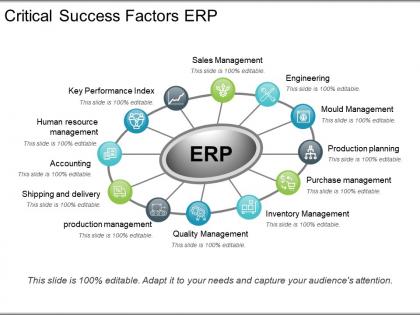
ERP might seem like a complicated term to many, but with the help of this professionally designed critical success factors ERP PPT example file, you as a presenter can certainly make your audience understand about every major aspect of it. Today, Enterprise Resource Planning is applicable in almost every major firm worldwide, which makes it such a universal concept. Irrespective of the fact that you belong to the customer support department or sales department, one can make use of CSF ERP PowerPoint model as an informative tool to educate the audience about the intricacies related to the subject. ERP is closely linked to other domains like data warehousing, business intelligence, etc. The high definition graphics of key ERP success factors PPT slide visual lets you explore the subject without any trouble. If you are a project manager or company owners or subject matter experts or consultants, you can use this high-definition illustration to help your audience retain the concept in a better way. The key ERP success factors PowerPoint presentation graphic comprises of a wide professionally designed PPT slide that has covered the subject in a flawless way. Control the hecklers with our Critical Success Factors Erp Ppt Example File. Calm down their aggressive approach.
People who downloaded this PowerPoint presentation also viewed the following :
Critical success factors erp ppt example file with all 5 slides:
Create business enthusiasm with our Critical Success Factors Erp Ppt Example File. They give a boost to financial activity.


FAQs for Critical success factors erp
Honestly, it's all about getting your departments to actually talk to each other instead of working in these weird isolated bubbles. Right now your accounting team probably has no clue what's happening in inventory (classic problem). An ERP fixes that by connecting finance, HR, supply chain - everything runs in real time. You'll cut down on manual data entry, get way better reports, and compliance becomes less of a headache. The biggest thing though? Define what you actually want before you start implementing. I've seen too many companies jump in without clear goals and it gets messy fast. Better visibility and streamlined processes are the main wins here.
Dude, culture is absolutely everything with ERP implementations. I've watched companies blow millions because their teams just refused to change how they work. You'll hit a wall fast if people are stuck thinking "this is how we've always done it." Leadership has to be 100% on board from the start, and honestly? Your whole company needs to see change as exciting, not scary. The tech side is actually the easy part - it's getting humans to embrace new processes that'll make or break you. Seriously, figure out if your people are ready for change before you even start shopping around for vendors.
Honestly, training is make-or-break for ERP projects. I've watched companies blow massive budgets because they treated it like an afterthought. Your team needs to get the "why" behind workflow changes, not just button-clicking tutorials. Role-specific training works way better than those generic sessions nobody pays attention to. Start early and don't think you're done at go-live - people forget stuff or panic when it's real. Oh, and budget around 15-20% for training. Sounds like a lot but trust me, it's cheaper than a failed rollout.
Honestly, change management is what separates successful ERP projects from total disasters. Most companies think it's just about the tech, but it's really a people problem. Start communicating the "why" way before go-live - like months ahead. Find those natural leaders in each department who can be your champions. They'll do more to convince skeptics than any executive memo ever will. Training gets rushed constantly, which is why adoption rates tank. Oh, and definitely address people's concerns directly instead of pretending everything's fine. People can smell BS from a mile away.
Track system uptime and user adoption rates first - that's your reality check on whether people actually like using the thing. Data accuracy matters too, obviously. Process stuff like order-to-cash times and inventory turnover will show if it's actually making work faster. ROI takes forever to show up but you gotta measure it anyway. Honestly, user satisfaction surveys are clutch because I've seen ERPs that look amazing in reports but everyone hates them. Oh, and start tracking from go-live day one so you'll have something to compare against later.
Dude, vendor selection will literally make or break everything. I've watched so many projects crash because someone picked the wrong partner - it's painful. You're basically getting married to these people for the long haul. They'll handle your implementation, training, all that ongoing support stuff. Pick someone with crappy project management? Your timeline's toast and your budget's gone. Do me a favor - actually call their references, dig into their methodology, see if they get your industry. Oh, and make sure their support doesn't suck because you'll need it.
Honestly, change management is your biggest nightmare - people will fight you on switching systems. Your old data? Way messier than you think, trust me. Everyone's gonna want custom features once you start (scope creep is real), and don't get me started on trying to make different software talk to each other. Timelines always slip, budgets blow up because training costs more than expected. Here's what actually works: get users excited about the change upfront and clean your data first. I can't stress this enough - those two steps will save you so much pain later.
Honestly, cross-departmental collaboration is what separates ERPs that actually work from expensive disasters. You need finance, IT, and operations talking constantly during rollout - otherwise you get these weird disconnected workflows that make zero sense. Sales will promise stuff operations can't deliver if nobody's communicating. The real breakthrough happens when teams stop being territorial about their data and start sharing requirements upfront. I've seen companies waste months because departments weren't aligned on basic processes. Set up regular cross-team check-ins early so you catch integration problems before they become major headaches.
Bad data will absolutely wreck your ERP system - I'm talking duplicate records, wrong inventory counts, the whole mess. Your reports become useless and people stop trusting the system entirely. Then they start building these annoying workarounds that totally defeat the point. Finance gets mad, operations gets confused, everyone's frustrated. Honestly, I've watched companies waste months trying to untangle data disasters they could've avoided. Set up validation rules from day one and check your data regularly. Way less painful than cleaning up later, trust me on this one.
Honestly, leadership buy-in is everything - I've seen too many projects crash without it. Get your end users involved early so they don't hate the new system before it even launches. Training is huge too, like way more than you'd expect. Don't go crazy with customizations at first (learned that one the hard way). Clean up your data beforehand or you'll regret it later. Oh, and your timeline? Double it. Change management sounds boring but it's actually critical. Celebrate the small stuff along the way - keeps everyone from losing their minds.
Look, most ERPs are straight-up nightmares because nobody thinks about the actual humans using them. Start by figuring out what your people actually do day-to-day, then build around that. Simple navigation helps tons. So does cutting down clicks and giving everyone dashboards that aren't info dumps. I swear these systems get designed by tech folks who've never had to process an invoice at 4pm on Friday. When you focus on making it intuitive, people won't fight the rollout as much. Training becomes way easier too.
Dude, think of ERP optimization like car maintenance - you can't just ignore it until something breaks. Run quarterly reviews to catch bottlenecks before they bite you. Most companies use like 20% of their ERP's actual capabilities, so keep training your people on new features. Your daily users will spot problems way before management does, so actually listen to their complaints. Oh, and don't skip those software updates - they're usually packed with performance fixes. The trick is building this stuff into your regular routine instead of scrambling when everything goes sideways.
Honestly? Executive buy-in is huge - like, make or break huge. You need those C-level people actually invested, not just writing checks. When they're really behind it, suddenly you've got budget, resources, and the clout to bulldoze through all the pushback you'll definitely get. Departments hate change (shocking, I know), so without that top-level muscle, you're basically screwed. I've seen too many projects die because someone's VP decided halfway through that maybe this whole thing wasn't worth the headache. Get your champions locked in first, then worry about everything else.
Map your ERP goals to what your business actually needs first - don't even look at vendors yet. Customer experience matters most? Focus on order fulfillment and service tracking. Cost cutting? Find systems that streamline ops and cut redundancies. I've watched too many companies fall for cool features that do absolutely nothing for their bottom line. Get people from different departments involved early - finance, ops, whoever. Otherwise you'll end up with something that only makes IT happy. Write this stuff down so you can actually track if it worked later.
So with cloud ERP, you're basically trading IT headaches for people problems. Less time fixing servers, more time convincing Karen from accounting that the new system won't destroy her life. The scalability part is actually pretty sweet - no huge upfront costs when you need to grow. But here's the thing: your internet goes down and you're screwed. I've seen companies nail the tech setup but completely bomb because nobody wanted to change how they work. Honestly? Figure out your change management game first, then worry about the rest.
-
Wonderful templates design to use in business meetings.
-
Appreciate the research and its presentable format.