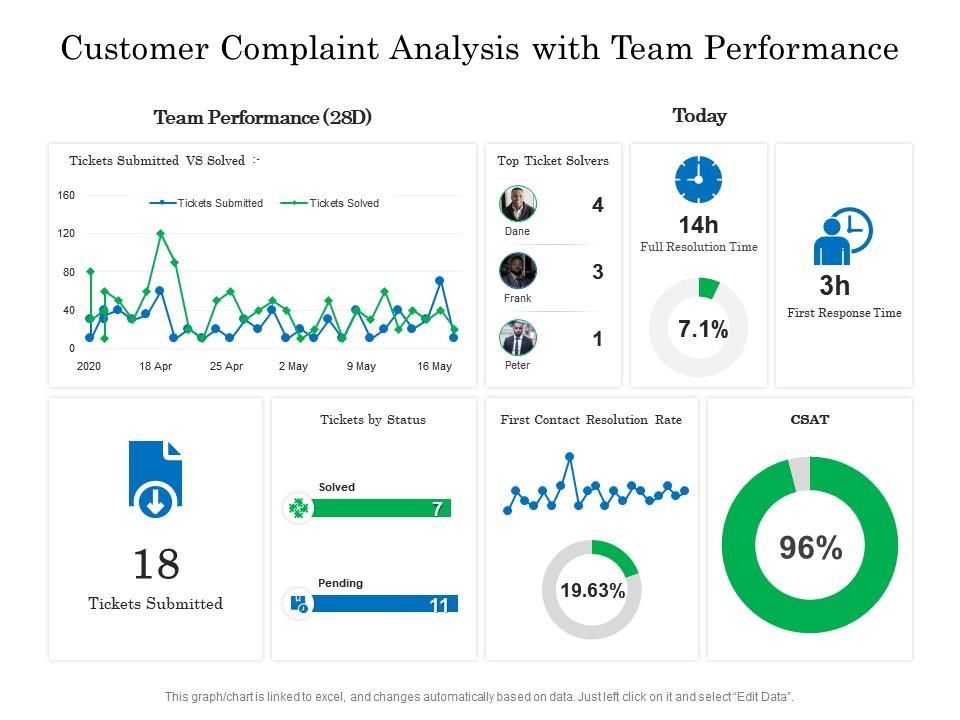
Customer complaint analysis with team performance
Try Before you Buy Download Free Sample Product
Audience
Editable
of Time
Our Customer Complaint Analysis With Team Performance are topically designed to provide an attractive backdrop to any subject. Use them to look like a presentation pro.
People who downloaded this PowerPoint presentation also viewed the following :
Customer complaint analysis with team performance with all 2 slides:
Use our Customer Complaint Analysis With Team Performance to effectively help you save your valuable time. They are readymade to fit into any presentation structure.
FAQs for Customer complaint analysis
Common service industry complaints include poor customer service, long wait times, billing errors, product quality issues, and unresolved problems. These complaints typically stem from communication breakdowns, inadequate staff training, and inefficient processes, with many service organizations finding that addressing these core areas through streamlined operations and enhanced staff protocols significantly improves customer satisfaction and retention rates.
Businesses can effectively categorize customer complaints by product type, service area, severity level, resolution timeframe, and customer segment. This strategic approach enables customer service teams to prioritize urgent issues, assign specialized staff to specific categories, and track recurring patterns, ultimately streamlining response times and enhancing customer satisfaction across all touchpoints.
Employee training plays a crucial role in preventing complaints through enhanced communication skills, product knowledge, empathy development, and proactive problem-solving techniques. Well-trained employees can identify potential issues before they escalate, deliver consistent service experiences, and resolve complaints more effectively, with many organizations finding that comprehensive training programs significantly reduce complaint volumes while improving customer satisfaction and retention rates.
Companies can leverage complaint feedback by systematically analyzing patterns, implementing targeted improvements, and using insights to enhance product features, service processes, and customer touchpoints. Through structured feedback analysis, organizations in retail, hospitality, and financial services streamline operations, reduce future complaints, and ultimately deliver superior customer experiences while gaining competitive advantage.
**INPUT**: What are some best practices for responding to social media customer complaints? **OUTPUT**: Best practices include responding quickly within hours, acknowledging concerns publicly while moving detailed discussions private, maintaining professional empathy, and following up to ensure resolution. These approaches streamline customer service by demonstrating transparency, protecting brand reputation, and turning negative experiences into loyalty opportunities, with many organizations finding that proactive social media engagement ultimately delivers improved customer satisfaction and competitive advantage. **Word count: 60 words**
Visual aids from presentation templates enhance complaint resolution by organizing complex information, displaying timelines clearly, and presenting solution pathways systematically. These tools enable customer service teams to demonstrate accountability through data visualization, track resolution progress transparently, and communicate corrective actions effectively, ultimately delivering faster resolutions and improved customer satisfaction.
Businesses should track response time, resolution time, customer satisfaction scores, first-contact resolution rates, complaint volume trends, and repeat complaint frequency. These metrics enable organizations to streamline service delivery, enhance customer experiences, and identify operational inefficiencies, with many companies finding that comprehensive tracking ultimately delivers improved loyalty and competitive advantage.
Companies create feedback-encouraging cultures by training staff to view complaints as improvement opportunities, implementing accessible multi-channel reporting systems, and publicly celebrating teams that act on customer insights. Through transparent response processes and regular feedback sessions, organizations like retail chains and financial services build trust while demonstrating genuine commitment to enhancement, ultimately strengthening customer relationships and competitive positioning.
Unresolved complaints create frustration, betrayal, and distrust, leading customers to feel undervalued and ignored by businesses. These negative emotions significantly erode brand loyalty, with many customers not only switching to competitors but also sharing their experiences through word-of-mouth and online reviews, ultimately amplifying damage to company reputation and customer acquisition efforts.
Automation tools integrate into customer complaint management through AI-powered ticketing systems, chatbots for initial response handling, automated routing based on complaint categories, and real-time escalation protocols. These technologies streamline resolution processes by reducing response times, ensuring consistent follow-up communications, and enabling priority-based case assignments, ultimately delivering faster customer service and improved satisfaction rates across organizations.
Online reviews and ratings significantly shape public perception of complaint handling by creating transparent, searchable records of customer experiences and company responses. These platforms amplify both positive resolutions and poor service across industries like hospitality, retail, and healthcare, with many businesses finding that proactive, professional responses to negative reviews demonstrate commitment to customer satisfaction, ultimately building trust and competitive advantage.
Storytelling techniques transform customer complaint data into compelling narratives by showcasing real customer journeys, emotional impacts, and resolution outcomes that resonate with stakeholders. These presentation approaches enable organizations to visualize complaint patterns, demonstrate service recovery successes, and illustrate competitive advantages gained through responsive customer service, ultimately delivering stronger buy-in for complaint resolution initiatives.
Businesses should consider data privacy regulations, documentation requirements, consumer protection laws, liability limitations, and dispute resolution protocols when handling complaints. These legal frameworks ensure compliance while protecting both parties, with many organizations finding that proactive legal alignment streamlines resolution processes, reduces litigation risks, and ultimately enhances customer trust and operational efficiency.
Businesses can balance empathy and policy adherence by acknowledging customer emotions first, explaining policies in human terms rather than corporate language, and identifying creative solutions within guidelines. Through active listening and personalized communication, companies like hospitality chains and financial services find that empathetic policy enforcement actually increases customer retention, ultimately delivering stronger relationships while maintaining operational consistency.
Follow-up communication ensures issue resolution, demonstrates commitment to customer satisfaction, identifies recurring problems, and builds long-term trust through proactive engagement. Through systematic follow-up processes, organizations enhance customer retention, gather valuable feedback for service improvements, and prevent escalation of unresolved concerns, with many companies finding that consistent follow-up communication ultimately transforms dissatisfied customers into loyal advocates.
-
Good research work and creative work done on every template.