Customer loyalty lifecycle ppt powerpoint presentation file model

Customer loyalty lifecycle ppt powerpoint presentation file model
Slide 1 of 5
Favourites Favourites

Try Before you Buy Download Free Sample Product

Audience Impress Your
Audience
Editable 100%
Editable
Time Save Hours
of Time
The Biggest Sale is ending soon in
0
0
:
0
0
:
0
0
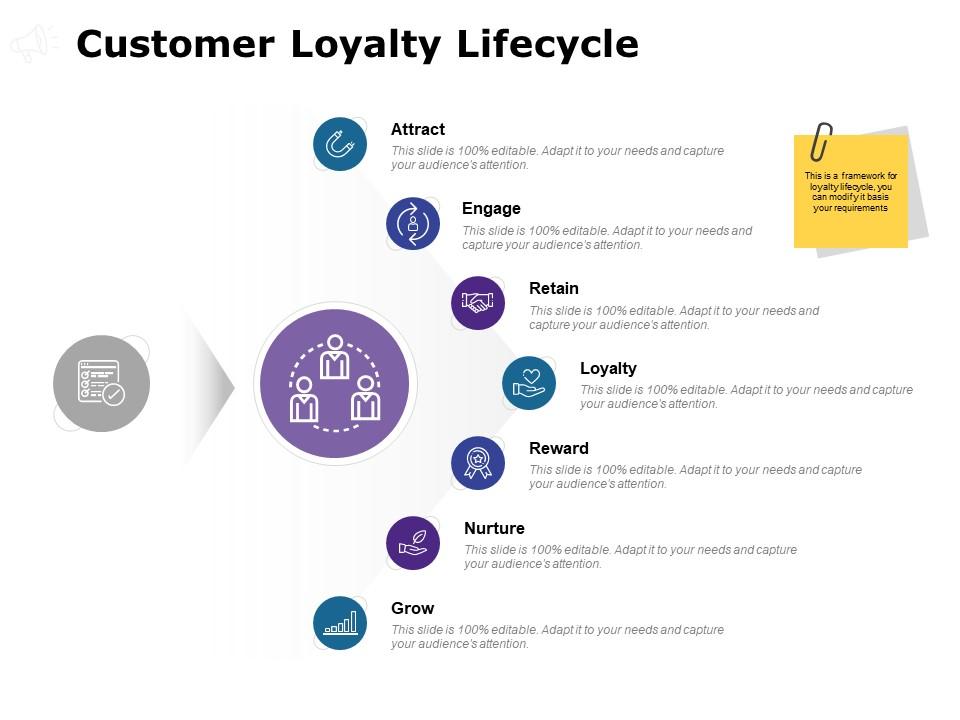
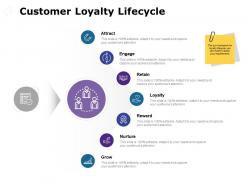
Presenting this set of slides with name Customer Loyalty Lifecycle Ppt Powerpoint Presentation File Model. This is a seven stage process. The stages in this process are Customer Loyalty Lifecycle, Retain, Nurture, Attract, Reward. This is a completely editable PowerPoint presentation and is available for immediate download. Download now and impress your audience.

People who downloaded this PowerPoint presentation also viewed the following :

FAQs for Customer loyalty lifecycle ppt powerpoint

The key stages of the customer loyalty lifecycle include awareness, acquisition, onboarding, engagement, retention, advocacy, and reactivation. These stages work together by creating touchpoints that build trust, deliver consistent value, and foster emotional connections, with many organizations finding that mapping customer journeys across these stages ultimately enhances retention rates and drives sustainable revenue growth.

Businesses measure customer loyalty through stage-specific metrics including acquisition cost and conversion rates early on, engagement frequency and purchase patterns during active phases, retention rates and customer lifetime value at maturity, and win-back campaign success during decline stages. These measurement approaches enable organizations to identify loyalty trends, optimize customer experiences, and implement targeted interventions, ultimately delivering improved retention and competitive advantage.

Customer feedback serves as the foundation for refining loyalty strategies, identifying pain points, personalizing experiences, and predicting customer behavior patterns throughout the lifecycle. Through systematic feedback collection and analysis, companies across retail, hospitality, and financial services can enhance retention rates, reduce churn, and ultimately deliver more targeted loyalty programs, with many organizations finding that responsive feedback integration significantly accelerates customer lifetime value growth.

Segmentation enables businesses to customize loyalty programs by analyzing purchasing behavior, demographics, lifecycle stages, and engagement preferences across distinct customer groups. Through targeted rewards, personalized communications, and relevant incentives, companies can deliver more meaningful experiences to high-value customers, occasional buyers, and new prospects, ultimately increasing program participation and retention rates.

Common pitfalls include neglecting onboarding experiences, inconsistent engagement across touchpoints, failing to personalize rewards, inadequate data integration, and poor retention timing. Many organizations struggle with siloed communications and generic approaches, while successful businesses find that seamless omnichannel experiences and data-driven personalization ultimately deliver stronger retention rates and increased customer lifetime value.

Digital transformation revolutionizes the customer loyalty lifecycle by enabling personalized experiences, real-time engagement tracking, and predictive analytics for retention strategies. Through AI-driven platforms and omnichannel integration, businesses streamline customer journeys, automate loyalty rewards, and deliver targeted communications, with many retailers and financial services finding that digital tools significantly enhance customer lifetime value and competitive advantage.

Engagement techniques include personalized onboarding experiences, targeted educational content, loyalty rewards programs, proactive customer support, and exclusive access to new features or services. These approaches enhance retention by delivering relevant value at each touchpoint, building emotional connections, and anticipating customer needs, with many organizations finding that lifecycle-specific engagement strategies significantly improve customer lifetime value and reduce churn rates.

Emotional connections significantly enhance customer loyalty and retention by creating psychological bonds that transcend transactional relationships, fostering trust, and reducing price sensitivity among consumers. Through personalized experiences, consistent brand messaging, and responsive customer service, companies like Apple and Starbucks cultivate deep emotional engagement, ultimately delivering higher retention rates, increased lifetime value, and stronger competitive positioning in increasingly crowded markets.

Effective reactivation strategies include personalized win-back campaigns, exclusive comeback offers, satisfaction surveys to address past issues, limited-time incentives, and targeted communication based on previous purchase behavior. These approaches work by re-establishing emotional connection, addressing departure reasons, and creating compelling value propositions, with many retailers and subscription services finding that personalized outreach combined with meaningful incentives successfully brings back 15-30% of dormant customers.

Loyalty programs can encourage brand advocacy by incorporating referral rewards, social sharing incentives, exclusive community access, tiered recognition systems, and personalized experiences that make customers feel valued. Through gamification elements and VIP treatment, programs transform satisfied customers into active brand ambassadors, with many retail and hospitality businesses finding that advocacy-focused loyalty initiatives significantly amplify word-of-mouth marketing while strengthening customer relationships.

**INPUT**: What metrics should businesses track to evaluate the success of their loyalty initiatives? **OUTPUT**: Businesses should track customer retention rates, repeat purchase frequency, average order value, Net Promoter Score, and customer lifetime value to evaluate loyalty initiatives. These metrics enable organizations to measure engagement depth, revenue impact, and advocacy levels across retail, hospitality, and financial services, ultimately delivering insights that enhance program effectiveness and competitive advantage.

Cultural differences significantly influence customer loyalty through varying communication preferences, relationship expectations, individualism versus collectivism orientations, and trust-building approaches across markets. While Western markets often prioritize transactional efficiency and individual benefits, Asian and Middle Eastern markets emphasize long-term relationships and community values, with many global brands finding that localized loyalty strategies deliver stronger retention and competitive advantage.

Personalization enhances customer loyalty by delivering tailored experiences, targeted recommendations, customized communications, and relevant product offerings that resonate with individual preferences and behaviors. Through advanced data analytics and AI-driven insights, businesses across retail, hospitality, and financial services create deeper emotional connections, increase purchase frequency, and reduce churn rates, ultimately building long-term customer relationships and competitive advantage.

AI and big data revolutionize customer loyalty by enabling personalized experiences, predictive analytics, real-time engagement optimization, and automated retention strategies across all lifecycle stages. Through machine learning algorithms, retailers can anticipate customer needs, banks can offer targeted rewards, and subscription services can reduce churn rates, ultimately delivering enhanced satisfaction and measurable loyalty improvements.

Businesses can seamlessly transition customers through the loyalty lifecycle by implementing personalized onboarding experiences, consistent value delivery, proactive engagement strategies, and data-driven retention programs. Through targeted communications and reward optimization, companies in retail, hospitality, and financial services enhance customer satisfaction, reduce churn rates, and ultimately build long-term relationships that deliver sustained revenue growth and competitive advantage.

Ratings and Reviews

0% of 100
Write a review
Most Relevant Reviews

No Reviews