Customer Relationship Management Performance Gap Analysis
Try Before you Buy Download Free Sample Product
Audience
Editable
of Time
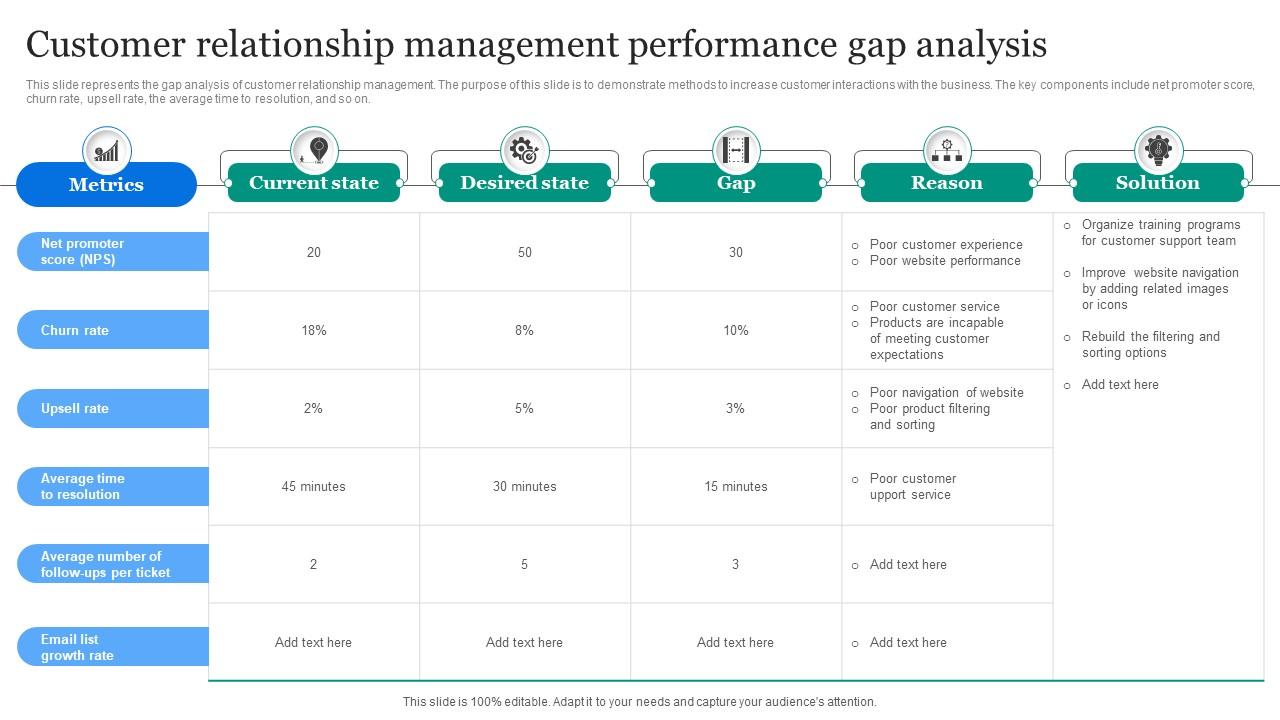
This slide represents the gap analysis of customer relationship management. The purpose of this slide is to demonstrate methods to increase customer interactions with the business. The key components include net promoter score, churn rate, upsell rate, the average time to resolution, and so on.
People who downloaded this PowerPoint presentation also viewed the following :
Customer Relationship Management Performance Gap Analysis with all 6 slides:
Use our Customer Relationship Management Performance Gap Analysis to effectively help you save your valuable time. They are readymade to fit into any presentation structure.
FAQs for Customer Relationship Management
Start with user adoption - seriously, if nobody's actually logging in, you're screwed from day one. Data quality comes next: duplicate contacts, missing info, all that messy stuff. Track your sales metrics too like conversion rates and how long deals take to close. Customer satisfaction is obviously key since that's why you got a CRM in the first place. System speed matters more than people think - slow software makes everyone hate their job. Monthly dashboard works best, just focus on trends instead of obsessing over every little number. Way less stressful that way.
Honestly, just dig into your CRM data first - see if you're actually hitting those conversion rates and sales targets. Your sales team will be brutally honest about what's broken (they always are). Look for where leads keep getting stuck in your pipeline or why customers bail at certain points. Data quality is huge too - messy records with duplicates will tank everything. I'd track user adoption, response times, ROI, the works. Oh, and don't forget to survey your customer service folks since they deal with frustrated users daily. Fix whatever's costing you money first.
Look, your team actually has to USE the CRM or it's completely pointless. I've watched companies drop serious cash on these systems while their sales people still track everything in random Excel files because the CRM sucks to use. Bad adoption = your data becomes worthless. You'll miss leads left and right. Reports? Forget about it - total garbage in, garbage out situation. The key is really nailing the training and - this might sound obvious but - actually setting it up so it matches how your people work, not fighting against their natural workflow. Otherwise you're just throwing money away.
Ugh, bad data is like having a broken GPS for your sales team. You're chasing contacts who left their jobs two years ago while real prospects slip through the cracks. Duplicate records everywhere, missing phone numbers, the usual nightmare. Your forecasts turn into wishful thinking because the numbers are trash. Marketing emails bounce left and right, making your campaigns look like amateur hour. Honestly, most teams wait until it's a total disaster before fixing anything. Set up some basic validation rules now and actually schedule regular cleanups. Trust me, future you will thank present you.
Connect your CRM numbers straight to the business goals that actually matter - retention rates to revenue, that kind of thing. Get everyone in a room first though, because I swear leadership and sales never agree on what "success" means. Hook your CRM data into those executive dashboards so the big picture stays front and center. Quarterly reviews work well for checking if this stuff is actually helping hit targets. Honestly, your CRM should make reaching business goals simpler, not just spit out reports that look impressive but don't do much.
Dude, training is literally what makes or breaks CRM success. Most companies blow thousands on software then wonder why it's not working - it's because nobody taught their people how to actually use it. You'll get terrible adoption rates and messy data entry when your team's clueless about the system. Focus on hands-on training around daily tasks, not boring feature walkthroughs. Make sure people know which fields actually matter and how to pull decent reports. I've watched too many expensive systems flop just because training was an afterthought.
Honestly, most companies mess up three big things. First - they migrate garbage data and then act shocked when everything looks terrible. Clean that stuff up BEFORE you switch systems. Second thing is training. People hate change already, so if you don't teach them properly they'll just complain the whole time. Third mistake? Going crazy with customizations right away. I've seen teams try to rebuild their entire workflow on day one and it's a disaster. Start simple with basic features that actually work, then add the fancy stuff later. Way less headache.
Honestly, I'd focus on the basics first - send out quick CSAT surveys after support calls and track your NPS scores. Response times are huge too (nobody wants to wait forever, right?). Customer Effort Score tells you if you're making things unnecessarily complicated. Your CRM probably already captures tons of behavioral stuff - resolution rates, how often people contact you multiple times about the same issue, escalations. The real magic happens when you combine survey responses with that data. Oh, and set up dashboards you actually check monthly. Spotting patterns early beats scrambling to fix disasters later.
Honestly, AI analytics tools are probably your best shot here. Start by figuring out where you're getting the biggest bottlenecks - that's way more important than just grabbing whatever tool looks coolest. Predictive analytics can help you focus on leads that'll actually convert instead of wasting time on duds. Workflow automation handles all those annoying repetitive tasks nobody wants to do anyway. Real-time dashboards are pretty clutch for catching problems early. Oh, and definitely get integration platforms so your CRM actually talks to your other tools - siloed data is the worst. Just make sure whatever you pick actually fixes your specific issues.
Oh man, integrating data sources is huge for CRM - seriously one of the best moves you can make. Right now you're probably seeing tiny fragments of each customer instead of the whole picture. Connect your email, social media, support tickets, sales data, website stuff - suddenly everything clicks. You'll spot patterns and opportunities that were totally invisible before. The personalization gets so much better too. I'd start with maybe 3-4 of your biggest data sources first, don't go crazy trying to connect everything at once. It's honestly a total game changer once you see those complete customer journeys.
Honestly, start with customer acquisition cost vs lifetime value - that's where the real money story lives. Your conversion rates matter too, plus how long deals take to close. Most people get obsessed with new leads but totally ignore retention and upsells, which is kinda backwards when you think about it. Sales cycle length and win rates will tell you if your pipeline's actually healthy. Oh, and check if your team's even using the CRM features - I've seen companies drop serious cash on tools that just sit there. Pull these monthly and see which features actually drive revenue instead of just looking pretty on demos.
Your frontline people are gonna be your goldmine here - they're stuck in that CRM all day dealing with actual customers. They know exactly which features are trash and slow everything down. What data's missing. Where customers get frustrated. Honestly, who else would know better? Set up monthly feedback sessions or just send quick surveys. Focus on fixing whatever's hitting customer experience hardest first. Those quick wins add up fast. I'd probably start with whatever's making their daily work the most annoying since happy employees = happy customers anyway.
Oh man, segmentation is honestly a game-changer for CRM stuff. You basically group customers by how they actually behave or what they're worth to you. Like, your high-value clients shouldn't get the same boring email as people who only buy sale items - that's just common sense. Once you've got these groups, you can see which messages actually work instead of guessing. I'd start simple though. Maybe 3-4 groups based on purchase history? Then just tweak your messaging for each one. Way better than sending random blast emails to everyone.
Honestly, I'd just jump straight into your CRM dashboard first. Check where people are dropping off or getting stuck - the data usually makes it pretty obvious once you dig in. Look at your lead-to-opportunity conversion rates, how fast deals are moving, and which features people actually use. The automated reports thing is clutch though, set those up to run weekly so you're not manually pulling numbers all the time. Then focus on fixing your biggest problem areas first. I mean, why waste time on small stuff when you've got major bottlenecks killing your conversion rates?
Set up monthly or quarterly check-ins and actually show up to them. Most people create fancy dashboards then never look at them again - such a waste. Your team knows where the real problems are, so ask them what's broken. Track stuff like how fast you respond to leads and conversion rates. Also get customer feedback, but here's the thing - don't just collect it and do nothing. Pick one thing to fix at a time or you'll drive everyone crazy. Oh, and those pain points your users complain about? That's where you'll find the biggest wins usually.
-
Happy to incorporate such stunning templates in my presentation. Made my presentation look professional and engaging.Â
-
Wow! The design and quality of templates on SlideTeam are simply the best.Â