Dashboard To Evaluate Talent Management Metrics Multiple Brands Launch Strategy
Try Before you Buy Download Free Sample Product
Audience
Editable
of Time
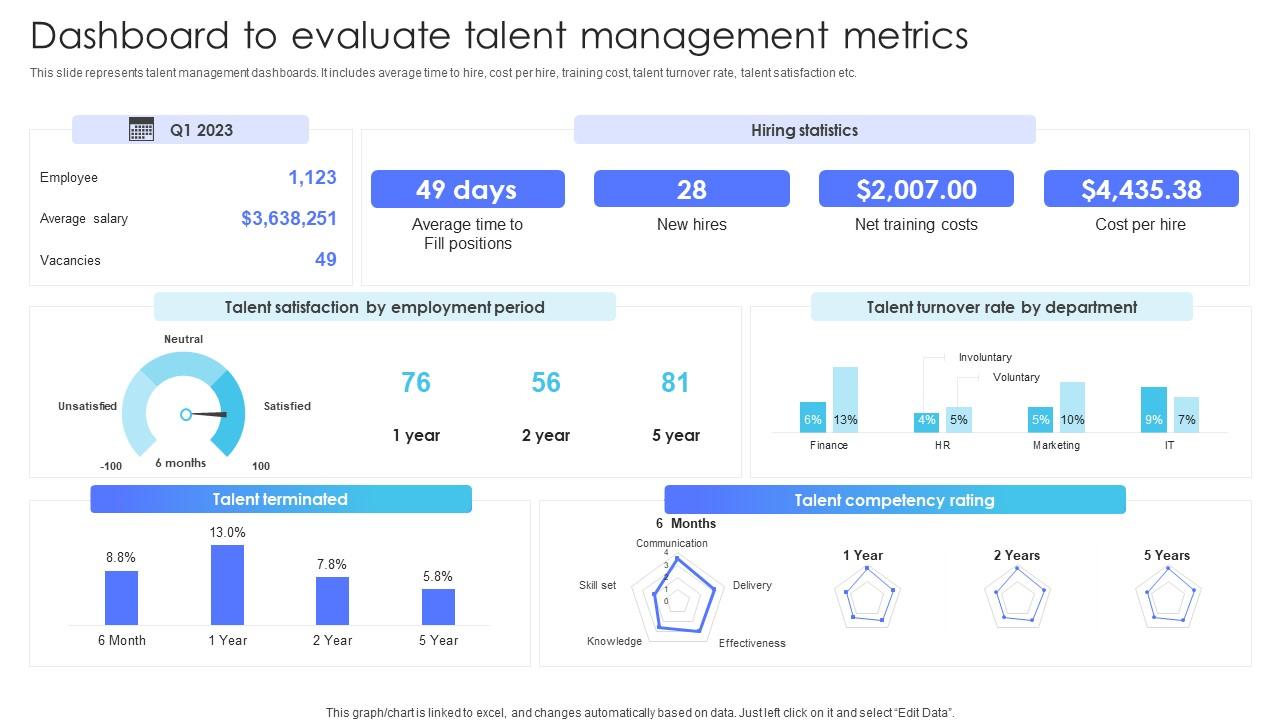
This slide represents talent management dashboards. It includes average time to hire, cost per hire, training cost, talent turnover rate, talent satisfaction etc.
People who downloaded this PowerPoint presentation also viewed the following :
Dashboard To Evaluate Talent Management Metrics Multiple Brands Launch Strategy with all 7 slides:
Use our Dashboard To Evaluate Talent Management Metrics Multiple Brands Launch Strategy to effectively help you save your valuable time. They are readymade to fit into any presentation structure.
FAQs for Dashboard To Evaluate Talent Management Metrics Multiple
Key talent management KPIs include employee retention rates, time-to-fill positions, performance ratings, engagement scores, internal mobility rates, and training completion metrics. These indicators enable organizations to optimize recruitment processes, enhance workforce development, and reduce turnover costs, with many companies finding that tracking these metrics strategically improves talent acquisition efficiency and long-term organizational performance.
Organizations measure talent management ROI by tracking metrics like employee retention rates, time-to-productivity for new hires, internal promotion percentages, and revenue per employee alongside program costs. Through comprehensive analytics, companies calculate cost savings from reduced turnover, faster onboarding, and enhanced performance, with many finding that strategic talent investments deliver 300-400% returns while strengthening competitive advantage.
Employee engagement serves as a foundational metric that influences retention rates, productivity levels, performance outcomes, and overall organizational health within talent management frameworks. Engaged employees demonstrate higher job satisfaction, reduced turnover intentions, and increased discretionary effort, with many organizations finding that strong engagement scores correlate directly with improved business performance and competitive advantage.
Diversity and inclusion metrics can be integrated through recruitment tracking, promotion rate analysis, pay equity assessments, retention measurements, and employee engagement surveys across demographic groups. These metrics enable organizations to identify gaps, set targeted goals, and measure progress systematically, with many companies finding that data-driven D&I strategies enhance innovation, reduce turnover, and ultimately deliver stronger business performance.
**INPUT**: What are the most effective methods for assessing the effectiveness of training and development programs? **OUTPUT**: Effective training assessment methods include pre and post-training evaluations, skill assessments, performance metrics analysis, participant feedback surveys, and ROI calculations. These approaches enable organizations to measure knowledge retention, behavioral changes, and business impact, with many companies finding that combining multiple assessment methods delivers comprehensive insights into program effectiveness and guides strategic workforce development investments. **Word count: 58 words**
Predictive analytics enhances talent management by forecasting employee performance, identifying flight risks, and optimizing recruitment decisions through data-driven insights. Organizations leverage these capabilities to reduce turnover costs, improve hiring accuracy, and develop targeted retention strategies, with companies in finance and healthcare finding significant improvements in workforce planning and ultimately gaining competitive advantage through strategic talent decisions.
Leadership development success metrics include 360-degree feedback scores, promotion rates from program participants, leadership competency assessments, employee engagement scores under developed leaders, and retention rates of high-potential talent. These measurements enable organizations to track skill progression, behavioral changes, and business impact, with many companies finding that participants demonstrate improved team performance, higher employee satisfaction, and enhanced strategic decision-making capabilities.
Turnover rates reveal talent retention effectiveness, recruitment quality, and organizational health by tracking departures across departments, roles, and time periods. While high turnover in retail or hospitality may indicate market norms, consistent patterns in specialized roles like engineering or finance suggest deeper engagement issues, with leading organizations using these insights to enhance retention strategies, improve manager training, and ultimately reduce replacement costs while strengthening competitive advantage.
Time-to-fill, quality of hire scores, retention rates within first year, cultural fit assessments, and performance ratings during probationary periods are most indicative of talent quality and organizational fit. These metrics work together by measuring recruitment efficiency, long-term employee success, and alignment with company values, with many organizations finding that combining quantitative performance data with cultural integration scores delivers the most comprehensive talent evaluation.
Organizations can measure performance review impact through retention rates of high performers, internal promotion percentages, skill development progression tracking, and employee engagement scores post-review. Many companies find that combining quantitative metrics like time-to-promotion with qualitative feedback assessments delivers comprehensive insights into review effectiveness, ultimately enabling more strategic talent development decisions and enhanced career progression pathways.
Talent pipeline metrics provide crucial visibility into future leadership readiness by tracking skill development, promotion rates, high-potential employee progress, and succession candidate availability across organizational levels. These metrics enable HR teams and executives to identify talent gaps early, accelerate targeted development programs, and ensure seamless leadership transitions, ultimately reducing recruitment costs while maintaining operational continuity during critical personnel changes.
External labor market trends significantly influence talent management metrics by affecting recruitment costs, turnover rates, compensation benchmarks, and time-to-fill positions across industries. Organizations in competitive sectors like technology and healthcare find that market dynamics directly impact their retention strategies, salary structures, and talent acquisition effectiveness, ultimately requiring adaptive metrics that reflect evolving workforce demands and competitive positioning.
Essential onboarding metrics include time-to-productivity, new hire retention rates, training completion percentages, manager satisfaction scores, and employee engagement levels during first 90 days. These measurements enable organizations to streamline integration processes, reduce turnover costs, and enhance early performance outcomes, with many companies finding that effective tracking ultimately delivers faster role competency and stronger long-term retention.
Organizations can utilize employee feedback through pulse surveys, exit interviews, performance discussions, and anonymous suggestion platforms to identify gaps in current talent management metrics. This strategic combination enables companies to refine measurement approaches, enhance retention strategies, and improve career development programs, with many finding that employee-driven insights ultimately deliver more accurate performance indicators and stronger organizational alignment.
Technology revolutionizes talent management metrics through automated data collection, real-time analytics, predictive modeling, and integrated reporting systems that eliminate manual processes. These platforms enable HR teams to track employee performance, engagement, and retention patterns across departments, while delivering actionable insights that enhance strategic decision-making and optimize workforce planning initiatives.
-
This PowerPoint layout is very helpful from a business point of view, and it's visually stunning too! I'm so happy with this product because it has helped me understand and deliver great presentations.Â
-
Informative and engaging! I really like the design and quality of the slides.