

Data flow funnel diagram five input and one output





Try Before you Buy Download Free Sample Product
 Impress Your
Audience
 100%
Editable
 Save Hours
of Time


People get emotive over trivial issues. Restore balance with our Data Flow Funnel Diagram Five Input And One Output.
People who downloaded this PowerPoint presentation also viewed the following :
Content of this Powerpoint Presentation
Description:
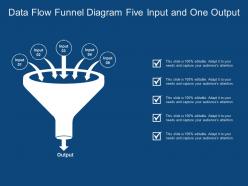
The image features a PowerPoint slide titled "Data Flow Funnel Diagram Five Input and One Output," which visually represents a funneling process where multiple inputs converge into a single output. This kind of diagram is used to illustrate the consolidation or filtering process where diverse data or information sources are streamlined into one focused outcome or result.
The slide comprises:
1. A funnel graphic with five arrows pointing downwards labeled "Input 01" to "Input 05," indicating various sources of data or information.
2. A single arrow labeled "Output" at the narrow end of the funnel, indicating the result of combining or filtering the inputs.
3. Text boxes adjacent to each input and the output for adding specific details.
Use Cases:
This type of visual is versatile and can be used across various industries for strategic presentations:
1. Marketing:
Use: To illustrate customer segmentation leading to a targeted marketing strategy.
Presenter: Marketing Director.
Audience: Marketing Team, Stakeholders.
2. Data Analytics:
Use: Demonstrating how multiple data sources are synthesized into actionable insights.
Presenter: Data Analyst.
Audience: Data Science Team, Business Analysts.
3. Finance:
Use: Showing how different financial inputs are factored into fiscal decision-making.
Presenter: Chief Financial Officer.
Audience: Finance Department, Investors.
4. Operations Management:
Use: Explaining the process of streamlining operations from various inputs to optimize workflow.
Presenter: Operations Manager.
Audience: Operations Team, Department Heads.
5. Supply Chain:
Use: Visualizing how multiple logistics inputs contribute to a single supply chain outcome.
Presenter: Supply Chain Specialist.
Audience: Logistics Partners, Supply Chain Team.
6. IT Services:
Use: Displaying how various technology inputs lead to a unified IT infrastructure.
Presenter: IT Project Manager.
Audience: IT Department, Technology Consultants.
7. Healthcare:
Use: Mapping out patient intake information leading to a singular care plan.
Presenter: Healthcare Administrator.
Audience: Medical Staff, Healthcare Providers.
Data flow funnel diagram five input and one output with all 5 slides:
Join the hunt for appropriate answers with our Data Flow Funnel Diagram Five Input And One Output. Get involved in handling the issue.
FAQs for Data flow funnel diagram five input
Key components of a Data Flow Funnel Diagram include data sources, processing stages, filtering mechanisms, transformation points, and output destinations. These elements work together by visualizing how information moves through systems, identifying bottlenecks, and streamlining data processing workflows, with many organizations finding that this approach enhances operational efficiency and decision-making capabilities.
Data Flow Funnel Diagrams enhance presentation visualization by transforming complex data processes into clear, sequential stages that audiences can easily follow and understand. These visual tools streamline information delivery by highlighting key transformation points, bottlenecks, and outcomes, with many organizations finding that funnel diagrams significantly improve stakeholder comprehension and decision-making during strategic presentations.
Industries with complex data processing workflows benefit most from Data Flow Funnel Diagrams, including healthcare, financial services, e-commerce, manufacturing, and telecommunications. These sectors leverage these diagrams to streamline patient data management, transaction processing, customer journey mapping, and supply chain optimization, ultimately delivering enhanced operational efficiency and improved decision-making capabilities.
Data Flow Funnel Diagrams emphasize data volume reduction and filtering stages through visual narrowing, while traditional flowcharts focus on sequential process steps with uniform visual elements. These funnel diagrams enable organizations to visualize data transformation, bottleneck identification, and quality improvement stages, with many businesses finding that this approach streamlines analytics workflows and enhances decision-making processes.
Software tools best suited for creating Data Flow Funnel Diagrams include Microsoft Visio, Lucidchart, Draw.io, Tableau, and specialized BI platforms like Power BI. These applications streamline diagram creation through drag-and-drop functionality, pre-built templates, and real-time data integration, with many organizations finding that cloud-based solutions enhance collaboration and deliver faster insights.
Data Flow Funnel Diagrams enable businesses to visualize customer journey touchpoints, identify conversion bottlenecks, and optimize resource allocation across marketing channels. Through these strategic visualizations, organizations streamline campaign targeting, enhance lead nurturing processes, and accelerate decision-making, with many retail and financial services companies finding that funnel analysis ultimately delivers improved ROI and competitive advantage.
Common mistakes include overcomplicated pathways, unclear labeling, inconsistent data definitions, missing feedback loops, and inadequate stakeholder input during design phases. These design flaws streamline by creating confusion rather than clarity, misaligning team understanding, and ultimately hindering decision-making processes, with many organizations finding that simplified, well-labeled diagrams enhance operational efficiency significantly.
Effectively analyzing data flow in funnel diagrams involves examining conversion rates between stages, identifying bottlenecks where significant data drops occur, and measuring throughput efficiency at each level. Organizations use these insights to optimize processes, streamline operations, and enhance customer journeys, with many businesses finding that targeted improvements at critical drop-off points deliver substantial increases in overall conversion performance.
User experience plays a crucial role in designing Data Flow Funnel Diagrams by ensuring clarity, intuitive navigation, and logical information hierarchy that stakeholders can easily interpret and act upon. Through strategic visual design, clear labeling, and streamlined data pathways, organizations enhance decision-making processes, reduce analysis time, and ultimately deliver better business insights across teams.
Successful Data Flow Funnel Diagrams include e-commerce platforms tracking customer journeys from browsing to purchase, healthcare systems monitoring patient data from admission through discharge, and financial institutions mapping loan applications through approval processes. These diagrams streamline operational workflows by identifying bottlenecks, optimizing resource allocation, and enhancing decision-making capabilities, with many organizations finding that visual data mapping ultimately delivers improved efficiency and measurable performance gains.
Color schemes and design elements significantly enhance Data Flow Funnel Diagram readability by creating visual hierarchy, distinguishing process stages, and guiding viewer attention through strategic contrast and consistency. Through thoughtful color coding and clean typography, organizations streamline complex data interpretation, reduce cognitive load, and enable stakeholders to quickly identify bottlenecks, ultimately delivering clearer insights and faster decision-making across departments.
Data Flow Funnel Diagrams enable tracking conversion rates, throughput volumes, processing times, bottleneck identification, and error rates at each stage. These metrics streamline performance evaluation by revealing workflow efficiency, resource utilization patterns, and capacity constraints, with many organizations finding that systematic funnel analysis ultimately delivers enhanced operational visibility and strategic optimization opportunities.
Data Flow Funnel Diagrams streamline complex data processes by visualizing information movement through stages, identifying bottlenecks, and highlighting transformation points from input to output. These diagrams enable organizations to optimize workflows, reduce processing time, and enhance data quality, with many financial services and healthcare institutions finding that visual mapping ultimately delivers improved operational efficiency and faster decision-making capabilities.
Best practices for presenting Data Flow Funnel Diagrams include using clear visual hierarchies, color-coding different data streams, labeling conversion rates at each stage, highlighting bottlenecks, and providing actionable insights. These approaches enhance stakeholder understanding by simplifying complex data flows, enabling faster decision-making, and ultimately delivering improved operational transparency and strategic alignment across organizations.
Ensuring accuracy and reliability in funnel diagrams requires validating data sources, implementing regular quality checks, using consistent measurement methodologies, and establishing clear data governance protocols. Through automated data collection systems and cross-verification processes, organizations streamline reporting accuracy while minimizing human error, with many businesses finding that standardized templates and regular audits ultimately deliver more trustworthy insights and better decision-making outcomes.
-
Much better than the original! Thanks for the quick turnaround.
-
Excellent products for quick understanding.