Decision Making Quality Improvement And Measurement Plan

Rating:
80%
Decision Making Quality Improvement And Measurement Plan
Slide 1 of 6

or

Favourites Favourites

Try Before you Buy Download Free Sample Product

Audience Impress Your
Audience
Editable 100%
Editable
Time Save Hours
of Time
The Biggest Sale is ending soon in
0
0
:
0
0
:
0
0
Rating:
80%
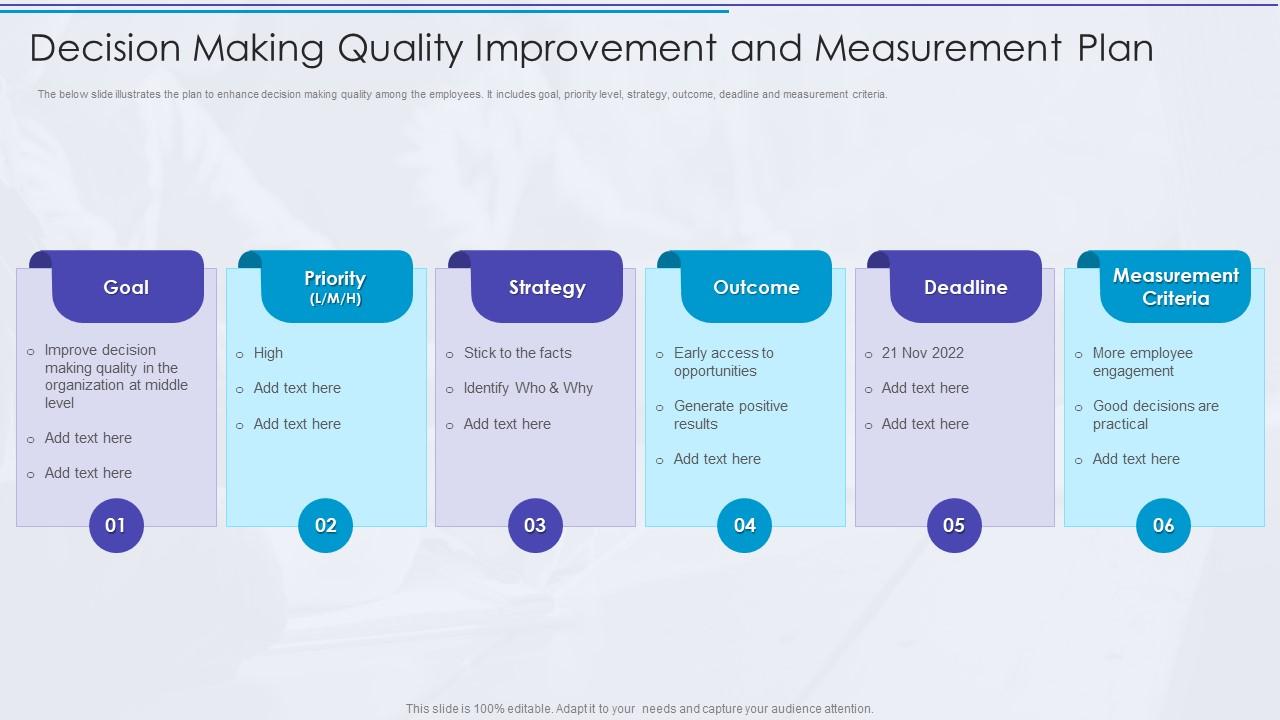
The below slide illustrates the plan to enhance decision making quality among the employees. It includes goal,priority level,strategy,outcome,deadline and measurement criteria. Presenting our set of slides with name Annual Sales Measurement Plan Icon. This exhibits information on four stages of the process. This is an easy to edit and innovatively designed PowerPoint template. So download immediately and highlight information on Annual Sales Measurement Plan Icon. Decision Making Quality Improvement And Measurement Plan. This exhibits information on six stages of the process. This is an easy to edit and innovatively designed PowerPoint template. So download immediately and highlight information on Strategy, Measurement Criteria, Deadline, Goal, Priority.

FAQs for Decision Making Quality Improvement

Honestly, it comes down to good info and knowing who calls the shots. You want solid data getting to decision-makers fast, not filtered through five people first. Time's tricky though - rush it and you'll regret it, but overthinking kills momentum. Team stuff is weirdly crucial. If everyone's scared to disagree or point out problems, you're screwed. Plus all those mental traps we fall into - like only hearing what confirms what we already think. I'd map out how decisions actually happen now (not how they're supposed to). Bet you'll find info getting stuck somewhere dumb.

Honestly, data analytics just takes the guessing out of decisions. You get real evidence instead of going with your gut or whatever worked five years ago. It shows you patterns you'd totally miss otherwise - like having superpowers for spotting problems before they blow up your budget. You can actually test different approaches and see what's moving the needle in your business. The cool part is catching issues early instead of dealing with expensive disasters later. My advice? Don't overthink it - just pick one decision you make all the time and see what data you already have sitting around that could help.

Your gut feeling is actually your brain doing crazy fast pattern matching with all the stuff you've learned over time. I used to think intuition was total BS, honestly. But it's more like your subconscious spotting things you can't quite put your finger on yet. Don't just go with it blindly though - use it as your starting signal. When something feels weird about a choice, that's worth digging into. Then back it up with actual facts and logic. It's like having a really good early warning system that you shouldn't ignore.

Don't treat your numbers and stories like they're fighting each other - they work better together. Look at your data first to spot what's happening, then dig into the qualitative stuff to figure out why. Honestly, I've watched way too many teams get paralyzed trying to turn everything into a metric. Sometimes customer feedback or gut instinct matters even when your spreadsheet looks messy. Set up your meetings so you review the hard numbers first, then talk through what people are actually seeing in the field. That back-and-forth is where the good decisions happen.

Honestly, I swear by the 10-10-10 rule - like how will this feel in 10 minutes vs 10 months vs 10 years? Puts things in perspective real quick. Pre-mortems are solid too where you imagine everything went wrong and trace back why. Devil's advocate stuff works but people get weirdly defensive sometimes lol. Sleep on the big ones if you can - your brain literally works different when you're not all wound up about it. Oh and build these habits now while things are chill, not when you're freaking out and need to think straight.

Honestly, involving other people in decisions usually works out way better. You'll catch stuff you never would've seen alone, plus people actually do what they agreed to help decide. That's like half the battle right there. More brains = better solutions and fewer stupid mistakes. The annoying part? It definitely takes longer and sometimes turns into a whole debate. But for anything important, it's worth it. Oh and don't invite everyone and their mom - just grab 2-3 people who actually know what they're talking about. Trust me on that one.

Honestly, your workplace culture is like the invisible rulebook for how decisions actually happen. When people feel safe to speak up, you get way better ideas floating around. But in those toxic, blame-heavy places? Everyone just nods along even when they know something's wrong - seen it too many times. Culture also shapes whether your team takes smart risks or just plays it ridiculously safe. Some places are all about the data, others go with gut instinct. And don't get me started on how long decisions take in different environments. If you want better outcomes, start by figuring out what your culture's really like first.

Honestly, the best thing you can do is figure out your benchmarks before you actually make the change - otherwise you're just guessing later. I'd track maybe 2-3 key things max, mix of hard numbers (costs, timelines) and feedback from people who are actually dealing with it. Post-mortems are seriously underrated btw. Check in at 30, 90, 180 days to see what's actually working. Write down what you learn because future you will thank you for it. Don't go overboard with data though - I made that mistake once and just ended up drowning in spreadsheets.

Honestly, start with making people feel safe to mess up - nobody makes smart choices when they're scared of looking stupid. Get your team talking openly about different ideas, and actually hear them out instead of just pretending to listen. I've watched so many groups just follow whoever talks the loudest, it's painful. Build some structure around how decisions happen so it's not total chaos. Oh, and celebrate the good risks that don't work out - that's huge. Show them how it's done by thinking out loud and saying "yeah, I was wrong about that" when you are.

Ugh, the worst thing I see is when teams rush into stuff without any real data backing them up. Then you've got that one person who just talks over everyone else - you know the type. Perfectionism is honestly way more dangerous than people think; I've seen it kill so many decent ideas. Oh, and confirmation bias is huge too - people just hunt for whatever proves they were right all along. My take? Set actual deadlines for decisions. Hunt down the people who disagree with you. A solid choice made fast usually wins over some "perfect" solution that takes forever.

So here's the thing - feedback loops are just tracking what happens after you make choices. Document your reasoning beforehand, then check back later to see how wrong you were (trust me, we're all wrong more than we think). I'm terrible at estimating how long projects will take, but now I know that about myself. Pick one type of decision you make regularly and track it for like a month. You'll start noticing your blind spots pretty quickly. It's basically building your own cheat sheet of what works and what doesn't for future decisions.

Honestly, tech is a total game-changer for making decisions faster. Instead of spending hours gathering data manually, you can set up dashboards that update in real-time. AI's gotten pretty insane at spotting patterns you'd probably miss anyway. What I'd do is figure out which data tasks bog you down the most - maybe it's pulling reports or analyzing trends? Then automate those first. The whole point is letting technology handle the boring grunt work so you can actually think strategically and talk to people who matter. Predictive models are clutch too for getting ahead of problems.

So basically, scenario planning is when you think through a bunch of different "what if" situations before making any big moves. Map out maybe 3-4 possible futures - yeah, including the crappy ones nobody wants to consider. It sounds boring but honestly? Your decisions get way stronger because you've already gamed out the contingencies. You're not just banking on everything going perfectly. I'd start simple - pick three scenarios for whatever you're deciding: best case, worst case, and what'll probably actually happen. It's like having a backup plan for your backup plan.

Honestly, scenario workshops work best - get people practicing actual decisions they'll face. Case studies are solid too since everyone learns from mistakes without consequences. Critical thinking courses help, especially the ones teaching decision trees and pros/cons frameworks. Role-playing feels super awkward initially but builds real confidence. Oh, and mentoring programs are clutch - pair newbies with your best decision-makers. My advice? Don't try everything simultaneously. Figure out where your team's struggling first, then pick maybe 2-3 methods max.

Honestly, benchmarking is like getting a reality check on whether your decisions actually work or if you're just stuck in "that's how we've always done it" mode. Look at 2-3 companies dealing with similar problems - not just whoever sounds cool. Map out how you currently make decisions, then see what the top performers do differently. You'll probably spot blind spots you didn't even know existed. The whole point is learning from frameworks that are already tested instead of starting from scratch. Just don't copy everything blindly - find what actually fits your situation.

Ratings and Reviews

80% of 100
Review Form
Write a review
Most Relevant Reviews
  1. 80%

    by Cletus Ross

    Great templates that you can use in your next keynote or conference. They are perfect for quick and visually-engaging delivery. 
  2. 80%

    by Dong Santos

    SlideTeam is the way to go when you are in a time crunch. Their templates have saved me many times in the past three months.

2 Item(s)

per page: