


Delivering Excellent Customer Services Powerpoint Presentation Slides





Try Before you Buy Download Free Sample Product
 Impress Your
 Audience
 100%
100% Editable
 Save Hours
 of Time


After sales service encompasses the support and assistance provided to customers after they have purchased a product or service. Grab our expertly crafted Our Delivering Excellent Customer Services template. It offers a comprehensive overview of the importance of after sales services and the benefits, requirements, and best practices associated with them. Our customer services deck emphasizes that after sales support is not just a reactive process but also a proactive business strategy that significantly enhances customer satisfaction, fosters brand loyalty, and stimulates positive word of mouth marketing. It covers various aspects of after-sales services, including training, assurance, support, assistance, rewards, etc. Additionally, our customer support PPT highlights the impact of excellent after sales services and provides valuable dashboards for tracking customer retention and satisfaction levels. It also addresses essential elements such as services, product guarantees, warranties, returns, replacements, configurations, installations, maintenance, and relocations. To explore these valuable insights further, we invite you to download our 100 percentage editable and customizable template, fully compatible with Google Slides. Get instant access.
People who downloaded this PowerPoint presentation also viewed the following :
Content of this Powerpoint Presentation
Slide 1: This slide introduces Delivering Excellent Customer Services. Commence by stating Your Company Name.
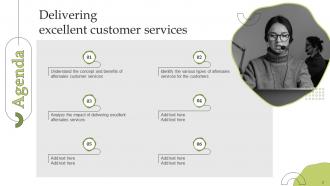
Slide 2: This slide depicts the Agenda of the presentation.
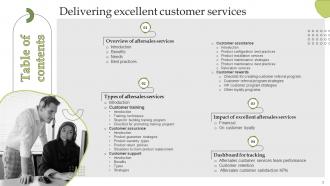
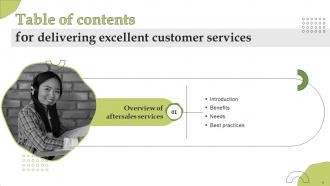
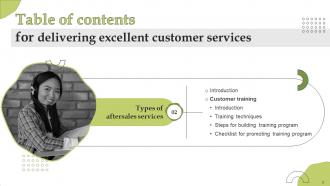
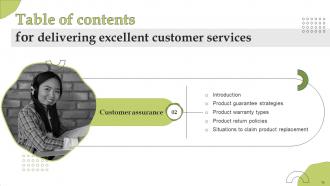
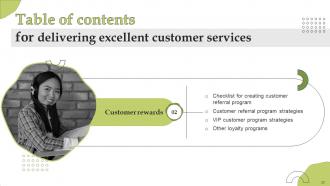
Slide 3: This slide includes the Table of contents.
Slide 4: This slide highlights the Title for the Topics to be covered further.
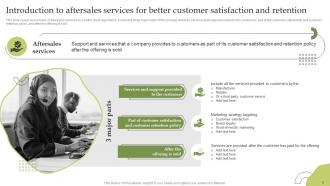
Slide 5: This slide covers an overview of aftersales services for a better client experience.
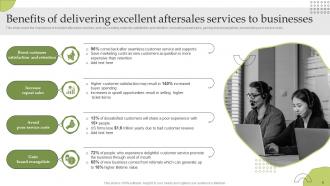
Slide 6: This slide exhibits the Benefits of delivering excellent aftersales services to businesses.
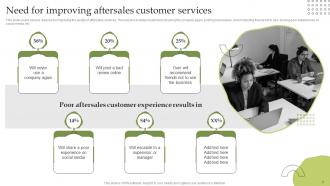
Slide 7: This slide covers various reasons for improving the quality of aftersales services.
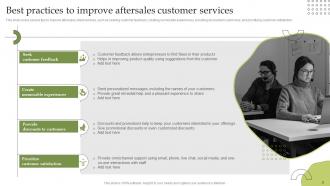
Slide 8: This slide states the various tips to improve aftersales client services.
Slide 9: This slide contains the Heading for the Contents to be discussed next.
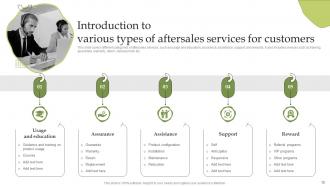
Slide 10: This slide depicts different categories of aftersales services, such as usage and education, assurance, assistance, support, and rewards.
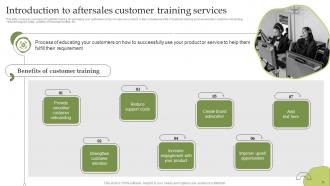
Slide 11: This slide covers an overview of customer training for educating your customers on how to use your product.
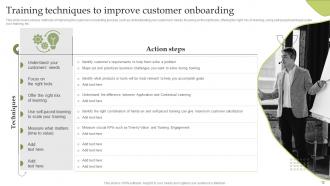
Slide 12: This slide reveals various methods of improving the customer onboarding process.
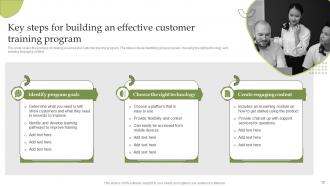
Slide 13: This slide shows the process of creating a successful customer training program.
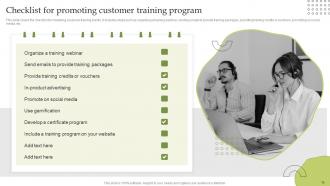
Slide 14: This slide presents the Checklist for promoting customer training program.
Slide 15: This slide displays the Title for the Ideas to be covered in the upcoming template.
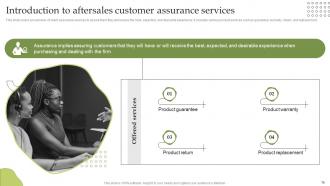
Slide 16: This slide covers an overview of client assurance services to assure them they will receive the best, expected, and desirable experience.
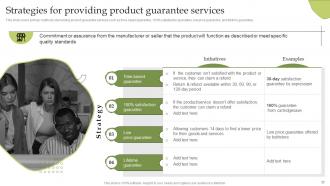
Slide 17: This slide depicts primary methods of providing product guarantee services.
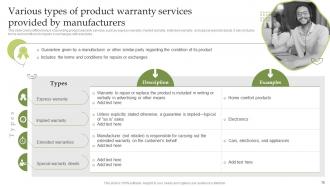
Slide 18: This slide states the different ways of providing product warranty services.
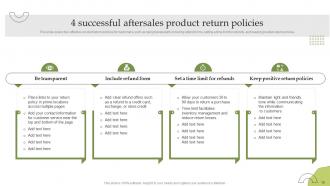
Slide 19: This slide portrays four effective product return policies for customers.
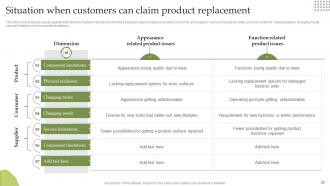
Slide 20: This slide shows various causes against which product replacement can be claimed.
Slide 21: This slide contains the Heading for the Ideas to be discussed next.
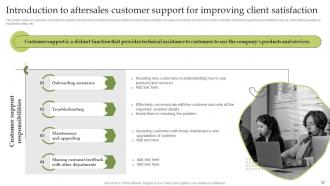
Slide 22: This slide covers an overview of customer support services to provide technical assistance to customers using the company's products and services.
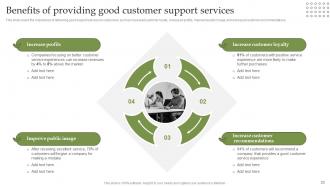
Slide 23: This slide states the importance of delivering good support services to customers.
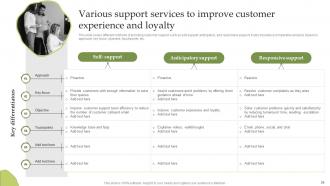
Slide 24: This slide highlights different methods of providing customer support, such as self-support, anticipatory, and responsive support.
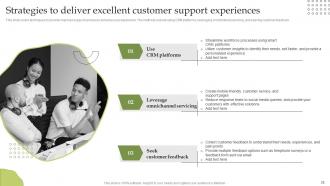
Slide 25: This slide covers techniques to provide improved support services to enhance user experience.
Slide 26: This slide exhibits the Title for the Contents to be covered in the upcoming template.
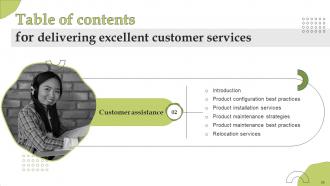
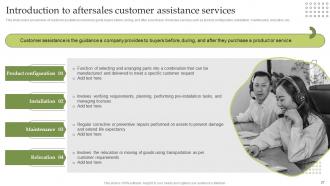
Slide 27: This slide covers an overview of customer assistance services to guide buyers before, during, and after a purchase.
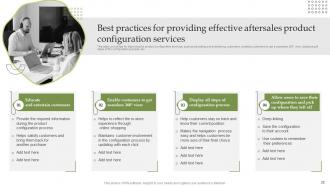
Slide 28: This slide portrays tips for improving the product configuration services.
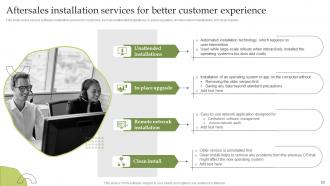
Slide 29: This slide shows various software installation services for customers.
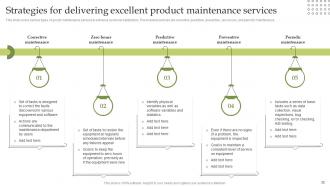
Slide 30: This slide contains various types of goods maintenance services to enhance customer satisfaction.
Slide 31: This slide highlights tips for optimizing maintenance services for a better customer experience.
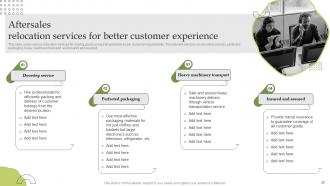
Slide 32: This slide indicates various relocation services for moving goods using transportation as per customer requirements.
Slide 33: This slide displays the Heading for the Topics to be discussed next.
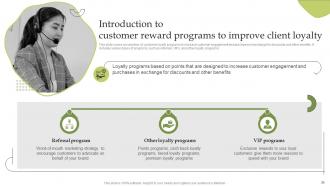
Slide 34: This slide covers an overview of customer loyalty programs to increase customer engagement and purchases in exchange for discounts and other benefits.
Slide 35: This slide depicts a checklist for building a compelling user referral program.
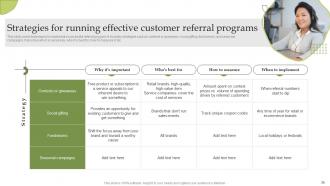
Slide 36: This slide covers techniques to implement a successful referral program.
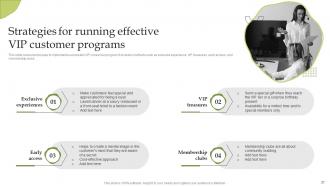
Slide 37: This slide mentions the techniques to implement a successful VIP consumer program.
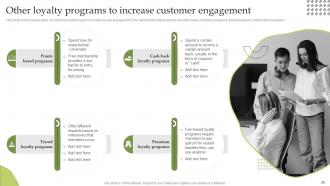
Slide 38: This slide covers various types of consumer loyalty programs to improve user engagement.
Slide 39: This slide portrays the Title for the Topics to be covered in the next template.
Slide 40: This slide covers the effect of excellent aftersales services on companies’ financial performance.
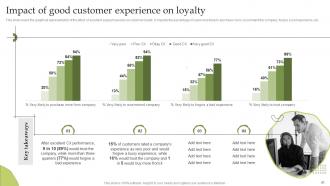
Slide 41: This slide illustrates the graphical representation of the effect of excellent support services on customer loyalty.
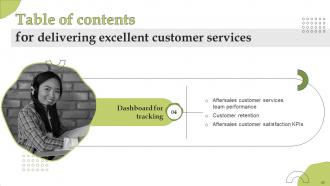
Slide 42: This slide contains the Heading for the Contents to be discussed further.
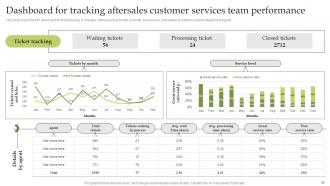
Slide 43: This slide covers the KPI dashboard for ticket tracking.
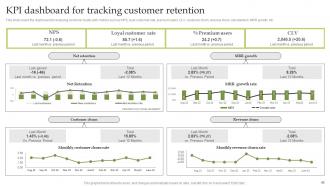
Slide 44: This slide shows the dashboard for analyzing customer loyalty with metrics.
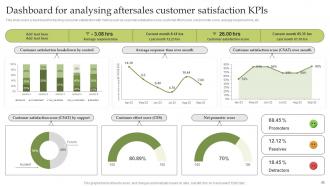
Slide 45: This slide displays a dashboard for tracking consumer satisfaction with metrics.
Slide 46: This is the Icons slide containing all the Icons used in the plan.
Slide 47: This slide is used for depicting some Additional information.
Slide 48: This slide incorporates the company's mission, vision, and goals.
Slide 49: This is the About us slide. State your organizational infomration here.
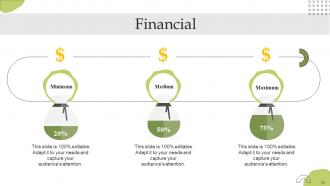
Slide 50: This slide elucidates information related to the Financial topic.
Slide 51: This slide represents the Title for the Ideas to be covered further.
Slide 52: This is the Idea generation sldie for encouraging fresh ideas.
Slide 53: This slide presents the organization's Timeline.
Slide 54: This is the Thank You slide for acknowledgement.
Delivering Excellent Customer Services Powerpoint Presentation Slides with all 59 slides:
Use our Delivering Excellent Customer Services Powerpoint Presentation Slides to effectively help you save your valuable time. They are readymade to fit into any presentation structure.













FAQs for Delivering Excellent Customer Services
Key components of excellent customer service include responsiveness, personalized communication, proactive problem-solving, omnichannel support availability, and consistent follow-up processes. These elements work together by reducing resolution times, enhancing customer satisfaction, and building long-term loyalty, with many organizations finding that strategic investment in these areas delivers measurable competitive advantage and increased retention rates.
Organizations measure customer service effectiveness through key performance indicators like response times, resolution rates, customer satisfaction scores, Net Promoter Score, and first-call resolution percentages. These metrics enable businesses to identify service gaps, optimize resource allocation, and enhance customer experiences, with many companies finding that comprehensive measurement systems ultimately deliver improved retention rates and competitive advantage in increasingly demanding markets.
Employee training plays a fundamental role in customer service excellence by developing communication skills, product knowledge, problem-solving abilities, and emotional intelligence among service representatives. Through comprehensive training programs, organizations enhance response times, improve first-call resolution rates, and deliver more personalized customer interactions, with many companies finding that well-trained employees significantly reduce customer complaints while increasing satisfaction scores and loyalty.
Technology enhances customer service by automating routine inquiries, providing real-time data access, and enabling personalized interactions through AI chatbots, CRM systems, and omnichannel platforms. These solutions streamline workflows for employees while delivering faster response times and 24/7 availability for customers, with many organizations finding that integrated technology ultimately reduces operational costs and significantly improves satisfaction ratings.
Common customer service improvement pitfalls include implementing changes without employee training, focusing solely on technology solutions while neglecting human elements, making promises beyond organizational capabilities, ignoring customer feedback during transitions, and rushing improvements without proper testing. Many organizations find that sustainable service excellence requires balancing automation with personal touch, ensuring staff buy-in through comprehensive training, and maintaining realistic expectations while gradually building enhanced capabilities.
Personalization is crucial for exceptional customer service, as it transforms generic interactions into meaningful experiences that build loyalty and trust. By leveraging customer data and preferences, businesses across retail, banking, and hospitality deliver tailored solutions, faster resolutions, and proactive support, ultimately enhancing satisfaction while driving competitive advantage.
Effective strategies include active listening, empathy acknowledgment, solution-focused responses, clear communication protocols, and escalation procedures when needed. These approaches streamline conflict resolution by de-escalating tensions, building trust, and maintaining professional boundaries, with many service organizations finding that well-trained staff ultimately deliver faster resolutions and enhanced customer retention rates.
Businesses create customer service excellence culture through comprehensive training programs, clear service standards, employee empowerment initiatives, regular feedback systems, and recognition rewards for exceptional performance. This strategic combination enables teams to consistently deliver superior customer experiences, with many organizations finding that empowered employees who understand service expectations ultimately drive higher satisfaction rates, increased loyalty, and sustainable competitive advantage.
Key customer service metrics include response time, resolution rate, customer satisfaction scores, Net Promoter Score, and first-call resolution percentage. These measurements enable organizations to streamline operations, enhance customer experiences, and identify improvement opportunities, with many companies finding that systematic tracking ultimately delivers competitive advantage and increased customer loyalty.
Customer feedback influences service practices by identifying pain points, revealing service gaps, and highlighting improvement opportunities across touchpoints. Through systematic feedback analysis, organizations enhance response times, personalize interactions, and streamline processes, with many retail and hospitality businesses finding that customer-driven improvements ultimately deliver higher satisfaction scores and stronger competitive advantage.
Leading companies demonstrate innovation through AI-powered chatbots, omnichannel support integration, predictive service analytics, personalized self-service portals, and real-time sentiment analysis. These approaches streamline customer interactions by reducing response times, anticipating needs, and delivering consistent experiences across touchpoints, with many organizations finding that strategic service innovation significantly enhances customer loyalty and competitive differentiation.
Small businesses can compete by leveraging personalized service, faster response times, direct owner involvement, flexible policies, and intimate customer knowledge that larger organizations often struggle to match. Through strategic use of affordable customer service technologies, streamlined communication channels, and empowered staff decision-making, small businesses deliver more authentic customer experiences, ultimately building stronger loyalty and competitive advantage in increasingly crowded markets.
Social media can be leveraged to improve customer service through real-time response monitoring, proactive engagement, personalized support delivery, community-driven problem solving, and transparent communication channels. These platforms enable organizations to address concerns faster, build stronger relationships, and demonstrate accountability publicly, with many companies finding that social listening ultimately delivers enhanced customer satisfaction and competitive advantage.
Businesses balance efficiency and service quality by implementing smart automation for routine inquiries, training staff to handle complex issues with empathy, and using data analytics to personalize interactions. Through strategic technology integration, companies like banks and retail chains streamline response times while maintaining human touchpoints for critical decisions, ultimately delivering faster service without sacrificing customer satisfaction.
Excellent customer service significantly strengthens brand loyalty by creating positive emotional connections, building trust through consistent experiences, and demonstrating genuine care for customer needs. Companies with superior service, like Amazon and Zappos, often see repeat purchase rates increase by 60-70%, while customers become brand advocates who refer others, ultimately delivering sustained revenue growth and competitive differentiation.
-
Happy to found you SlideTeam. You guys are value for money. Amazing slides.
-
A library of engaging, customizable and content-ready templates.