Demand Generation Marketing Metrics To Measure Performance
Try Before you Buy Download Free Sample Product
Audience
Editable
of Time
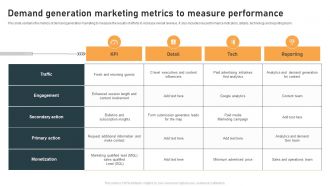
This slide contains the metrics of demand generation marketing to measure the results of efforts to increase overall revenue. It also includes key performance indicators, details, technology and reporting team.
People who downloaded this PowerPoint presentation also viewed the following :
Demand Generation Marketing Metrics To Measure Performance with all 6 slides:
Use our Demand Generation Marketing Metrics To Measure Performance to effectively help you save your valuable time. They are readymade to fit into any presentation structure.
FAQs for Demand Generation Marketing Metrics
Key demand generation metrics include lead volume, cost per lead, lead quality scores, conversion rates, and customer acquisition cost. These metrics work together by tracking campaign performance from initial awareness through final purchase, with many B2B organizations finding that combining leading indicators like engagement rates with lagging indicators like revenue attribution delivers comprehensive insights into campaign effectiveness and ROI optimization.
Marketing teams align demand generation metrics with business objectives by mapping lead quality scores to revenue targets, tracking customer acquisition costs against lifetime value projections, and measuring pipeline velocity alongside sales cycle goals. This strategic approach enables organizations to demonstrate marketing ROI through revenue attribution, optimize resource allocation across channels, and ultimately accelerate business growth while ensuring marketing investments directly contribute to bottom-line results.
Conversion rate serves as a critical performance indicator that measures how effectively demand generation efforts transform prospects into qualified leads, customers, and revenue-generating opportunities across different funnel stages. This metric enables marketing teams to identify high-performing channels, optimize resource allocation, and demonstrate ROI, with many organizations finding that tracking conversion rates by campaign type ultimately delivers better budget decisions and improved customer acquisition costs.
Effectively tracking lead source performance requires implementing comprehensive attribution models, UTM parameter tracking, multi-touch analytics, and integrated CRM systems that monitor conversion rates across channels. Through advanced marketing automation platforms, organizations can analyze cost-per-lead, lead quality scores, and revenue attribution by source, while tracking customer journey touchpoints, ultimately enabling strategic budget reallocation and optimized campaign performance.
Lead quality metrics include lead scoring based on demographics and behavior, conversion rates from lead to opportunity, time-to-close ratios, customer acquisition cost, and lifetime value calculations. These assessments enable marketing teams to refine targeting strategies, optimize campaign spend, and align with sales objectives, with many organizations finding that tracking engagement depth alongside conversion velocity delivers significantly better pipeline quality and revenue outcomes.
Companies leverage CLV in demand generation by prioritizing high-value customer segments, allocating marketing budgets based on projected returns, and personalizing campaigns for maximum retention impact. This strategic approach enables businesses to focus resources on prospects with the greatest long-term potential, optimize acquisition costs across channels, and develop targeted messaging that resonates with valuable customer profiles, ultimately delivering improved ROI and sustainable revenue growth.
MQLs represent prospects showing initial interest through marketing engagement, while SQLs are leads vetted by sales teams as ready for direct outreach and conversion conversations. This distinction enables marketing and sales teams to optimize resource allocation, track campaign effectiveness more precisely, and accelerate pipeline velocity, with many organizations finding that clear MQL-to-SQL criteria ultimately delivers higher conversion rates and stronger sales-marketing alignment.
Attribution modeling enhances demand generation metrics by tracking customer touchpoints across multiple channels, identifying which interactions drive conversions, and revealing the true customer journey complexity. Through multi-touch attribution, organizations can optimize budget allocation, refine content strategies, and improve campaign targeting, with many marketing teams finding that proper attribution increases ROI by 15-30% while eliminating ineffective spending.
Setting demand generation benchmarks involves analyzing historical performance data, industry standards, competitor analysis, and specific business goals to establish realistic yet ambitious targets. Organizations should start with baseline metrics from previous campaigns, compare against industry averages for their sector, and gradually increase targets by 10-15% quarterly, with many companies finding that segmented benchmarks by channel, audience, and campaign type deliver more actionable insights than broad organizational averages.
Customer engagement significantly impacts demand generation metrics by driving higher conversion rates, increasing lead quality scores, and extending customer lifetime value. Engaged prospects demonstrate stronger purchase intent through email opens, content downloads, and social interactions, with many B2B companies finding that highly engaged leads convert 60% faster and generate substantially higher revenue per acquisition.
CRM platforms, marketing automation software, web analytics tools, attribution modeling solutions, and business intelligence dashboards can significantly enhance demand generation tracking. These technologies streamline data collection, automate lead scoring, and provide comprehensive visibility across customer touchpoints, with many organizations finding that integrated analytics platforms ultimately deliver faster campaign optimization and improved ROI measurement.
Feedback loops from sales teams improve demand generation metrics by identifying lead quality gaps, refining targeting criteria, and optimizing conversion pathways throughout the funnel. Through regular sales insights, marketing teams can adjust messaging, enhance lead scoring models, and prioritize high-converting channels, ultimately delivering better-qualified prospects and higher ROI on demand generation investments.
Content consumption metrics in demand generation track engagement depth, time spent, content downloads, page views, and social shares to measure audience interest and buying intent. These metrics enable marketers to identify high-performing content, optimize messaging strategies, and nurture prospects more effectively, with many organizations finding that detailed consumption analytics ultimately streamline lead qualification and accelerate sales cycles.
A/B testing optimizes demand generation metrics by comparing different versions of campaigns, landing pages, email subject lines, and call-to-action buttons to identify highest-performing elements. Through systematic testing, businesses enhance conversion rates, reduce cost-per-lead, and improve customer acquisition efficiency, with many marketing teams finding that continuous optimization delivers significantly better ROI and measurable performance improvements.
Analyzing drop-off rates reveals critical friction points, content effectiveness gaps, audience targeting misalignments, and conversion pathway obstacles throughout your demand generation funnel. These insights enable organizations to optimize messaging, streamline user experiences, and reallocate resources strategically, with many marketing teams finding that addressing high drop-off stages delivers significantly improved conversion rates and enhanced ROI.
-
I never had to worry about creating a business presentation from scratch. SlideTeam offered me professional, ready-made, and editable presentations that would have taken ages to design.
-
Colors used are bright and distinctive.