

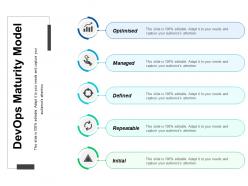
Devops maturity model





Try Before you Buy Download Free Sample Product
 Impress Your
Audience
 100%
Editable
 Save Hours
of Time


Our Devops Maturity Model are topically designed to provide an attractive backdrop to any subject. Use them to look like a presentation pro.
People who downloaded this PowerPoint presentation also viewed the following :
Devops maturity model with all 5 slides:
Use our Devops Maturity Model to effectively help you save your valuable time. They are readymade to fit into any presentation structure.


FAQs for
The DevOps Maturity Model includes initial ad-hoc processes, managed repeatable practices, defined standardized workflows, quantitatively measured operations, and optimized continuous improvement stages. These stages enable organizations to systematically enhance collaboration, automate deployment pipelines, and accelerate delivery cycles, with many enterprises finding that progressing through each level delivers significantly improved operational efficiency and competitive advantage.
Organizations assess DevOps maturity through comprehensive evaluations of automation capabilities, collaboration practices, deployment frequency, incident response times, and cultural alignment. Many companies utilize structured frameworks like DORA metrics, capability assessments, and cross-functional surveys, with financial services and technology firms finding that regular maturity audits enable targeted improvements and accelerated digital transformation outcomes.
Key metrics for evaluating DevOps maturity progress include deployment frequency, lead time for changes, mean time to recovery, change failure rate, and automated test coverage percentages. These measurements enable organizations to track operational efficiency improvements across development cycles, with many enterprises finding that consistent monitoring of these indicators streamlines resource allocation, minimizes system downtime, and ultimately delivers faster service delivery and enhanced competitive advantage.
Culture fundamentally shapes DevOps transformation success by fostering collaboration between development and operations teams, encouraging continuous learning, and supporting risk-taking through experimentation. Organizations with strong cultural alignment see significantly faster deployment cycles, reduced failure rates, and enhanced innovation, while those neglecting cultural change often struggle with resistance, ultimately finding that technical tools alone cannot deliver sustainable transformation.
Automation serves as the primary catalyst for DevOps maturity progression, enabling organizations to streamline deployment pipelines, reduce manual errors, and accelerate release cycles at each evolutionary stage. As teams advance through maturity levels, comprehensive automation transforms development workflows, testing processes, and infrastructure management, with many enterprises finding that strategic automation investments ultimately deliver faster time-to-market and enhanced operational efficiency.
Organizations can selectively accelerate certain DevOps capabilities while developing foundational elements simultaneously, though completely bypassing core stages often creates technical debt and integration challenges. While some companies successfully fast-track automation or monitoring implementations, most find that sustainable transformation requires building cultural collaboration, basic CI/CD processes, and measurement frameworks progressively, ultimately delivering more reliable outcomes.
Teams can effectively transition to DevOps by implementing cultural changes, establishing cross-functional collaboration, adopting automation tools, and creating shared responsibility models. This transformation requires gradual integration of continuous integration practices, automated testing, and monitoring systems, with many organizations finding that starting with pilot projects in specific departments enables smoother adoption while building momentum across broader development teams.
Essential tools evolve across maturity stages, from basic version control like Git and Jenkins for CI/CD in initial phases, to advanced container orchestration with Kubernetes, infrastructure-as-code tools like Terraform, and comprehensive monitoring platforms such as Prometheus and Grafana. These technologies enable organizations to streamline deployment processes, enhance operational visibility, and ultimately deliver faster, more reliable software releases while maintaining security and scalability.
Communication and collaboration evolve from siloed, manual handoffs at basic levels to automated, transparent workflows with shared tools and metrics at advanced stages. Organizations progress through structured feedback loops, cross-functional team integration, and real-time collaboration platforms, with many enterprises finding that mature DevOps cultures enable faster delivery cycles and enhanced operational efficiency.
Common pitfalls include rushing transformation without cultural readiness, neglecting automation fundamentals, inadequate toolchain integration, insufficient cross-team collaboration, and overlooking measurement frameworks. These challenges often stem from treating DevOps as purely technical rather than organizational, with many enterprises finding that sustainable maturity requires gradual cultural shifts alongside technological improvements, ultimately delivering lasting competitive advantage.
Leadership can support DevOps maturity by providing dedicated resources, fostering cross-functional collaboration, investing in automation tools, and establishing clear metrics for continuous improvement. Through strategic resource allocation and cultural transformation initiatives, organizations streamline development cycles, enhance deployment reliability, and accelerate time-to-market, with many enterprises finding that executive commitment ultimately delivers competitive advantage and operational excellence.
The DevOps Maturity Model significantly accelerates software delivery speed while enhancing quality through automated testing, continuous integration, streamlined deployment pipelines, and improved collaboration between development and operations teams. Organizations progressing through maturity levels experience faster release cycles, reduced defects, and enhanced system reliability, with many financial services and e-commerce companies achieving deployment frequencies from monthly to daily while maintaining superior quality standards.
Customer feedback and user experience factor into DevOps maturity assessments through continuous monitoring, real-time analytics, automated feedback loops, and performance metrics that directly measure end-user satisfaction. Organizations with higher DevOps maturity integrate customer insights into their development cycles, enabling faster response times to user issues, proactive service improvements, and enhanced product quality, ultimately delivering superior customer experiences and competitive advantage.
DevOps maturity directly enhances organizational agility by streamlining development cycles, accelerating deployment frequency, and improving cross-functional collaboration between teams. As organizations progress through maturity levels, they develop faster response capabilities to market changes, reduced time-to-market for new features, and greater operational flexibility, ultimately delivering competitive advantages in increasingly dynamic business environments.
Small and medium-sized enterprises can leverage the DevOps Maturity Model by starting with foundational practices like automated testing, continuous integration, and cross-functional collaboration before advancing to sophisticated deployment strategies. These organizations benefit from the model's phased approach, with many finding that incremental improvements in automation and team integration deliver faster development cycles, reduced operational costs, and enhanced competitive positioning.
No Reviews