

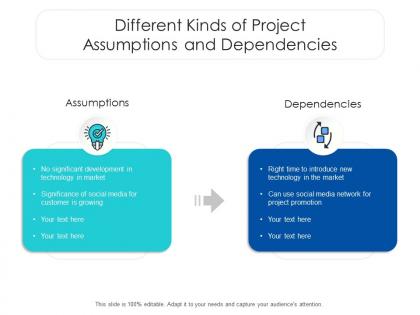
Different kinds of project assumptions and dependencies




Try Before you Buy Download Free Sample Product
 Impress Your
 Audience
 100%
100% Editable
 Save Hours
 of Time


Our Different Kinds Of Project Assumptions And Dependencies are topically designed to provide an attractive backdrop to any subject. Use them to look like a presentation pro.
People who downloaded this PowerPoint presentation also viewed the following :
Different kinds of project assumptions and dependencies with all 2 slides:
Use our Different Kinds Of Project Assumptions And Dependencies to effectively help you save your valuable time. They are readymade to fit into any presentation structure.
FAQs for Different kinds of project
The key phases of project management include initiation, planning, execution, monitoring and controlling, and closing, each building upon the previous to ensure systematic project delivery. These phases contribute to success by establishing clear objectives, defining scope and resources, coordinating team activities, tracking progress against milestones, and capturing lessons learned, ultimately delivering projects on time, within budget, and meeting stakeholder expectations.
Effective communication enhances project collaboration by establishing clear expectations, facilitating real-time information sharing, creating transparent feedback loops, and ensuring aligned decision-making processes. Through structured communication frameworks, project teams streamline coordination, minimize misunderstandings, and accelerate problem resolution, while stakeholders receive consistent updates that build trust, ultimately delivering improved project outcomes and stronger organizational alignment.
Risk management serves as a critical foundation for project planning and execution by identifying potential threats, assessing their impact, developing mitigation strategies, and establishing contingency plans. Through proactive risk assessment and monitoring, project managers streamline decision-making, minimize costly delays, and maintain stakeholder confidence, ultimately delivering projects on time and within budget while enhancing organizational resilience.
Project managers utilize agile methodologies by implementing iterative sprints, continuous stakeholder feedback, and flexible scope management to respond quickly to evolving requirements. Through regular sprint reviews and retrospectives, teams in software development, marketing campaigns, and product launches can pivot strategies, reallocate resources, and maintain project momentum, ultimately delivering higher client satisfaction and competitive advantage.
Best practices for setting and measuring project goals include defining SMART criteria, establishing clear deliverables, creating measurable milestones, aligning with stakeholder expectations, and implementing regular progress tracking systems. These approaches streamline project execution by enhancing accountability, improving resource allocation, and enabling proactive risk management, with many organizations finding that structured goal-setting ultimately delivers faster project completion and higher success rates.
Cultural differences impact global project management through varying communication styles, decision-making processes, time orientations, and hierarchy expectations, creating both coordination challenges and innovation opportunities. While manufacturing and technology companies navigate different approaches to deadlines and authority structures, these diverse perspectives ultimately enhance problem-solving capabilities and market understanding, with many international organizations finding that cultural intelligence significantly improves project outcomes.
Effective project scheduling and resource allocation tools include Microsoft Project, Asana, Trello, Monday.com, and Smartsheet, each offering unique strengths in timeline visualization and team coordination. These platforms streamline project workflows by automating task dependencies, optimizing resource distribution, and providing real-time progress tracking, with many organizations finding that integrated scheduling tools reduce project delays by up to 30% while enhancing team productivity.
Project managers ensure quality control by establishing clear standards, conducting regular reviews, implementing continuous monitoring systems, and maintaining stakeholder feedback loops throughout each phase. These approaches streamline delivery by catching issues early, reducing rework costs, and maintaining client satisfaction, with many organizations finding that proactive quality frameworks ultimately deliver faster project completion and stronger competitive positioning.
Common project management challenges include scope creep, resource constraints, timeline delays, communication breakdowns, and stakeholder misalignment. These obstacles can be mitigated through clear project charters, regular milestone reviews, and robust communication protocols, with many organizations finding that proactive risk management and stakeholder engagement ultimately deliver improved project outcomes and operational efficiency.
Project management methodologies vary significantly across industries, with IT favoring Agile and Scrum for iterative development, construction utilizing traditional Waterfall approaches for sequential phases, and healthcare emphasizing compliance-driven frameworks like Lean Six Sigma. These tailored methodologies address sector-specific requirements, regulatory constraints, and operational timelines, ultimately delivering enhanced efficiency, reduced risks, and improved outcomes within each industry's unique environment.
Effective scope creep strategies include establishing clear project boundaries, implementing formal change control processes, maintaining regular stakeholder communication, documenting all requirements thoroughly, and setting realistic expectations upfront. These approaches enable project managers to evaluate requests systematically, assess impacts on timeline and budget, and negotiate strategic adjustments while preserving project integrity and stakeholder relationships.
Stakeholder analysis significantly influences project prioritization by identifying key stakeholder interests, power dynamics, and strategic objectives, enabling project managers to align initiatives with organizational goals and stakeholder expectations. Through systematic stakeholder mapping, organizations can strategically allocate resources to high-impact projects, minimize conflicts, and ensure buy-in, ultimately delivering enhanced project success rates and stronger stakeholder relationships.
Post-completion project evaluation methods include performance metrics analysis, stakeholder feedback surveys, lessons learned sessions, return on investment calculations, and quality assessments against original objectives. These comprehensive reviews enable organizations to identify successful practices, streamline future project delivery, and enhance resource allocation strategies, with many finding that systematic post-project analysis delivers improved operational efficiency and competitive advantage.
Project managers build high-performing teams through clear communication, defined roles, regular feedback, and fostering collaborative environments that encourage innovation and accountability. By implementing structured goal-setting, recognizing achievements, and providing professional development opportunities, teams in sectors like construction, healthcare, and technology deliver projects faster, with higher quality outcomes, and ultimately achieve greater organizational success and competitive advantage.
Stakeholder feedback drives iterative project management by ensuring alignment with business objectives, identifying potential risks early, and validating deliverables against user expectations throughout development cycles. This continuous input enables project managers to make data-driven adjustments, minimize costly revisions, and ultimately deliver solutions that meet stakeholder needs while maintaining project timelines and budgets.
-
Much better than the original! Thanks for the quick turnaround.
-
Presentation Design is very nice, good work with the content as well.
-
Content of slide is easy to understand and edit.
-
Unique design & color.