Digital Marketing Expense Assessment For Online Business

Rating:
100%
Digital Marketing Expense Assessment For Online Business
Slide 1 of 7
Favourites Favourites

Try Before you Buy Download Free Sample Product

Audience Impress Your
Audience
Editable 100%
Editable
Time Save Hours
of Time
The Biggest Sale is ending soon in
0
0
:
0
0
:
0
0
Rating:
100%
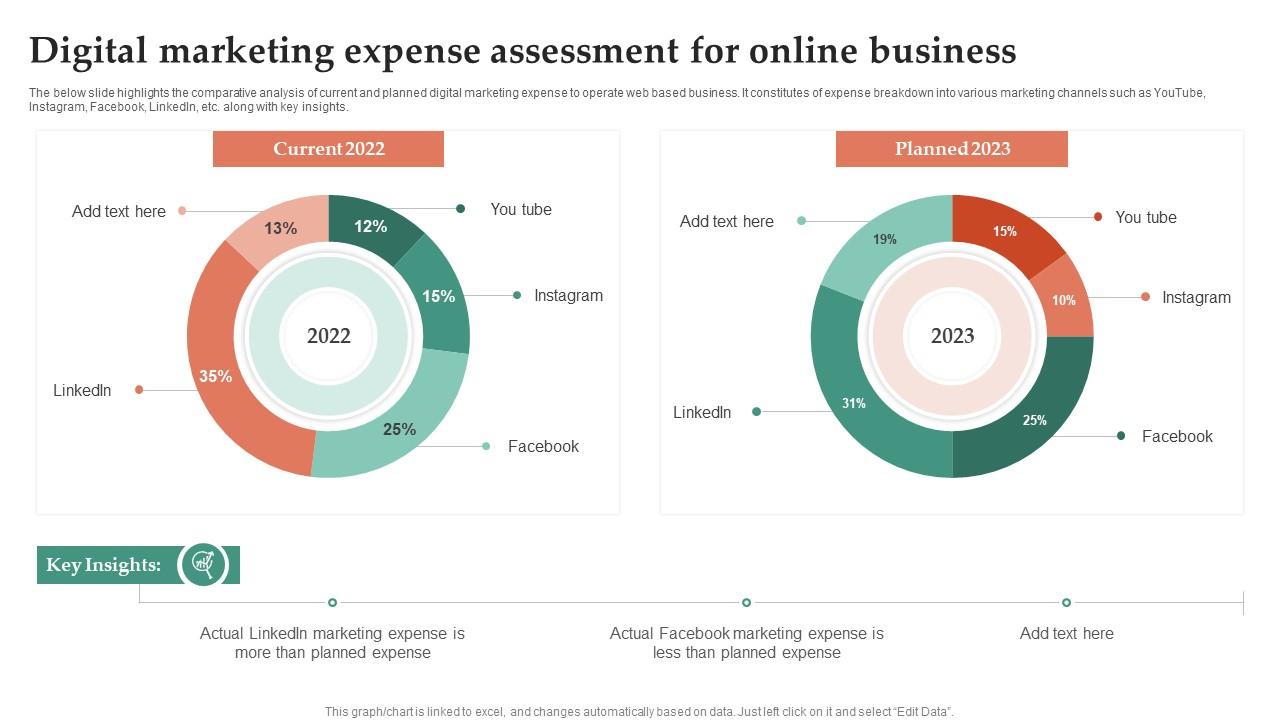
The below slide highlights the comparative analysis of current and planned digital marketing expense to operate web based business. It constitutes of expense breakdown into various marketing channels such as YouTube, Instagram, Facebook, LinkedIn, etc. along with key insights. Presenting our well structured Digital Marketing Expense Assessment For Online Business. The topics discussed in this slide are Linkedin Marketing Expense, Facebook Marketing Expense. This is an instantly available PowerPoint presentation that can be edited conveniently. Download it right away and captivate your audience.

People who downloaded this PowerPoint presentation also viewed the following :

FAQs for Digital Marketing Expense Assessment

Key metrics for evaluating digital marketing expenses include return on ad spend (ROAS), customer acquisition cost (CAC), lifetime value (LTV), conversion rates, and cost per lead. These metrics enable businesses to optimize budget allocation, measure campaign profitability, and demonstrate marketing ROI, with many organizations finding that strategic measurement ultimately delivers enhanced performance and competitive advantage.

Businesses determine digital marketing ROI by tracking conversion rates, customer acquisition costs, lifetime value metrics, attribution modeling, and revenue attribution across channels. Through analytics platforms and marketing automation tools, companies measure campaign performance, optimize budget allocation, and calculate cost-per-lead ratios, ultimately delivering measurable returns and strategic insights for future investment decisions.

Customer segmentation enables precise digital marketing budget allocation by dividing audiences into distinct groups based on demographics, behaviors, purchase history, and engagement patterns. This strategic approach allows marketers to assess ROI more accurately across different segments, optimize spending on high-performing channels, and reduce waste on ineffective campaigns, ultimately delivering better targeting precision and measurable cost efficiency.

Companies can allocate digital marketing budgets effectively by analyzing channel performance metrics, target audience behavior, conversion rates, and ROI data across platforms like social media, search engines, and email marketing. Through strategic testing and data-driven adjustments, organizations streamline resource allocation, maximize campaign effectiveness, and enhance customer acquisition costs, ultimately delivering measurable growth and competitive advantage.

Common pitfalls in digital marketing expense assessment include inadequate attribution modeling, overlooking hidden costs, failing to track long-term customer value, and insufficient cross-channel integration. These challenges can be avoided by implementing comprehensive analytics frameworks, establishing clear ROI benchmarks, and conducting regular budget audits, with many organizations finding that strategic expense tracking ultimately delivers improved campaign efficiency and competitive advantage.

Customer acquisition cost (CAC) serves as a fundamental metric in digital marketing expense analysis by measuring the total cost of acquiring each new customer through specific channels, campaigns, and strategies. By comparing CAC against customer lifetime value and revenue per acquisition, businesses can optimize their marketing spend allocation, identify the most cost-effective channels, and ensure sustainable growth while maximizing return on investment.

Tools for tracking digital marketing expenses and performance include Google Analytics, HubSpot, Salesforce Marketing Cloud, Adobe Analytics, and SEMrush, which provide comprehensive ROI measurement and budget optimization capabilities. These platforms streamline expense monitoring by integrating campaign data, automating reporting workflows, and delivering real-time performance insights, with many marketing teams finding that strategic tool combinations ultimately enhance resource allocation and competitive advantage.

Businesses should reassess their digital marketing budgets quarterly, with comprehensive annual reviews and monthly performance monitoring of key campaigns and channels. This strategic approach enables organizations to adapt to market changes, optimize underperforming investments, and capitalize on emerging opportunities, with many companies finding that regular budget adjustments improve ROI and competitive positioning.

External factors significantly influence digital marketing spending through economic downturns reducing budgets, industry trends shifting channel priorities, competitive pressures increasing investment needs, and regulatory changes affecting platform availability. During economic uncertainty, companies often maintain or increase digital spending while cutting traditional marketing, with retail and healthcare sectors finding that strategic digital investments during challenging periods ultimately deliver enhanced market share and customer acquisition advantages.

A/B testing informs digital marketing investments by revealing which campaigns, channels, and creative approaches deliver the highest ROI, conversion rates, and customer acquisition costs. Through systematic testing of ad copy, landing pages, and targeting strategies, companies can reallocate budgets toward proven performers, ultimately reducing wasteful spending while maximizing returns on future marketing investments.

Assessment of past campaigns guides future digital marketing strategies by identifying high-performing channels, optimizing budget allocation, refining target audience segments, and eliminating underperforming tactics. Through comprehensive analysis of ROI, engagement metrics, and conversion data, organizations streamline their marketing investments, enhance campaign effectiveness, and ultimately deliver higher returns while minimizing wasted spend across increasingly competitive digital landscapes.

Businesses leverage data analytics to refine digital marketing expense assessments by tracking customer acquisition costs, analyzing conversion rates across channels, and measuring lifetime value metrics. Through advanced attribution modeling and performance dashboards, organizations can optimize budget allocation, identify high-ROI campaigns, and eliminate underperforming spend, ultimately delivering more strategic resource allocation and enhanced marketing efficiency.

Companies should adopt competitive intelligence tools, industry report analysis, cost-per-acquisition benchmarking, channel-specific spend ratios, and ROI comparison frameworks to assess their digital marketing investments. Through platforms like SEMrush and industry surveys, organizations can evaluate their social media, PPC, and content marketing allocations against sector standards, ultimately identifying optimization opportunities and ensuring competitive positioning in increasingly digital-first markets.

Considering lifetime customer value is crucial when evaluating digital marketing expenses, as it shifts focus from short-term acquisition costs to long-term revenue potential and strategic profitability. This approach enables businesses to justify higher upfront marketing investments, optimize budget allocation across channels, and make data-driven decisions that prioritize customer retention, ultimately delivering sustainable growth and competitive advantage.

Influencer and affiliate marketing play strategic roles in digital marketing budgets by offering performance-based cost structures, expanding audience reach, and providing measurable ROI through authentic endorsements. These channels enable businesses to allocate resources more efficiently while diversifying their marketing mix, with many companies finding that influencer partnerships deliver higher engagement rates and affiliate programs generate qualified leads at lower acquisition costs.

Ratings and Reviews

100% of 100
Write a review
Most Relevant Reviews
  1. 100%

    by Dion Dunn

    Appreciate the research and its presentable format.
  2. 100%

    by Dewayne Nichols

    Unique and attractive product design.

2 Item(s)

per page: