Digital Marketing Performance Evaluation Dashboard Advertisement Campaigns To Acquire Mkt SS V
Try Before you Buy Download Free Sample Product
Audience
Editable
of Time
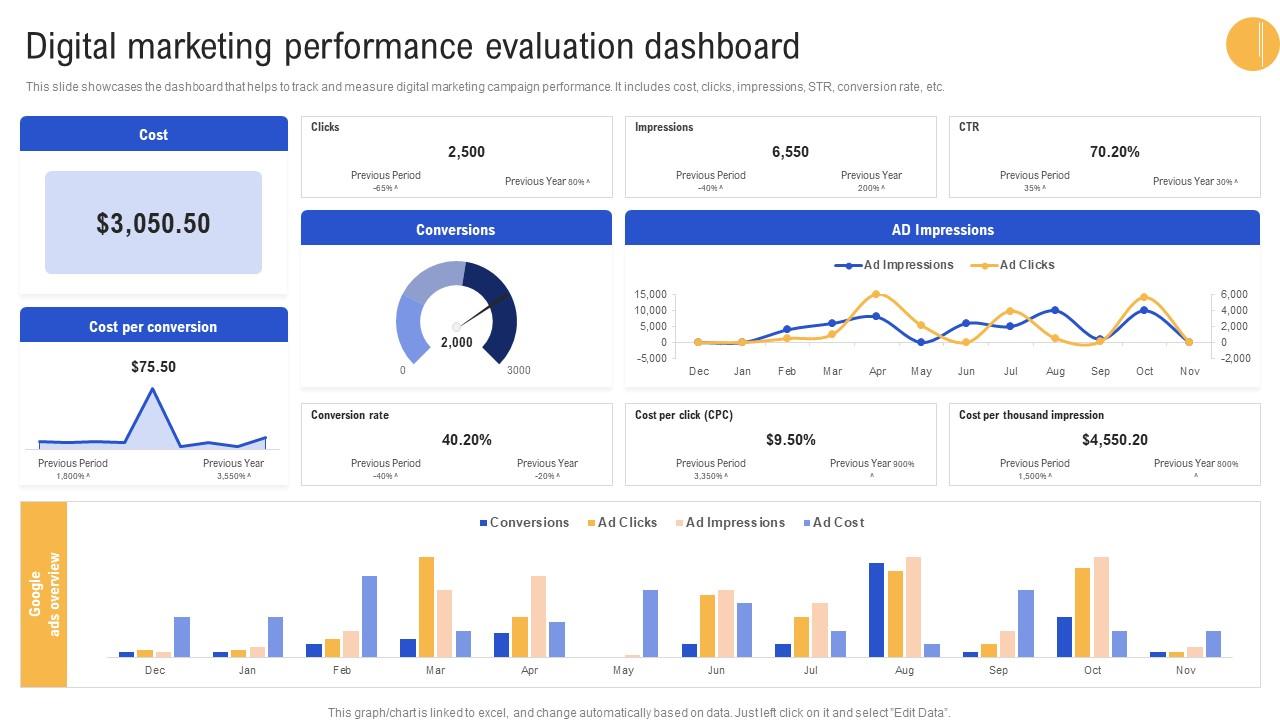
This slide showcases the dashboard that helps to track and measure digital marketing campaign performance. It includes cost, clicks, impressions, STR, conversion rate, etc.
People who downloaded this PowerPoint presentation also viewed the following :
Digital Marketing Performance Evaluation Dashboard Advertisement Campaigns To Acquire Mkt SS V with all 7 slides:
Use our Digital Marketing Performance Evaluation Dashboard Advertisement Campaigns To Acquire Mkt SS V to effectively help you save your valuable time. They are readymade to fit into any presentation structure.
FAQs for Digital Marketing Performance Evaluation Dashboard Advertisement Campaigns To Acquire
Key performance indicators for digital marketing effectiveness include conversion rates, customer acquisition cost, return on ad spend, engagement metrics, and lifetime customer value. These KPIs enable businesses to optimize campaign performance, allocate resources strategically, and measure ROI across channels, with many organizations finding that tracking these metrics together delivers comprehensive insights for data-driven marketing decisions.
A/B testing assesses digital marketing performance by comparing two campaign versions simultaneously, measuring metrics like click-through rates, conversion rates, engagement levels, and ROI across different audiences. Through systematic testing of headlines, visuals, and call-to-actions, marketers can optimize campaigns in real-time, ultimately delivering higher conversion rates and improved customer acquisition costs.
Customer feedback serves as a critical performance indicator for digital marketing strategies, providing insights into campaign effectiveness, audience sentiment, brand perception, and customer satisfaction levels. Through surveys, social media monitoring, and review analysis, businesses can identify which marketing messages resonate most effectively, optimize targeting strategies, and enhance customer experiences, ultimately delivering improved ROI and stronger competitive positioning in an increasingly data-driven marketplace.
Digital marketing ROI is measured by comparing revenue generated against marketing costs, tracking metrics like conversion rates, customer acquisition costs, and lifetime value across channels. Through analytics platforms, attribution modeling, and sales funnel analysis, businesses can assess campaign effectiveness, optimize budget allocation, and demonstrate measurable returns, with many organizations finding that comprehensive tracking ultimately delivers improved performance and strategic competitive advantage.
Google Analytics, SEMrush, HubSpot, Hootsuite, and Adobe Analytics are among the most effective tools for tracking digital marketing metrics. These platforms streamline performance evaluation by monitoring website traffic, social media engagement, and conversion rates, with many organizations finding that integrated dashboards ultimately deliver comprehensive insights and enhanced campaign optimization across multiple channels.
Social media engagement metrics correlate with digital marketing performance through tracking conversion rates, lead generation quality, and customer acquisition costs across platforms. By analyzing likes, shares, comments, and click-through rates alongside sales data, businesses can identify which content drives revenue, optimize budget allocation, and enhance targeting strategies, ultimately delivering measurable ROI improvements.
Best practices for analyzing website traffic and user behavior data include setting clear KPIs, segmenting audiences by demographics and behavior, tracking conversion funnels, monitoring bounce rates and session duration, and implementing heat mapping tools. These analytical approaches enhance decision-making by identifying high-performing content, optimizing user journeys, and personalizing experiences, with many e-commerce and service organizations finding that data-driven insights significantly improve conversion rates and customer retention.
Conversion rates improve through A/B testing different elements, optimizing landing pages based on user behavior data, refining targeting parameters, and adjusting messaging to match audience preferences identified in performance analysis. These strategic modifications enable businesses to streamline customer journeys, reduce friction points, and enhance user experiences, with many e-commerce and service companies finding significantly higher conversions and improved ROI.
Digital marketing performance evaluation significantly impacts budget allocation by identifying high-performing channels, audiences, and campaign elements that deliver optimal ROI. Through detailed analytics, organizations can reallocate resources from underperforming initiatives to proven strategies, with many companies finding that data-driven budget decisions enhance campaign effectiveness by 40-60% while minimizing wasted spending.
Email marketing performance can be evaluated through open rates, click-through rates, conversion rates, bounce rates, and unsubscribe metrics, alongside deliverability scores and engagement timing analysis. These metrics enable marketers to optimize subject lines, content personalization, and send frequency, with many e-commerce and SaaS companies finding that A/B testing combined with segmentation strategies ultimately delivers higher customer retention and revenue growth.
Tracking conversion funnels reveals exactly where potential customers drop off during their journey from awareness to purchase, enabling marketers to identify bottlenecks, optimize underperforming stages, and maximize ROI. Through funnel analysis, companies in e-commerce, SaaS, and financial services can strategically allocate resources to high-impact touchpoints, ultimately improving conversion rates and reducing customer acquisition costs.
Brand awareness and reach factors contribute to digital marketing evaluation by measuring campaign visibility, audience penetration, and market presence across channels. These metrics enable organizations to assess their message distribution effectiveness, track competitive positioning, and gauge customer recognition growth, with many retail and service companies finding that strong awareness correlates with increased conversions and sustained customer acquisition.
Measuring multichannel digital marketing performance presents attribution complexity, data silos across platforms, inconsistent tracking methodologies, customer journey fragmentation, and cross-device measurement difficulties. These challenges create incomplete performance pictures, with many organizations finding that unified analytics platforms and standardized KPIs ultimately deliver clearer ROI insights and more strategic campaign optimization.
Businesses can effectively set benchmarks by analyzing historical performance data, researching industry standards, establishing competitor baselines, and defining specific KPIs aligned with business objectives. Through comprehensive market research and performance tracking tools, organizations streamline goal-setting processes, enhance measurement accuracy, and deliver more strategic campaigns, with many companies finding that data-driven benchmarking ultimately enables competitive advantage and measurable ROI improvements.
When performance evaluation reveals underperforming digital channels, strategies include reallocating budget to high-performing channels, A/B testing creative elements, refining audience targeting, optimizing conversion funnels, and implementing cross-channel attribution models. These approaches enable organizations to enhance ROI by identifying specific bottlenecks, with many retailers and financial services finding that strategic reallocation and creative optimization ultimately deliver improved conversion rates and reduced customer acquisition costs.
-
Out of the box and creative design.
-
Easily Understandable slides.