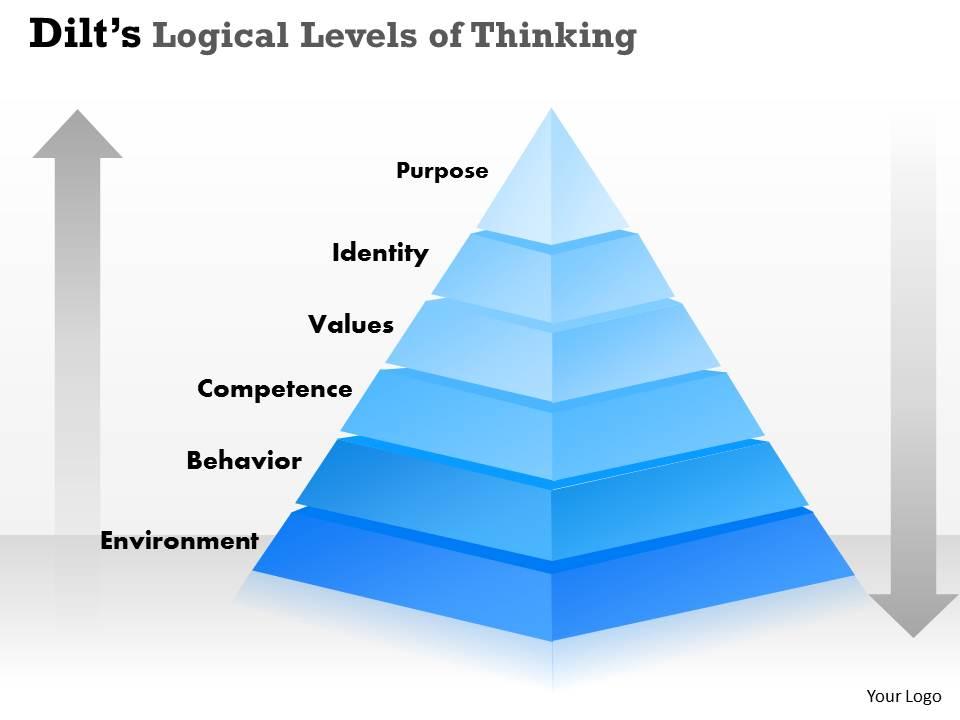
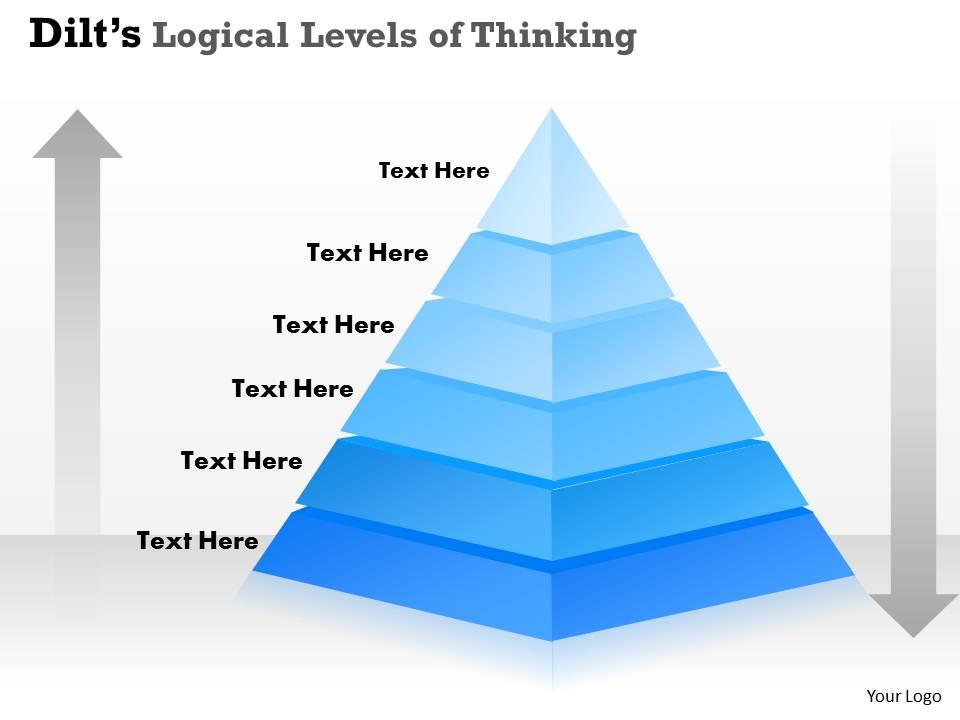
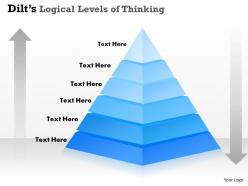
Dilts logical levels of thinking powerpoint template slide
Try Before you Buy Download Free Sample Product
Audience
Editable
of Time
Becalm nerves with our Dilts logical Levels Of Thinking PowerPoint Template Slide. Your Ideas will convert the excitement into positive output.
People who downloaded this PowerPoint presentation also viewed the following :
Dilts logical levels of thinking powerpoint template slide with all 6 slides:
Extract energy from our Dilts logical Levels Of Thinking PowerPoint Template Slide. Your ideas will get all activated.
FAQs for Dilts logical levels of thinking
Dilts' Logical Levels framework includes environment, behaviors, capabilities, beliefs and values, identity, and purpose, arranged hierarchically from concrete to abstract. These components enable organizations to systematically address change management by examining workplace conditions, employee actions, skill development, and cultural alignment, with many consulting firms finding that this structured approach delivers clearer strategic outcomes and enhanced organizational transformation.
Dilts' Logical Levels guide organizational change by addressing environment, behaviors, capabilities, beliefs, identity, and purpose in sequence, ensuring comprehensive transformation rather than surface-level adjustments. Organizations apply this framework by first establishing physical changes, then developing new skills and processes, reshaping cultural beliefs, redefining organizational identity, and ultimately aligning with higher mission, with many companies finding this systematic approach delivers sustainable change and enhanced employee engagement.
Each level addresses different aspects of growth, with environment shaping external conditions, behaviors developing practical skills, capabilities building core competencies, beliefs transforming mindsets, identity reshaping self-concept, and purpose connecting to deeper meaning. These levels create a comprehensive framework for development, with many organizations finding that addressing higher levels like beliefs and identity delivers more sustainable transformation than focusing solely on behavioral changes, ultimately enabling more profound personal and professional growth.
In Dilts' model, beliefs and values serve as the driving force behind behaviors, with beliefs determining what we think is possible and values establishing what we consider important or worthwhile. This hierarchical relationship means that when organizations align employee beliefs about company mission with core values, behaviors naturally shift toward desired outcomes, with many companies finding that addressing limiting beliefs at the values level creates more sustainable behavioral change than direct behavior modification alone.
Looking at a team missing deadlines, surface-level issues might include poor time management or unclear tasks, while deeper logical levels reveal problems like conflicting departmental values, lack of strategic alignment with company identity, or mismatched organizational purpose. Financial services firms, healthcare systems, and manufacturing companies increasingly use this framework to distinguish between operational fixes and fundamental cultural shifts, ultimately delivering more targeted interventions that address root causes rather than symptoms.
Coaches use Dilts' Logical Levels to facilitate breakthroughs by systematically exploring each level—environment, behavior, capabilities, beliefs, identity, and purpose—to identify where clients feel stuck and where transformation can occur. This structured approach enables coaches to guide clients from surface-level concerns to deeper identity and purpose work, ultimately delivering profound shifts in perspective and sustainable behavioral change.
Identity serves as the foundation for self-perception and personal values, directly influencing beliefs about capabilities, available strategies, and behavioral choices according to Dilts' model. When professionals have a strong identity as innovative leaders, they naturally adopt growth-oriented beliefs and strategic behaviors, with many organizations finding that identity-aligned employees demonstrate greater resilience, creativity, and performance outcomes.
Teams can utilize the Logical Levels framework to enhance collaboration by addressing alignment across environment, behaviors, capabilities, beliefs, identity, and purpose dimensions. By systematically examining each level, teams identify collaboration barriers, align shared values and goals, develop necessary skills, and create supportive structures, ultimately fostering deeper trust, clearer communication, and more effective teamwork across diverse organizational contexts.
Common pitfalls include oversimplifying complex issues into rigid hierarchies, skipping levels during analysis, and assuming changes must always flow top-down from identity to environment. Many organizations find that successful application requires flexibility, recognizing that levels interconnect dynamically, and that practical solutions often emerge from addressing multiple levels simultaneously rather than following a linear progression, ultimately delivering more sustainable organizational change.
Educators can implement Dilts Logical Levels by structuring lessons that address environment, behavior, capabilities, beliefs, identity, and purpose sequentially. Through classroom activities that connect learning objectives to students' values and self-concept, teachers enhance engagement and retention, with many educational institutions finding that this framework delivers deeper comprehension and sustained motivation.
Dilts Logical Levels aids conflict resolution by systematically addressing disputes at environment, behavior, capability, belief, identity, and purpose levels, helping identify root causes rather than surface symptoms. Through this structured approach, mediators and organizations can resolve workplace tensions, team disagreements, and organizational conflicts more effectively, ultimately delivering sustainable solutions and improved collaboration.
Tools complementing Dilts' Logical Levels include systems thinking frameworks, coaching questioning techniques, organizational assessment surveys, change management methodologies, and neuro-linguistic programming interventions. These approaches enhance the model's effectiveness by providing structured data gathering, stakeholder engagement protocols, and implementation pathways, with many organizations finding that combining multiple diagnostic tools delivers deeper insights and more sustainable transformation outcomes.
Cultural applications of Dilts Logical Levels vary significantly, with collectivist societies emphasizing identity and purpose alignment with group values, while individualistic cultures focus more on personal beliefs and capabilities development. Organizations in hierarchical contexts like Asia often start with environment and behavior changes before addressing deeper levels, whereas Western implementations frequently begin with identity and values work, ultimately requiring cultural adaptation to deliver meaningful transformation and sustainable change across diverse global contexts.
Dilts' framework offers insights for developing leadership skills by addressing identity, beliefs, capabilities, behaviors, and environmental factors systematically. Through this multi-level approach, leaders can enhance self-awareness, align personal values with organizational goals, and develop strategic thinking capabilities, while many organizations finding that leaders trained in this framework demonstrate improved decision-making, team engagement, and transformational leadership effectiveness.
Logical Levels enhance goal-setting and strategic planning by aligning environment, behaviors, capabilities, beliefs, identity, and purpose into a coherent framework. This systematic approach enables organizations to identify gaps between current and desired states, develop comprehensive strategies that address multiple organizational layers, and ensure strategic initiatives resonate with core values and mission, ultimately delivering more sustainable outcomes and stronger stakeholder commitment.
-
Nice and innovative design.
-
Wonderful templates design to use in business meetings.