


Effective qa transformation strategies to improve product quality powerpoint presentation slides





Try Before you Buy Download Free Sample Product
 Impress Your
 Audience
 100%
100% Editable
 Save Hours
 of Time


QA transformation builds a gradual approach to measuring, managing, and integrating processes to consistently deliver financial and timely benefits to the company. Here is a competently designed Effective QA Transformation Strategies to Improve Product Quality that implements various techniques to improve product efficiency. The factors that are affected by poor implementation of QA Transformation Techniques are High Active Defect Rate, fall in the Product Quality, increase in Product Delivery Time, decrease in overall Team Effectiveness, etc. Hence the company must adopt specific testing techniques to improve the product quality leading to effective QA Transformation. This proposal provides information on Information Technology company overview, need for QA transformation in the company, QA key performance indicators, QA team structure, the importance of QA Transformation and testing, strategies and approaches to improve QA Transformation, performance metrics, benefits of Software Testing, testing tools for Effective QA Transformation, recommendations for QA Transformation, outcomes of successful Transformation, estimated future results and performance after Strategy Implementation, the cost involved in Transformation Process, dashboard analysis, etc. Get access now.
People who downloaded this PowerPoint presentation also viewed the following :
Content of this Powerpoint Presentation
Slide 1: This slide introduces Effective QA Transformation Strategies to Improve Product Quality. State Your Company Name and begin.
Slide 2: This is an Agenda slide. State your agendas here.
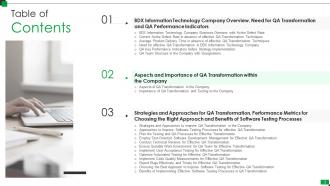
Slide 3: This slide presents Table of Content for the presentation.
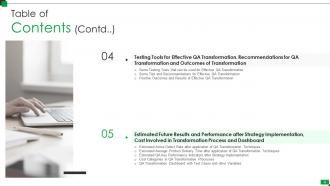
Slide 4: This is another slide continuing Table of Content for the presentation.
Slide 5: This slide shows title for topics that are to be covered next in the template.
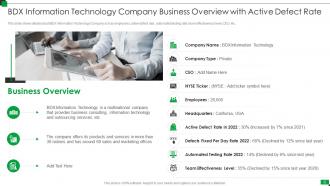
Slide 6: This slide shows details about BDX Information Technology Company such as employees, active defect rate, etc.
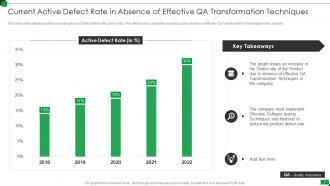
Slide 7: This slide shows details about the increasing Product Defect Rate in the past 5 years.
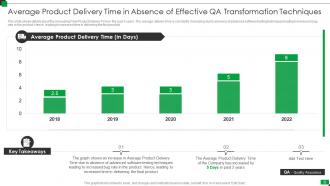
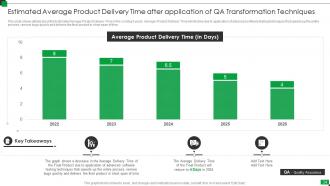
Slide 8: This slide shows details about the increasing Final Product Delivery Time in the past 5 years.
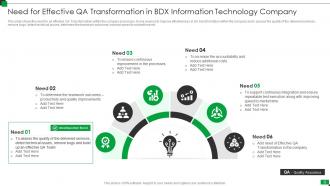
Slide 9: This slide shows the need for an effective QA Transformation within the company processes.
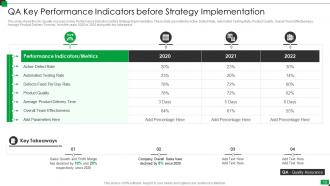
Slide 10: This slide shows the QA (Quality Assurance) Key Performance Indicators before Strategy Implementation.
Slide 11: This slide show the various members of the QA Team structure along with their designations.
Slide 12: This slide displays title for 'Aspects & importance of QA transformation'.
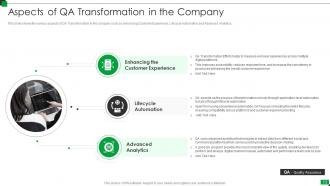
Slide 13: This slide shows the various aspects of QA Transformation in the company.
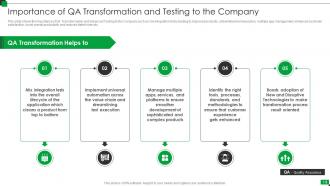
Slide 14: This slide shows the Importance of QA Transformation and Advanced Testing to the Company.
Slide 15: This slide presents title for 'Strategies & approaches, performance metrics & benefits of software testing processes'.
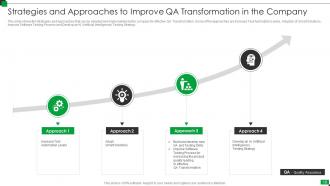
Slide 16: This slide shows the Strategies and Approaches that can be adopted and implemented by the company for effective QA Transformation.
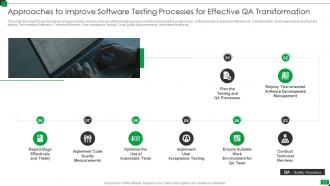
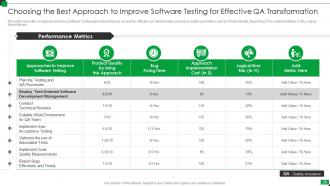
Slide 17: This slide discusses the best practices and approaches of how to improve software testing process and for increasing the quality of your software products.
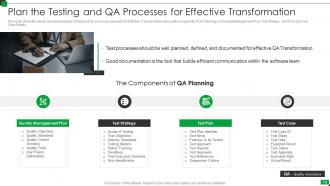
Slide 18: This slide shows the details about planning the Testing and QA processes approach for Effective Transformation.
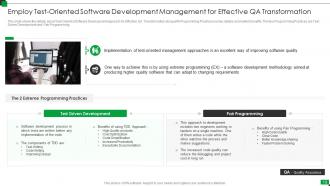
Slide 19: This slide shows the details about Test-Oriented Software Development Approach for Effective QA Transformation.
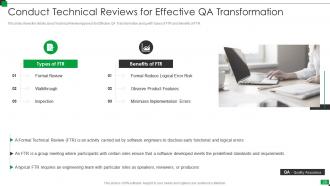
Slide 20: This slide shows the details about Technical Review Approach for Effective QA Transformation along with Types of FTR and Benefits of FTR.
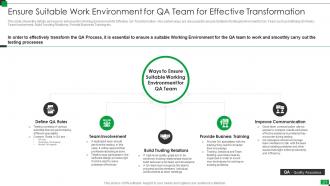
Slide 21: This slide shows the details and ways to enhance the Working Environment for Effective QA Transformation.
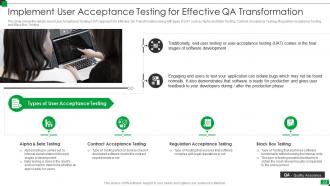
Slide 22: This slide shows the details about User Acceptance Testing (UAT) Approach for Effective QA Transformation.
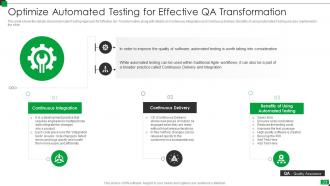
Slide 23: This slide shows the details about Automated Testing Approach for Effective QA Transformation.
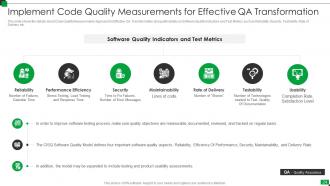
Slide 24: This slide shows the details about Code Quality Measurements Approach for Effective QA Transformation.
Slide 25: This slide shows the details about Timely Bug Reporting Approach for Effective QA Transformation.
Slide 26: This slide shows the comparison of various Software Testing Approaches that can be used for effective QA transformation.
Slide 27: This slide shows the comparison of various Software Testing Approaches that can be used for effective QA transformation.
Slide 28: This slide exhibits title for 'Testing tools, recommendations & outcomes of transformation'.
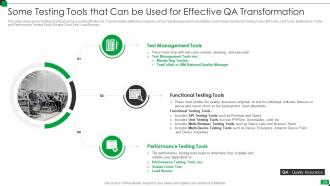
Slide 29: This slide shows some Testing Tools that can be used for Effective QA Transformation within the company.
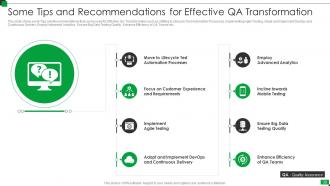
Slide 30: This slide shows some Tips and Recommendations that can be used for Effective QA Transformation.
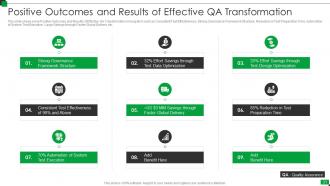
Slide 31: This slide shows some Positive Outcomes and Results of Effective QA Transformation in long term.
Slide 32: This slide depicts title for 'Estimated future results, cost involved & dashboard'.
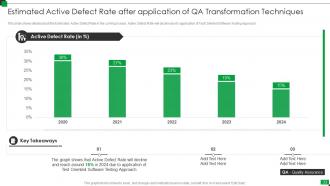
Slide 33: This slide shows details about the Estimated Active Defect Rate in the coming 5 years.
Slide 34: This slide shows details about the Estimated Average Product Delivery Time in the coming 5 years.
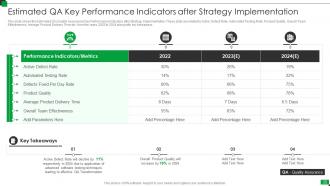
Slide 35: This slide shows the Estimated QA (Quality Assurance) Key Performance Indicators after Strategy Implementation.
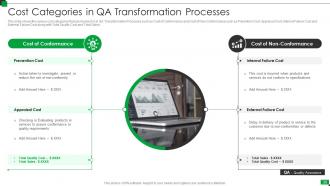
Slide 36: This slide shows the various cost categories that are involved in in QA Transformation Processes.
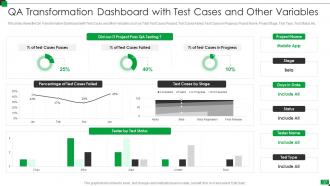
Slide 37: This slide shows the QA Transformation Dashboard with Test Cases and other Variables.
Slide 38: This slide showcases Icons for Effective QA Transformation Strategies TP Improve Product Quality.
Slide 39: This slide is titled as Additional Slides for moving forward.
Slide 40: This is Our Mission slide with related imagery and text.
Slide 41: This is About Us slide to show company specifications etc.
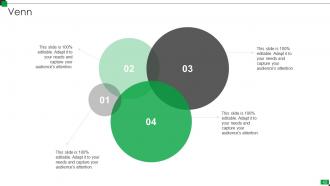
Slide 42: This slide depicts Venn diagram with text boxes.
Slide 43: This slide shows Post It Notes. Post your important notes here.
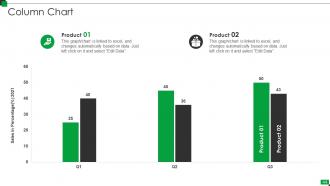
Slide 44: This slide displays Column chart with two products comparison.
Slide 45: This is a Timeline slide. Show data related to time intervals here.
Slide 46: This slide shows Circular Diagram with additional textboxes.
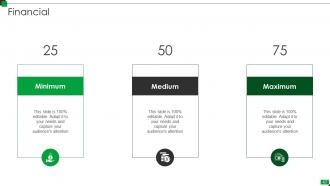
Slide 47: This is a Financial slide. Show your finance related stuff here.
Slide 48: This is a Thank You slide with address, contact numbers and email address.
Effective qa transformation strategies to improve product quality powerpoint presentation slides with all 53 slides:
Use our Effective QA Transformation Strategies To Improve Product Quality Powerpoint Presentation Slides to effectively help you save your valuable time. They are readymade to fit into any presentation structure.

















FAQs for Effective qa transformation strategies to improve product quality
Key components of an effective QA transformation strategy include test automation frameworks, continuous integration pipelines, risk-based testing approaches, cross-functional collaboration models, and performance monitoring systems. These elements work together by streamlining testing cycles, reducing manual effort, and enhancing defect detection, with many organizations finding that strategic QA transformation ultimately delivers faster releases and improved customer experiences.
Automation can be integrated into existing QA processes through test script automation, continuous integration pipelines, automated regression testing, and AI-powered defect detection tools. These technologies streamline workflows by reducing manual testing time, enabling faster release cycles, and improving test coverage accuracy, with many software development teams finding that strategic automation delivers significantly enhanced efficiency and competitive advantage in increasingly rapid deployment environments.
Continuous testing accelerates feedback loops, enables early defect detection, and integrates quality assurance throughout the development lifecycle, reducing costs and time-to-market significantly. Through automated testing frameworks, organizations streamline validation processes, enhance software reliability, and support agile methodologies, with many enterprises finding that continuous testing ultimately delivers faster releases and improved customer satisfaction.
Organizations can measure QA transformation success through key metrics like defect reduction rates, faster release cycles, improved test coverage, cost per defect, and customer satisfaction scores. These measurements enable businesses to track operational efficiency gains, with many companies finding that comprehensive QA transformations deliver 40-60% faster deployment times and significantly enhanced product quality, ultimately strengthening competitive advantage.
Common QA transformation challenges include resistance to change, skill gaps, tool integration complexities, budget constraints, and timeline pressures. These obstacles can be overcome through comprehensive change management programs, targeted training initiatives, phased implementation approaches, and strong leadership support, with many organizations finding that investing in upfront planning and stakeholder engagement ultimately delivers smoother transitions and sustainable quality improvements.
Team training and development is crucial in QA transformation strategies, serving as the foundation for adopting new methodologies, tools, automation frameworks, and quality standards effectively. Through comprehensive upskilling programs, organizations enhance testing capabilities, reduce defect rates, and accelerate delivery cycles, with many companies finding that well-trained QA teams deliver significantly improved software quality and competitive advantage.
Essential QA modernization tools include test automation frameworks, AI-powered testing platforms, continuous integration pipelines, cloud-based testing environments, and performance monitoring solutions. These technologies streamline testing processes by accelerating test execution, enhancing defect detection, and enabling seamless DevOps integration, with many organizations finding that strategic automation ultimately delivers faster releases and improved software quality.
Shift-left testing accelerates QA transformation by identifying defects earlier in development cycles, reducing fixing costs, and enabling faster feedback loops between development and testing teams. This approach streamlines release schedules, enhances code quality through automated testing integration, and ultimately delivers more reliable software products, with many organizations finding that early defect detection significantly improves overall development efficiency.
DevOps QA implementation requires establishing continuous integration pipelines, automated testing frameworks, collaborative cross-functional teams, infrastructure as code practices, and comprehensive monitoring systems. These approaches streamline development cycles by enabling faster feedback loops, reducing manual testing bottlenecks, and enhancing deployment reliability, with many organizations finding that strategic automation ultimately delivers significantly improved software quality and accelerated time-to-market advantages.
Stakeholder collaboration enhances QA transformation outcomes by aligning testing objectives with business goals, ensuring comprehensive requirement gathering, and facilitating cross-functional knowledge sharing throughout development cycles. Through regular communication between QA teams, developers, product managers, and business users, organizations streamline defect resolution, accelerate delivery timelines, and ultimately deliver higher-quality products that meet customer expectations.
**OUTPUT**: Critical QA transformation metrics include defect detection rates, time-to-market acceleration, test automation coverage, customer satisfaction scores, and cost per defect resolution. These measurements enable organizations to quantify improvements in software quality, development velocity, and operational efficiency, with many technology companies finding that comprehensive metric tracking delivers up to 40% faster release cycles and significantly enhanced product reliability.
Organizations can balance QA and speed to market by implementing automated testing frameworks, adopting agile methodologies, establishing risk-based testing priorities, and creating cross-functional teams that integrate quality throughout development cycles. Through strategic automation and continuous integration practices, companies streamline testing processes while maintaining rigorous standards, with many finding that this approach reduces time-to-market by 40% while enhancing product reliability and customer satisfaction.
Cultural shifts necessary for successful QA transformation include embracing collaborative testing mindsets, adopting continuous learning approaches, accepting shared quality ownership, implementing transparent communication practices, and fostering innovation-driven experimentation. These transformations enable teams to transition from reactive bug-finding to proactive quality assurance, with many organizations finding that cross-functional collaboration and data-driven decision making ultimately deliver faster releases and enhanced product reliability.
Performance testing integrates into QA transformation through automated load testing, continuous monitoring, shift-left practices, cloud-based scalability testing, and real-time performance analytics. These strategies streamline quality assurance by identifying bottlenecks early, enabling faster release cycles, and delivering seamless user experiences, with many organizations finding that proactive performance validation ultimately reduces costs while enhancing competitive advantage.
Emerging QA trends include AI-powered test automation, shift-left testing, continuous integration practices, cloud-based testing platforms, and API-first validation approaches. These technologies streamline quality assurance by reducing manual testing overhead, accelerating release cycles, and enhancing defect detection accuracy, with many organizations finding that strategic QA transformation delivers faster deployment timelines and significantly improved software reliability.
-
Great product with effective design. Helped a lot in our corporate presentations. Easy to edit and stunning visuals.
-
I discovered this website through a google search, the services matched my needs perfectly and the pricing was very reasonable. I was thrilled with the product and the customer service. I will definitely use their slides again for my presentations and recommend them to other colleagues.