


Elements Of Reinforcement Learning Powerpoint Presentation Slides
The Reinforcement Learning Provider Company is a leading firm known for its accurate algorithms in predicting a companys debt repayment capacity, dilution likelihood, and default risk. Our Elements of Reinforcement Learning PowerPoint presentation provides a comprehensive overview of this company, highlighting the reasons to choose their services and introducing the concept of reinforcement learning. The presentation covers key elements of RL, including policy, reward signal, value function, and model. It delves into the workings of reinforcement learning, explaining its workflow, approaches, and learning models such as the Markov Decision Process, Q-Learning, and SARSA. The deck also showcases real-world examples of RL applications in various industries, including gaming, marketing, image processing, robotics, healthcare, broadcast journalism, and manufacturing. Additionally, it explores the relationship between reinforcement learning and other machine learning approaches such as supervised, unsupervised, and deep learning. The presentation concludes with information about the companys training program, pricing details, timeline, and a performance tracking dashboard for reinforcement learning models. Access this insightful resource now and unlock the potential of reinforcement learning for your business.





































You must be logged in to download this presentation.


Do you want to remove this product from your favourites?
 Impress your
 audience
 100%
100% Editable
 Save Hours
 of Time
PowerPoint presentation slides
Deliver this complete deck to your team members and other collaborators. Encompassed with stylized slides presenting various concepts, this Elements Of Reinforcement Learning Powerpoint Presentation Slides is the best tool you can utilize. Personalize its content and graphics to make it unique and thought-provoking. All the sixty six slides are editable and modifiable, so feel free to adjust them to your business setting. The font, color, and other components also come in an editable format making this PPT design the best choice for your next presentation. So, download now.

People who downloaded this PowerPoint presentation also viewed the following :
Content of this Powerpoint Presentation
Slide 1: This slide introduces Elements of Reinforcement Learning. Commence by stating Your Company Name.
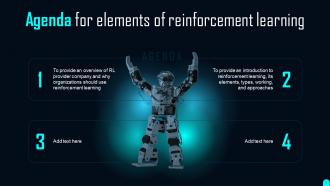
Slide 2: This slide depicts the Agenda of the presentation.
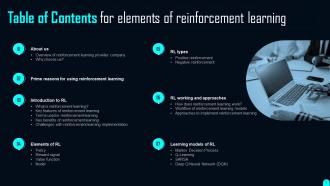
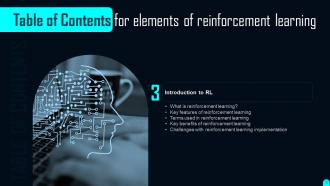
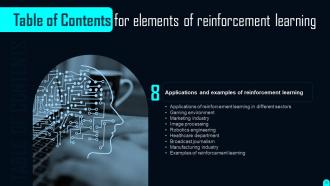
Slide 3: This slide reveals the Table of contents.
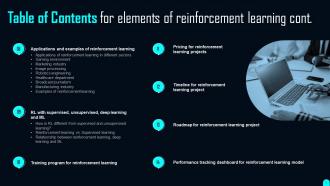
Slide 4: This is yet another slide continuing the Table of contents.
Slide 5: This slide includes the Title for the Topics to be covered in the next template.
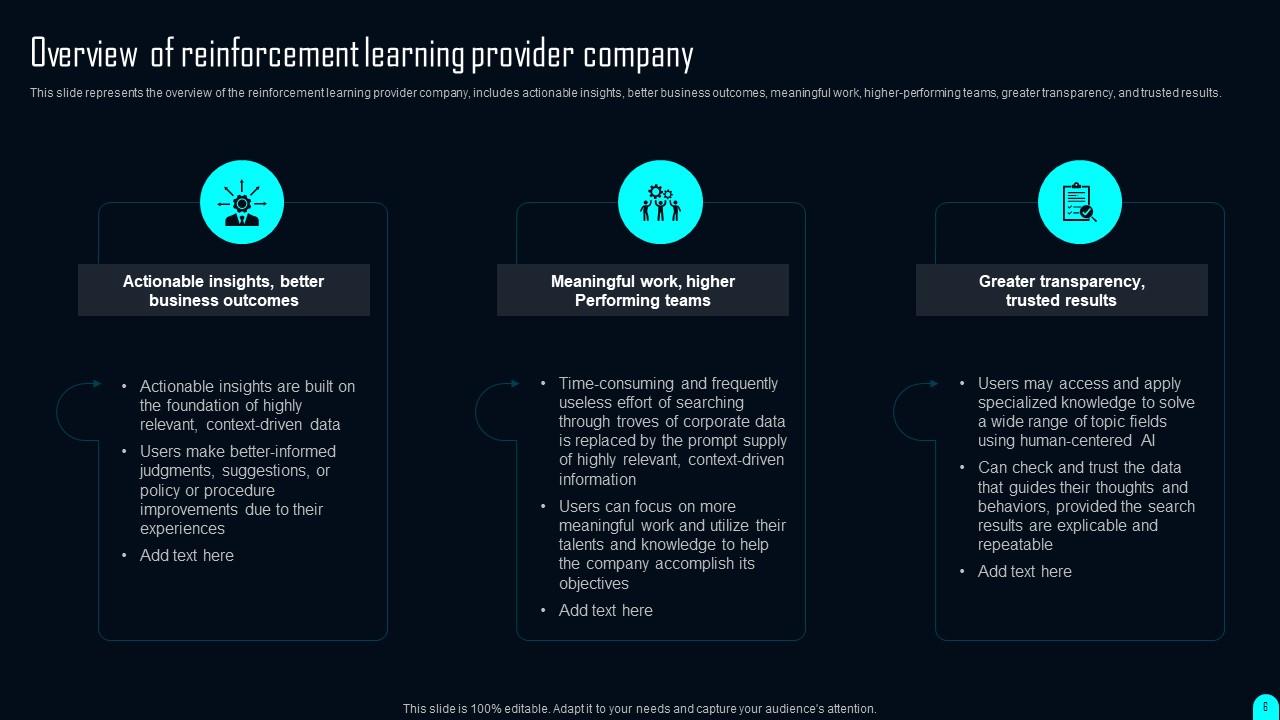
Slide 6: This slide represents the overview of the reinforcement learning provider company.
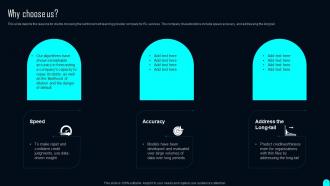
Slide 7: This slide depicts the reasons for clients choosing the reinforcement learning provider company for RL services.
Slide 8: This slide highlights the Heading for the Contents to be covered next.
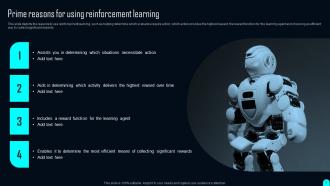
Slide 9: This slide states the prime reasons to use reinforcement learning.
Slide 10: This slide potrays the Title for the Ideas to be discussed further.
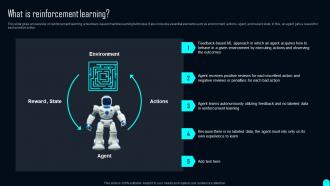
Slide 11: This slide gives an overview of reinforcement learning, a feedback-based machine learning technique.
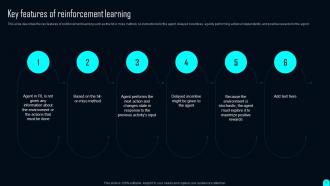
Slide 12: This slide describes the key features of reinforcement learning such as the hit or miss method, delayed incentives, etc.
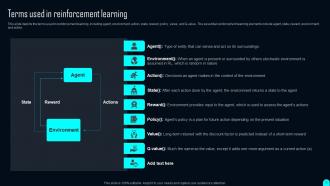
Slide 13: This slide depicts the terms used in reinforcement learning, including agent, environment, etc.
Slide 14: This slide presents the Key benefits of reinforcement learning that applies to complex problems.
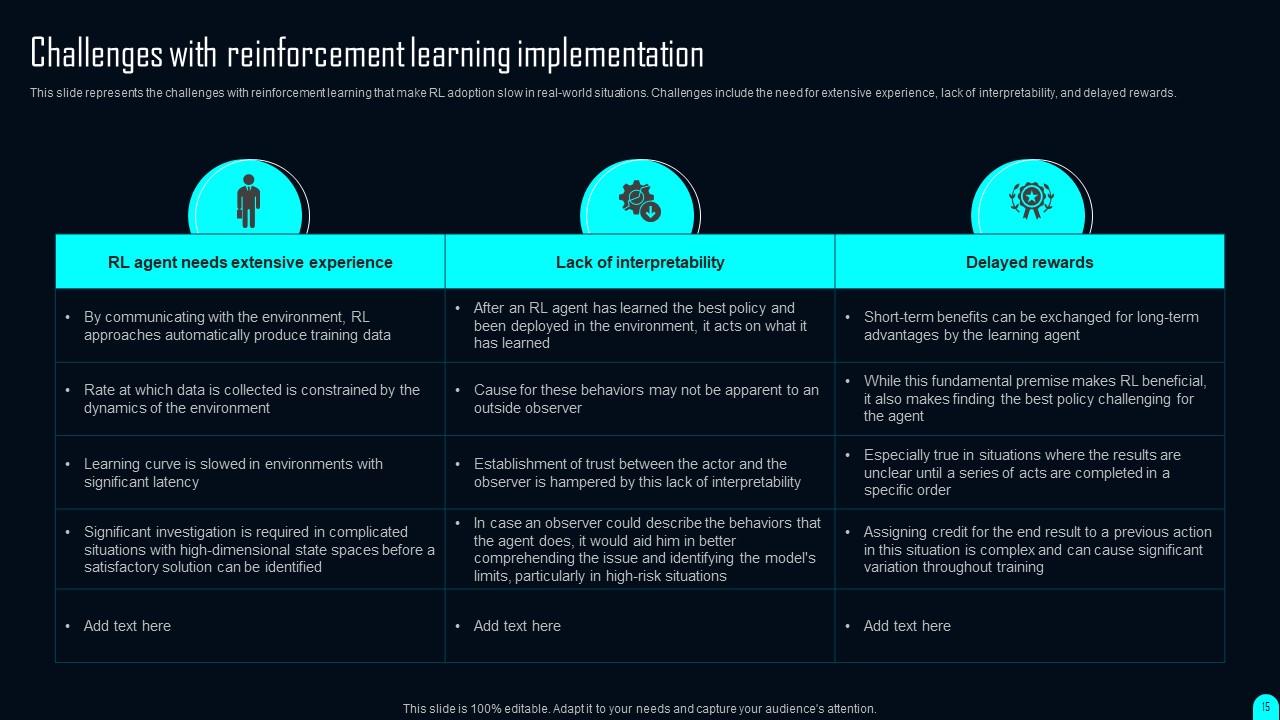
Slide 15: This slide represents the challenges with reinforcement learning that make RL adoption slow in real-world situations.
Slide 16: This slide incorporates the Heading for the Topics to be covered next.
Slide 17: This slide represents an overview of the policy element of reinforcement learning, which defines the behavior of the agent.
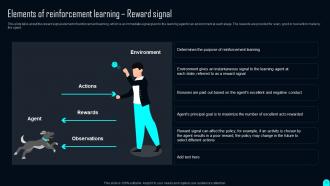
Slide 18: This slide talks about the reward signal element of reinforcement learning.
Slide 19: This slide outlines another element of reinforcement learning which is value function.
Slide 20: This slide shows the model element of reinforcement learning.
Slide 21: This slide exhibits the Title for the Topics to be covered further.
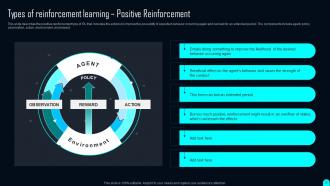
Slide 22: This slide describes the positive reinforcement type of Reinforcement Learning.
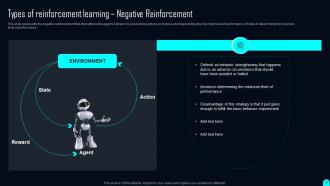
Slide 23: This slide represents the negative reinforcement that strengthens the agent's behavior to avoid wrong actions.
Slide 24: This slide exhibits the Heading for the Contents to be discussed further.
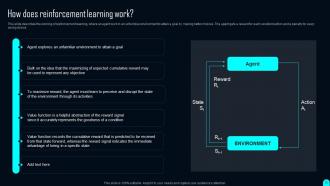
Slide 25: This slide deals with the working of reinforcement learning, where an agent work in an unfamiliar environment to attain a goal by making better choices.
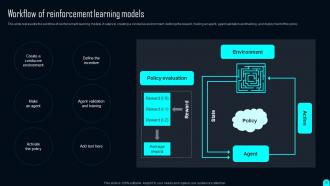
Slide 26: This slide presents the workflow of reinforcement learning models.
Slide 27: This slide talks about the three approaches to implement reinforcement learning in real-world situations.
Slide 28: This slide incorporates the Title for the Topics to be covered further.
Slide 29: This slide represents the Markov decision process model of reinforcement learning.
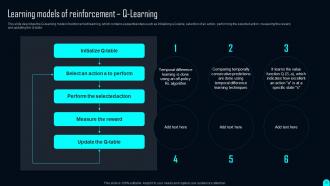
Slide 30: This slide describes the Q-learning model of reinforcement learning, which contains numerous sequential steps.
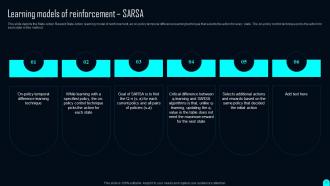
Slide 31: This slide depicts the State Action Reward State Action learning model of reinforcement.
Slide 32: This slide represents the deep Q neural network model of reinforcement learning that is helpful in a large space environment to define a table.
Slide 33: This slide contains the Heading for the Contents to be discussed further.
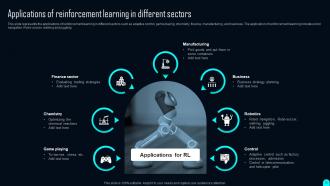
Slide 34: This slide reveals the applications of reinforcement learning in different sectors.
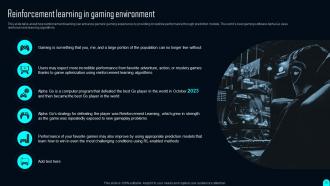
Slide 35: This slide talks about how reinforcement learning can enhance gamers' gaming experience by providing incredible performance through prediction models.
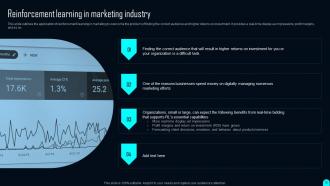
Slide 36: This slide outlines the application of reinforcement learning in marketing to overcome the problem of finding the correct audience and higher returns on investment.
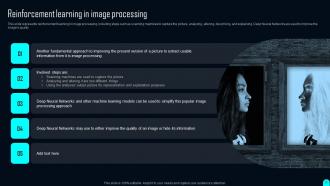
Slide 37: This slide represents reinforcement learning in image processing, including various steps.
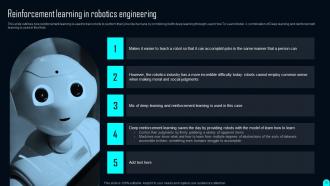
Slide 38: This slide outlines how reinforcement learning is used to train robots to perform their jobs like humans.
Slide 39: This slide displays the application of reinforcement learning in healthcare department.
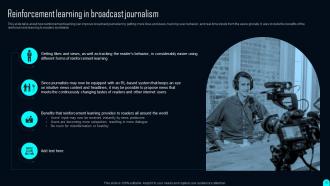
Slide 40: This slide talks about how reinforcement learning can improve broadcast journalism.
Slide 41: This slide describes the application of reinforcement learning in the manufacturing field.
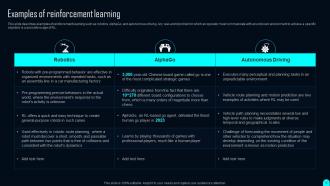
Slide 42: This slide describes examples of reinforcement learning such as robotics, AlphaGo, and autonomous driving.
Slide 43: This slide includes the Title for the Topics to be covered further.
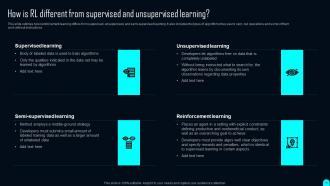
Slide 44: This slide outlines how reinforcement learning differs from supervised, unsupervised, and semi-supervised learning.
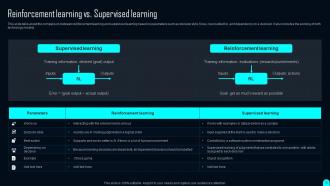
Slide 45: This slide talks about the comparison between reinforcement learning and supervised learning based on various parameters.
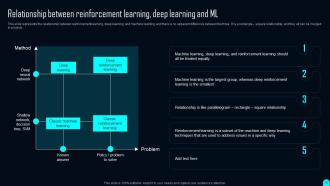
Slide 46: This slide represents the relationship between reinforcement learning, deep learning, and machine learning, and states no apparent difference between the three.
Slide 47: This slide covers the Heading for the Contents to be discussed further.
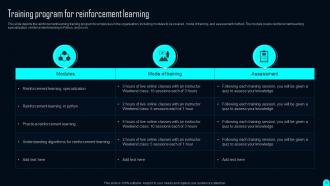
Slide 48: This slide depicts the reinforcement learning training program for employees in the organization.
Slide 49: This slide elucidates the Title for the Ideas to be discussed in the next template.
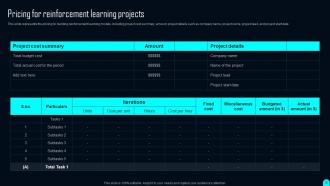
Slide 50: This slide represents the pricing for building reinforcement learning models.
Slide 51: This slide contains the Title for the Topics to be discussed further.
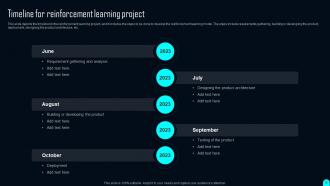
Slide 52: This slide depicts the timeline for the reinforcement learning project.
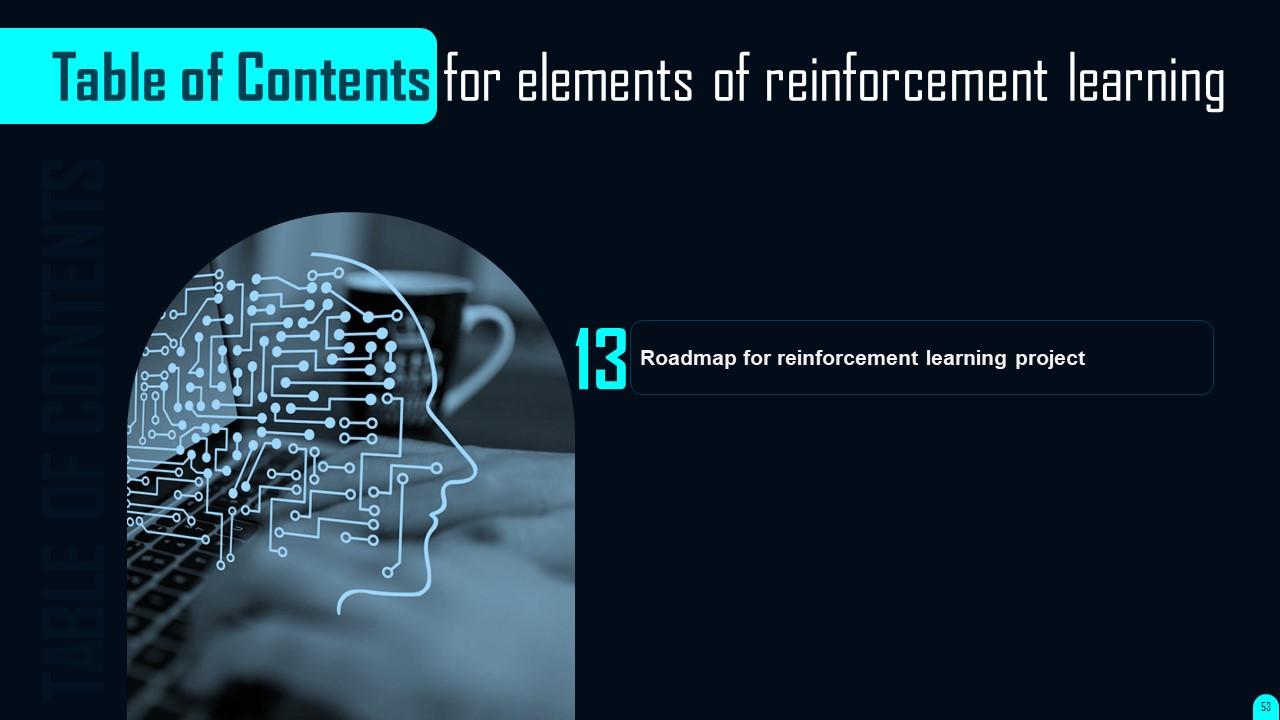
Slide 53: This slide exhibits the Title for the Contenst to be covered further.
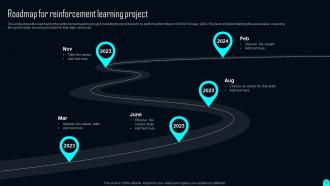
Slide 54: This slide illustrates the roadmap for the reinforcement learning project.
Slide 55: This slide includes the Title for the Topics to be covered next.
Slide 56: This slide represents the performance tracking dashboard for the reinforcement learning model based on different time frames and categories.
Slide 57: This is the Icons slide reinforcement learning containing all the Icons used in the plan.
Slide 58: This slide reveals the Additional Company information.
Slide 59: This is Our mission slide. State your Organization's mission in this one.
Slide 60: This is About us slide depicting the Organization's information.
Slide 61: This slide exhibits the 30 60 90 days plan for efficient planning.
Slide 62: This slde shows the Magnifying glass for minute details.
Slide 63: This is the Venn Diagram slide for relevant Company information.
Slide 64: This slide includes the Important notes for reminders and deadlines.
Slide 65: This is the Puzzle slide with related imagery.
Slide 66: This is the Thank you slide for acknowledgemnt.
Elements Of Reinforcement Learning Powerpoint Presentation Slides with all 71 slides:
Use our Elements Of Reinforcement Learning Powerpoint Presentation Slides to effectively help you save your valuable time. They are readymade to fit into any presentation structure.
-
This visual representation is stunning and easy to understand. I like how organized it is and informative it is.
-
Best Representation of topics, really appreciable.
