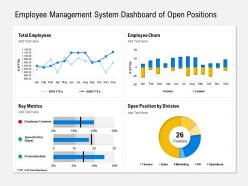
Employee management system dashboard of open positions
Try Before you Buy Download Free Sample Product
Audience
Editable
of Time
Our Employee Management System Dashboard Of Open Positions are topically designed to provide an attractive backdrop to any subject. Use them to look like a presentation pro.
People who downloaded this PowerPoint presentation also viewed the following :
Employee management system dashboard of open positions with all 2 slides:
Use our Employee Management System Dashboard Of Open Positions to effectively help you save your valuable time. They are readymade to fit into any presentation structure.
FAQs for Employee management system dashboard
Key features include payroll processing, time and attendance tracking, performance management, benefits administration, and employee self-service portals. These systems streamline HR operations by automating routine tasks, centralizing employee data, and enhancing communication workflows, with many organizations finding that comprehensive platforms ultimately deliver improved operational efficiency and better employee experiences across departments.
An employee management system enhances productivity and engagement by streamlining administrative tasks, automating performance tracking, facilitating clear communication channels, and providing real-time feedback mechanisms. These systems enable managers to identify skill gaps, recognize achievements promptly, and optimize resource allocation, while employees benefit from transparent goal-setting and career development pathways, ultimately delivering improved job satisfaction and operational efficiency.
An employee management system streamlines recruitment by automating job postings across multiple platforms, centralizing candidate applications, enabling automated resume screening, and facilitating collaborative hiring workflows. These technologies enhance efficiency by reducing manual administrative tasks, accelerating candidate evaluation processes, and improving communication between hiring teams, ultimately delivering faster time-to-hire and better candidate experiences.
Data security significantly enhances employee management system effectiveness by protecting sensitive personal information, ensuring regulatory compliance, and maintaining employee trust through encrypted data storage and access controls. Strong security measures enable organizations to confidently digitize HR processes, streamline payroll and benefits administration, and facilitate remote workforce management, ultimately delivering operational efficiency while safeguarding against costly data breaches.
Mobile accessibility significantly enhances employee management system usability by enabling real-time access to HR functions, streamlining communication between remote teams, and facilitating instant updates to personal information and schedules. With mobile-optimized platforms, organizations experience improved employee engagement, faster approval processes, and reduced administrative bottlenecks, ultimately delivering enhanced operational efficiency and better workforce satisfaction across distributed teams.
Integrations with payroll and benefits management streamline HR operations by automating data synchronization, reducing manual entry errors, and ensuring compliance with tax regulations and benefit requirements. These connections enable real-time updates across systems, faster payroll processing, and seamless benefits enrollment, ultimately delivering operational efficiency and enhanced employee experiences while minimizing administrative overhead.
Businesses should track employee satisfaction scores, turnover rates, time-to-hire, performance review completion rates, and absenteeism patterns to measure system effectiveness. These metrics enable organizations to identify operational inefficiencies, streamline HR processes, and enhance workforce productivity, with many companies finding that comprehensive tracking ultimately delivers improved employee retention and reduced administrative costs.
Employee management systems streamline performance reviews by automating review cycles, centralizing feedback collection, tracking goal progress, and generating comprehensive performance reports. These platforms enable managers to provide continuous feedback, set measurable objectives, and identify development opportunities, while employees gain transparency into their progress, ultimately enhancing organizational productivity and retention.
Automation streamlines routine HR tasks like payroll processing, attendance tracking, leave management, performance evaluations, and compliance reporting within employee management systems. Through intelligent workflows, organizations reduce manual errors, accelerate processing times, and free HR professionals to focus on strategic initiatives, ultimately delivering enhanced operational efficiency and improved employee experiences across all organizational levels.
An employee management system supports labor law compliance by automating time tracking, maintaining comprehensive employment records, generating regulatory reports, and monitoring wage and hour requirements. Through centralized documentation and automated alerts, organizations streamline audit processes, reduce legal risks, and ensure consistent policy enforcement across departments, ultimately delivering greater operational transparency and regulatory confidence.
Potential challenges include data migration complexities, employee resistance to new processes, integration difficulties with existing HR systems, training requirements, and ensuring data security compliance. While these obstacles can initially slow adoption, organizations that address them through phased implementation, comprehensive training, and strong change management ultimately streamline operations, enhance productivity, and gain competitive advantage in talent management.
Employee self-service features benefit employees by enabling direct access to payroll information, benefits enrollment, time-off requests, and personal data updates, while reducing dependency on HR for routine inquiries. These capabilities streamline HR operations by automating administrative tasks, minimizing paperwork, and freeing teams to focus on strategic initiatives, ultimately delivering faster service resolution and enhanced operational efficiency across organizations.
Customization options in employee management systems cater to diverse business needs by allowing flexible workflows, configurable reporting structures, and adaptable user permissions that align with specific organizational hierarchies and processes. These systems enable companies across retail, healthcare, and manufacturing sectors to tailor performance metrics, approval chains, and data fields to their unique requirements, ultimately delivering enhanced operational efficiency and seamless integration with existing business frameworks.
Employee training modules within an employee management system streamline learning delivery, track progress, ensure compliance, and identify skill gaps across the organization. These integrated systems enable HR teams to automate course assignments, monitor completion rates, and generate compliance reports, while employees access personalized learning paths, ultimately enhancing workforce capabilities and reducing administrative overhead.
Analytics and reporting features transform raw employee data into actionable insights by tracking performance metrics, identifying workforce trends, and revealing operational patterns that inform strategic planning. Through comprehensive dashboards and predictive analytics, organizations streamline resource allocation, enhance talent retention strategies, and optimize workforce productivity, ultimately delivering competitive advantage in increasingly dynamic business environments.
-
Very well designed and informative templates.
-
I discovered this website through a google search, the services matched my needs perfectly and the pricing was very reasonable. I was thrilled with the product and the customer service. I will definitely use their slides again for my presentations and recommend them to other colleagues.