Employee Performance KPI Tracker For 360 Degree Appraisal
Try Before you Buy Download Free Sample Product
Audience
Editable
of Time
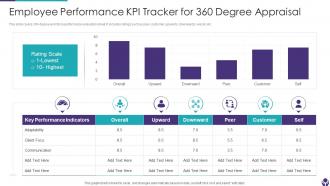
This slide covers 360 degree workforce performance evaluation sheet. It includes ratings such as peer, customer, upwards, downwards, overall, etc.
People who downloaded this PowerPoint presentation also viewed the following :
Employee Performance KPI Tracker For 360 Degree Appraisal with all 7 slides:
Use our Employee Performance KPI Tracker For 360 Degree Appraisal to effectively help you save your valuable time. They are readymade to fit into any presentation structure.
FAQs for Employee Performance KPI Tracker For
Key performance indicators for employee performance include productivity metrics, quality scores, goal achievement rates, attendance records, and customer satisfaction ratings. These KPIs enable organizations to streamline performance evaluations, enhance workforce development, and deliver strategic insights, with many companies finding that combining quantitative metrics with qualitative assessments ultimately drives better employee engagement and operational efficiency.
Organizations effectively communicate performance expectations by establishing clear KPI definitions, setting specific measurable targets, providing detailed performance rubrics, conducting regular calibration sessions, and offering continuous feedback mechanisms. Through structured onboarding sessions and quarterly reviews, managers ensure employees understand measurement criteria, success benchmarks, and improvement pathways, while transparent dashboards enable real-time performance visibility, ultimately fostering accountability and driving consistent results across teams.
Employee feedback plays a crucial role in identifying KPI relevance gaps, measurement accuracy issues, goal alignment problems, and tracking system usability challenges within performance management systems. Through regular feedback sessions, organizations can refine their tracking methodologies, adjust target benchmarks, and enhance user interface design, ultimately delivering more meaningful performance insights and improved employee engagement across departments.
KPIs should be reviewed quarterly for performance assessment and updated annually or when organizational goals shift, with strategic reviews occurring during budget cycles, restructuring, or market changes. This approach enables organizations to maintain performance alignment while adapting to evolving priorities, with many companies finding that regular quarterly check-ins combined with annual strategic updates deliver optimal tracking effectiveness and organizational agility.
Technology tools for tracking employee performance KPIs include automated performance management platforms, real-time analytics dashboards, AI-powered assessment systems, mobile feedback applications, and integrated HR information systems. These technologies streamline data collection, provide continuous monitoring capabilities, and deliver comprehensive reporting insights, with many organizations finding that automated tracking reduces administrative overhead while enabling managers to make more informed, data-driven performance decisions.
Companies ensure equitable and inclusive performance KPIs by establishing standardized metrics across roles, incorporating diverse evaluation methods like peer feedback and self-assessments, and regularly auditing for bias patterns. Through transparent goal-setting processes and culturally sensitive measurements, organizations can minimize subjective assessments while accounting for different work styles, ultimately delivering fair evaluations that enhance employee trust and retention.
Visual presentations enhance employee performance KPI understanding by transforming complex data into accessible charts, graphs, and dashboards that highlight trends, comparisons, and progress metrics at a glance. These visual formats enable managers and employees to quickly identify performance gaps, celebrate achievements, and focus discussions on actionable insights, ultimately fostering more productive performance conversations and strategic workforce development.
Employee performance balance requires integrating measurable metrics like sales targets, productivity rates, and attendance records with qualitative evaluations including leadership skills, collaboration effectiveness, and cultural alignment. Through structured review processes, many organizations combine quarterly KPI dashboards with peer feedback, manager observations, and self-assessments, ultimately delivering comprehensive performance insights that enhance both individual development and strategic talent decisions.
Common pitfalls include setting irrelevant or too many KPIs, lacking employee buy-in, insufficient training on tracker usage, focusing solely on quantitative metrics while ignoring qualitative factors, and poor data quality management. These challenges often result from rushed implementations without proper stakeholder consultation, with many organizations finding that successful KPI tracking requires clear communication, balanced metrics, and ongoing system refinement to enhance performance management effectiveness.
Employee self-assessment enhances KPI tracking systems by promoting ownership, increasing awareness of performance gaps, encouraging goal alignment, and fostering continuous improvement conversations between managers and team members. Through regular self-evaluation processes, organizations streamline performance reviews, improve accuracy of assessments, and ultimately deliver higher engagement levels, with many companies finding that employees become more proactive in addressing development areas.
Effective motivation strategies include performance-based bonuses, public recognition programs, career advancement opportunities, skill development initiatives, and flexible work arrangements tied to KPI achievements. These approaches enhance engagement by connecting individual performance to tangible rewards, with many organizations finding that combining monetary incentives with professional growth opportunities delivers sustained motivation and improved results.
KPI data enables managers to conduct objective, evidence-based performance conversations by highlighting specific achievements, identifying improvement areas, and setting clear development goals together. This data-driven approach transforms potentially difficult discussions into collaborative problem-solving sessions, with many organizations finding that employees respond more positively to concrete metrics than subjective feedback, ultimately strengthening manager-employee relationships.
Using KPIs for performance evaluation presents both challenges and opportunities for employee morale and retention, depending on implementation transparency, goal alignment, and feedback frequency. While poorly designed KPI systems can create stress and competition, well-structured approaches enhance clarity, recognition, and career development, with many organizations finding that balanced scorecards ultimately improve engagement and reduce turnover.
Organizations ensure KPI trackers promote continuous improvement by incorporating goal progression metrics, skill development milestones, learning pathway integration, and regular feedback loops within their tracking systems. Through strategic performance monitoring, companies enable personalized development plans, identify skill gaps early, and create advancement opportunities, while fostering a growth-oriented culture that ultimately enhances employee engagement and organizational capability.
**INPUT**: What best practices should be followed when designing a KPI tracker for remote or hybrid teams? **OUTPUT**: Best practices include establishing clear outcome-based metrics, implementing real-time visibility dashboards, setting transparent communication protocols, and balancing quantitative targets with qualitative assessments. These approaches streamline remote management by enhancing accountability, reducing micromanagement tendencies, and maintaining team cohesion, with many organizations finding that strategic KPI design ultimately delivers improved productivity and stronger employee engagement across distributed workforces.
-
SlideTeam was so customer-centric and quick service-provider that I doubted the amount I was paying and literally re-checked the transaction.
-
Extremely professional slides with attractive designs. I especially appreciate how easily they can be modified and come in different colors, shapes, and sizes!