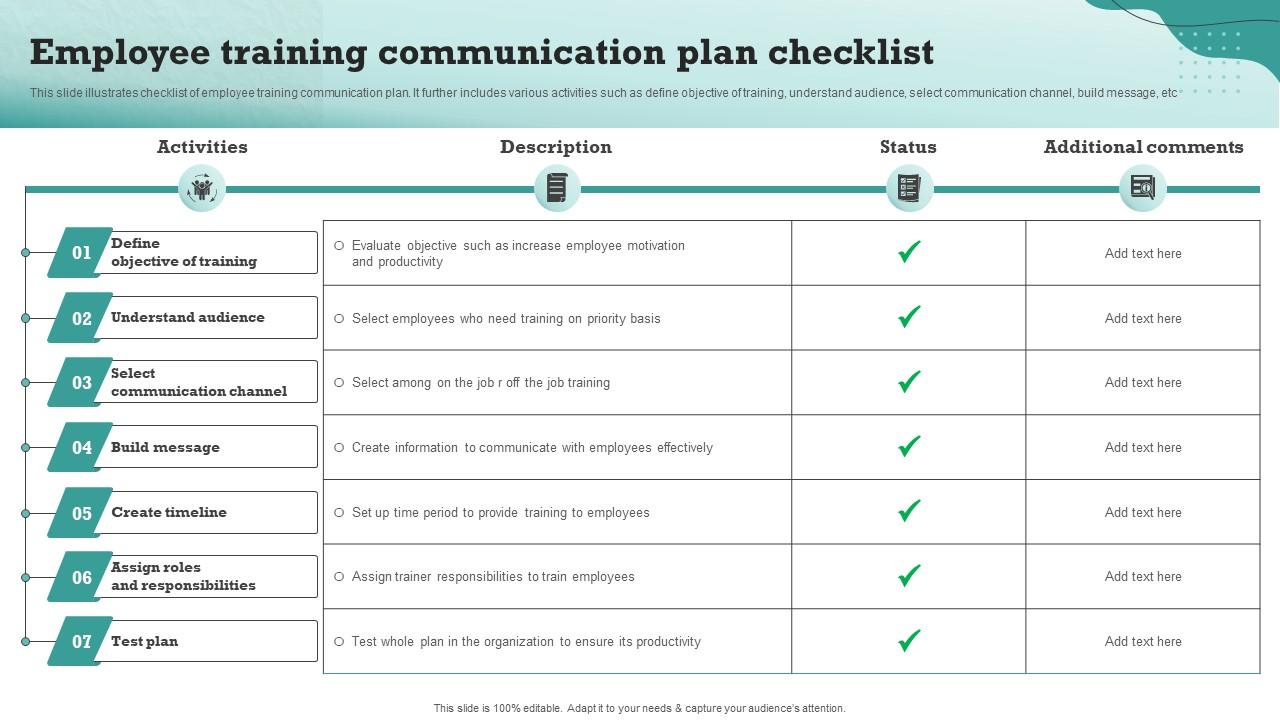
Employee Training Communication Plan Checklist
Try Before you Buy Download Free Sample Product
Audience
Editable
of Time
This slide showcases communication plan for corporate Excel training for employees within organization. It further includes various levels such as fundamental, intermediate, advanced and programming with VBA, etc.
People who downloaded this PowerPoint presentation also viewed the following :
Employee Training Communication Plan Checklist with all 9 slides:
Use our Employee Training Communication Plan Checklist to effectively help you save your valuable time. They are readymade to fit into any presentation structure.
FAQs for Employee Training
An effective employee training communication plan should include clear learning objectives, detailed program schedules, participation requirements, assessment criteria, and resource accessibility information. These components work together by establishing expectations, streamlining enrollment processes, and ensuring consistent messaging across departments, with many organizations finding that comprehensive communication significantly enhances training adoption rates and ultimately delivers improved employee engagement and skill development outcomes.
Organizations assess employee training needs through skills gap analyses, performance evaluations, employee surveys, manager feedback sessions, and competency assessments. These methods enable companies to identify specific knowledge deficiencies, skill requirements, and learning preferences across departments, with many finding that comprehensive needs assessments ultimately streamline communication strategies and enhance training program effectiveness.
Technology enhances training communication through interactive learning platforms, real-time feedback systems, virtual collaboration tools, mobile learning apps, and video conferencing capabilities. These solutions streamline information delivery, enable immediate clarification of complex concepts, and facilitate seamless interaction between trainers and participants, with many organizations finding that digital integration significantly improves knowledge retention and training effectiveness.
Feedback from previous training programs informs future communication plans by identifying communication gaps, preferred learning channels, timing preferences, and engagement barriers that participants experienced. This data enables organizations to refine messaging clarity, adjust delivery methods, optimize scheduling, and enhance content relevance, with many companies finding that feedback-driven communication strategies increase training completion rates and knowledge retention significantly.
Remote employee training engagement best practices include interactive virtual sessions, multi-channel communication approaches, flexible scheduling options, peer collaboration tools, and regular feedback mechanisms. These strategies enhance participation by accommodating different time zones, learning preferences, and technological capabilities, with many organizations finding that combining synchronous workshops with asynchronous resources ultimately delivers higher completion rates and improved skill retention.
Cultural differences significantly impact communication strategies through varying communication styles, language preferences, hierarchical expectations, and feedback approaches across diverse teams. Organizations increasingly adapt their training by incorporating multilingual resources, cultural sensitivity workshops, and flexible communication channels, with many global companies finding that culturally-aware strategies enhance employee engagement, reduce misunderstandings, and ultimately deliver stronger collaboration and operational efficiency.
Training communication plan effectiveness can be evaluated through pre-and-post assessments, employee feedback surveys, engagement analytics, completion rates, and behavioral observation metrics. These methods enable organizations to measure knowledge retention, communication clarity, and training adoption across departments, with many companies finding that comprehensive evaluation delivers improved employee performance, reduced training costs, and ultimately enhanced operational efficiency.
Visuals and graphics enhance understanding by simplifying complex concepts, creating memorable associations, and appealing to different learning styles through charts, infographics, and interactive elements. These visual components streamline information processing and improve retention rates significantly, with many organizations finding that employees demonstrate better comprehension and faster skill application when training incorporates strategic visual storytelling and data visualization techniques.
Email systems, intranets, learning management systems, mobile apps, and digital signage represent the most effective platforms for training communications. These technologies streamline information delivery by providing instant access, tracking engagement metrics, and enabling targeted messaging across departments, with many organizations finding that integrated approaches combining multiple platforms ultimately enhance participation rates and ensure consistent message reach.
Storytelling enhances training communications by creating relatable scenarios, emotional connections, and memorable learning experiences that resonate with employees across different roles and departments. Through narrative-driven case studies, real workplace challenges, and success stories from various industries like healthcare, retail, and manufacturing, organizations can transform abstract concepts into engaging content, ultimately improving knowledge retention and employee participation in training programs.
**INPUT**: What strategies can help overcome resistance to training among employees? **OUTPUT**: Overcoming training resistance involves clear communication about benefits, involving employees in program design, offering flexible scheduling options, and providing incentives for participation. Organizations across sectors like healthcare and manufacturing find that linking training to career advancement, using peer champions, and demonstrating immediate job relevance significantly enhances buy-in, ultimately delivering improved engagement and skill development outcomes.
Training communication plans should be reviewed quarterly and updated annually, with immediate revisions following major organizational changes, technology implementations, or regulatory updates. Many organizations find that regular assessment cycles, combined with employee feedback collection and performance metrics analysis, ensure messaging stays relevant and effective, ultimately delivering improved engagement rates and better training outcomes across diverse workforce segments.
Managers and team leaders serve as crucial communication bridges, translating organizational training objectives into team-specific contexts, providing ongoing reinforcement through regular check-ins, and modeling expected behaviors from training programs. These leaders enhance training effectiveness by offering personalized feedback, addressing individual concerns, and creating accountability structures, with many organizations finding that managerial support significantly increases training retention and practical application.
Organizations can align training communication with business goals by connecting program objectives to strategic priorities, using consistent messaging that emphasizes skill development's impact on performance metrics, and regularly communicating progress toward organizational targets. Through strategic alignment frameworks, companies streamline employee understanding of how training contributes to competitive advantage, operational efficiency, and growth objectives, ultimately delivering measurable business outcomes.
Organizations should track metrics including engagement rates, message open and click-through rates, feedback scores, knowledge retention assessments, and completion rates across different communication channels. These measurements enable companies to optimize their training communication strategies by identifying which formats resonate best with employees, ultimately delivering improved learning outcomes and enhanced organizational performance.
-
The slides are remarkable with creative designs and interesting information. I am pleased to see how functional and adaptive the design is. Would highly recommend this purchase!Â
-
A library of engaging, customizable and content-ready templates.Â