Employees Training Plan Budget Preparation

Rating:
80%
Employees Training Plan Budget Preparation
Slide 1 of 6
Favourites Favourites

Try Before you Buy Download Free Sample Product

Audience Impress Your
Audience
Editable 100%
Editable
Time Save Hours
of Time
The Biggest Sale is ending soon in
0
0
:
0
0
:
0
0
AI-Ready
Upload this template to AI and ask it to make any changes to content or color
100% editable Powerpoint Template for AI-assisted presentations. Finish your work in less time. Download Prompt Kit ​
Works with
Microsoft PowerPoint
Microsoft 365
Claude for PowerPoint
ChatGPT
Google Slides
Microsoft Copilot
Rating:
80%
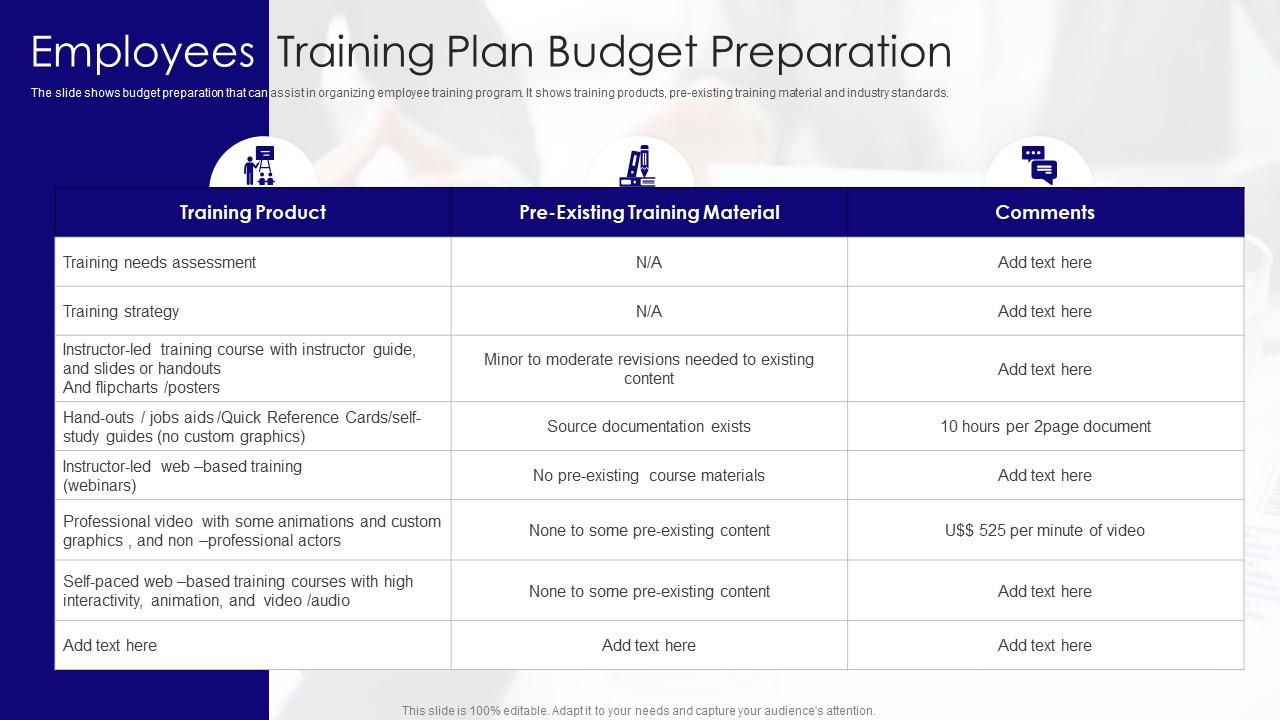
The Slide Shows Budget Preparation That Can Assist In Organizing Employee Training Program. It Shows Training Products, Pre Existing Training Material And Industry Standards. Presenting our well structured Employees Training Plan Budget Preparation. The topics discussed in this slide are Training Product, Training Strategy, Pre Existing Training Material. This is an instantly available PowerPoint presentation that can be edited conveniently. Download it right away and captivate your audience.

FAQs for Employees Training

Key factors include skills gap analysis, business objectives alignment, employee performance data, industry compliance requirements, and ROI projections. Organizations should prioritize high-impact training areas, consider delivery methods and associated costs, evaluate vendor options versus in-house development, and establish metrics for measuring effectiveness, with many companies finding that strategic budget allocation significantly enhances workforce capabilities and competitive positioning.

Organizations can measure training ROI by tracking performance metrics, productivity improvements, employee retention rates, revenue growth, and cost reductions following training programs. Through skills assessments, customer satisfaction scores, and reduced turnover costs, companies across sectors like retail and manufacturing demonstrate measurable returns, with many finding 200-300% ROI within twelve months.

Effective training budget forecasting methods include historical data analysis, skills gap assessments, strategic alignment reviews, departmental needs surveys, and industry benchmarking. These approaches streamline resource allocation by identifying priority training areas, predicting seasonal demands, and measuring ROI potential, with many organizations finding that combining multiple forecasting methods delivers more accurate budgets and enhanced workforce development outcomes.

Companies can balance in-house and external training by leveraging internal expertise for role-specific skills, company culture, and ongoing development, while utilizing external providers for specialized expertise, industry certifications, and emerging technologies. This strategic combination enables organizations to maximize resource allocation, enhance employee capabilities more cost-effectively, and ultimately deliver comprehensive skill development that drives competitive advantage.

Technology significantly optimizes training budgets through automated content delivery, personalized learning paths, virtual reality simulations, data analytics, and cloud-based platforms. These digital solutions streamline costs by reducing instructor expenses, travel requirements, and material production, while enabling scalable training programs that reach more employees simultaneously, ultimately delivering enhanced learning outcomes and measurable ROI for organizations.

Organizations ensure training alignment by conducting thorough needs assessments, establishing clear performance metrics tied to business objectives, and regularly evaluating program outcomes against strategic targets. Through structured competency mapping and stakeholder feedback loops, companies across sectors like manufacturing and financial services streamline workforce development, ultimately delivering measurable ROI and enhanced competitive positioning.

Innovative funding approaches include corporate partnerships with educational institutions, government grants and tax incentives, employee-contributed learning funds, revenue-sharing with training providers, and cross-departmental budget pooling. Many organizations increasingly leverage apprenticeship programs, vendor-sponsored certifications, and peer-to-peer knowledge exchanges, ultimately delivering cost-effective skill development while maximizing resource allocation across multiple business units.

Small businesses can effectively allocate limited training resources by prioritizing skills that directly impact revenue generation, focusing on cross-training employees for operational flexibility, and leveraging cost-effective digital learning platforms. Through strategic combinations of online courses, peer mentoring, and targeted external workshops, small organizations streamline development costs while enhancing productivity and employee retention, ultimately delivering competitive advantage.

Interactive workshops, mentorship programs, cross-functional skill development, leadership training, and technology-based learning platforms consistently yield the highest employee engagement rates. These programs enhance engagement by offering hands-on experiences, career advancement opportunities, and personalized development paths, with many organizations finding that employees show increased retention and productivity when training directly connects to their professional growth goals.

Employee feedback shapes future training budgets by identifying skill gaps, evaluating program effectiveness, and highlighting emerging learning needs across departments. Through surveys, performance reviews, and focus groups, organizations can strategically allocate resources toward high-impact training areas, ultimately delivering better ROI on learning investments and enhanced workforce capabilities that drive competitive advantage.

Common pitfalls include underestimating technology costs, failing to align training with business objectives, neglecting employee skill gaps analysis, overlooking measurement metrics, and allocating funds without considering scalability. These oversights often result in wasted resources and ineffective programs, with many organizations finding that strategic budget planning, regular needs assessments, and outcome-focused investments ultimately deliver better employee performance and competitive advantage.

Organizations can leverage partnerships by collaborating with universities for specialized courses, partnering with technology vendors for product training, engaging industry associations for certification programs, and working with consulting firms for leadership development. These strategic alliances enable companies to access expert-level training without full development costs, expand curriculum offerings significantly, and deliver cutting-edge skills training that enhances competitive advantage while optimizing resource allocation.

Key metrics include employee performance scores, skill assessment improvements, training completion rates, knowledge retention tests, and post-training productivity measurements. Organizations should also track ROI through reduced turnover costs, faster onboarding times, and increased internal promotions, with many companies finding that comprehensive measurement systems ultimately deliver clearer budget justification and strategic workforce development insights.

Workforce skill gaps can be identified through performance reviews, skills assessments, employee surveys, manager feedback, and analyzing productivity metrics against industry benchmarks. These evaluation methods enable organizations to pinpoint specific training needs, prioritize budget allocation strategically, and ultimately deliver targeted development programs that enhance operational efficiency and competitive advantage.

Maximizing training effectiveness on tight budgets involves leveraging internal expertise through peer-to-peer learning, utilizing free online resources and webinars, implementing microlearning sessions, and creating cross-departmental knowledge sharing programs. These cost-effective approaches enable organizations to deliver comprehensive skill development while minimizing expenses, with many companies finding that strategic resource allocation ultimately enhances employee capabilities and operational efficiency.

Ratings and Reviews

80% of 100
Review Form
Write a review
Most Relevant Reviews
  1. 80%

    by Donn Hart

    Thank you for offering such helpful pre-designed templates. They are really beneficial to me in my job.
  2. 80%

    by Dwain Johnston

    The templates are handy and I can personalize them as per my needs. Glad to be your subscriber!

2 Item(s)

per page: