


Enhanced Intelligence IT Powerpoint Presentation Slides




Try Before you Buy Download Free Sample Product
 Impress Your
 Audience
 100%
100% Editable
 Save Hours
 of Time


Enhanced intelligence offers a chance to make more accurate data-driven decisions in business. Grab our insightfully designed Enhanced Intelligence template. It includes information on the firm that offers augmented intelligence services, a description of augmented intelligence, pricing, and a training program for businesses. Our Intelligence Amplification deck discusses the lack of AI, the advantages of engaging in augmented intelligence, why companies should do so now, and how it addresses the big data issue. Additionally, it incorporates the market size of enhanced intelligence, the effect of COVID-19 on the expanded intelligence market, its impact on our everyday lives, and how it assists rather than replaces humans. It also exhibits an overview of the workings, benefits, tools, and strategies to create augmented intelligence for business. Further, our Cognitive Augmentation PPT describes the applications of enhanced intelligence in different sectors such as retail, finance, healthcare, manufacturing, logistic planning, and the use of it online verification. Lastly, our Decision Support module highlights the training and pricing for Enhanced Intelligence development, a timeline, a roadmap, and a dashboard for enhanced intelligence tracking. Get access now.
People who downloaded this PowerPoint presentation also viewed the following :
Content of this Powerpoint Presentation
Slide 1: This slide introduces Enhanced Intelligence (IT). Commence by stating Your Company Name.
Slide 2: This slide depicts the Agenda of the presentation.
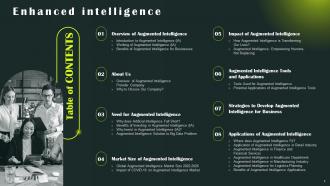
Slide 3: This slide incorporates the Table of Contents.
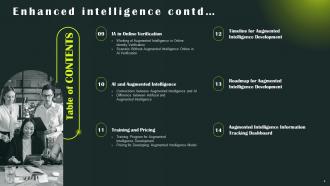
Slide 4: This is yet another slide continuing the Table of Contents.
Slide 5: This slide highlights the Title for the Topics to be covered further.
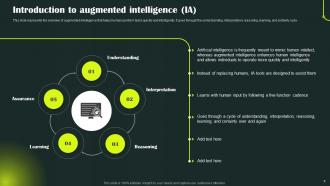
Slide 6: This slide represents the overview of augmented intelligence that helps humans perform tasks quickly and intelligently.
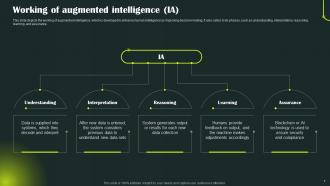
Slide 7: This slide depicts the working of augmented intelligence, which is developed to enhance human intelligence by improving decision-making.
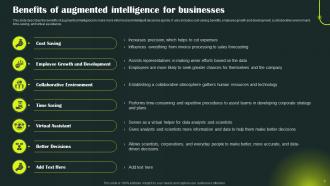
Slide 8: This slide describes the benefits of augmented intelligence to make more informed and intelligent decisions quickly.
Slide 9: This slide shows the Heading for the Contents to be discussed next.
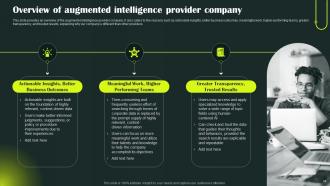
Slide 10: This slide provides an overview of the augmented intelligence provider company.
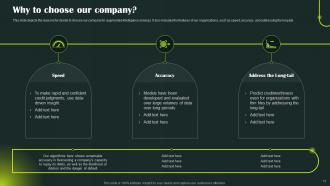
Slide 11: This slide depicts the reasons for clients to choose our company for augmented intelligence services.
Slide 12: This slide mentions the Title for the Ideas to be covered further.
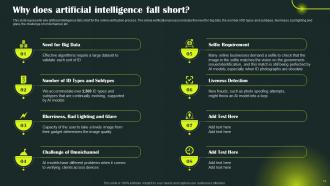
Slide 13: This slide represents why artificial intelligence falls short for the online verification process.
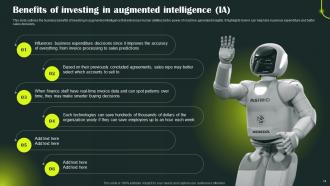
Slide 14: This slide outlines the business benefits of investing in augmented intelligence.
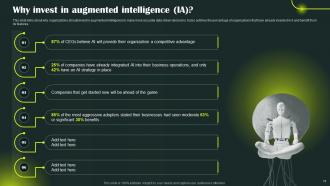
Slide 15: This slide talks about why organizations should invest in augmented intelligence to make more accurate data-driven decisions.
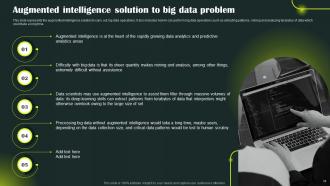
Slide 16: This slide represents the augmented intelligence solution to carry out big data operations.
Slide 17: This slide elucidates the Heading for the Contents to be discussed in the following template.
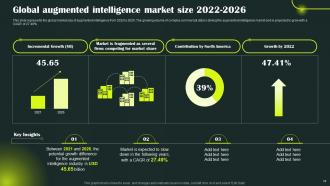
Slide 18: This slide reveals the global market size of augmented intelligence from 2022 to 2026.
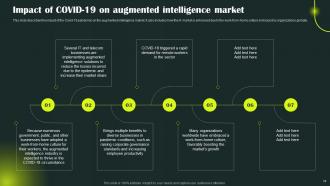
Slide 19: This slide describes the impact of the Covid-19 pandemic on the augmented intelligence market.
Slide 20: This slide showcases the Title for the Contents to be covered in the forth-coming template.
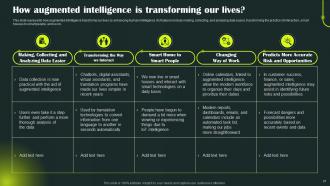
Slide 21: This slide represents how augmented intelligence transforms our lives by enhancing human intelligence.
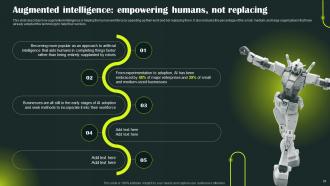
Slide 22: This slide describes how augmented intelligence is helping the human workforce by speeding up their work and not replacing them.
Slide 23: This slide indicates the Heading for the Topics to be discussed next.
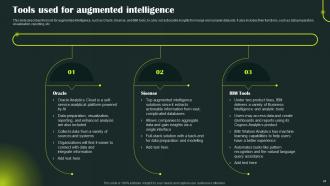
Slide 24: This slide highlights the Tools used for augmented intelligence.
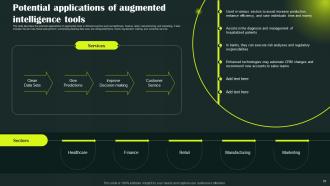
Slide 25: This slide describes the potential applications of augmented tools in different sectors.
Slide 26: This slide presents the Title for the Topics to be covered in the following template.
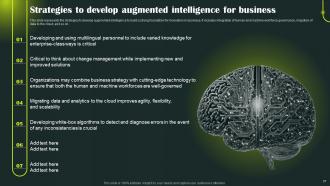
Slide 27: This slide represents the strategies to develop augmented intelligence to build a strong foundation for innovation in business.
Slide 28: This sldie includes the Heading for the Components to be discussed next.
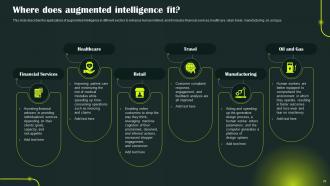
Slide 29: This slide depicts the applications of augmented intelligence in different sectors to enhance human intellect.
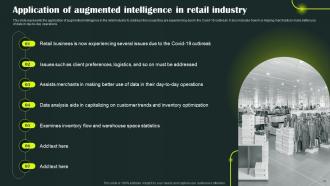
Slide 30: This slide showcases the Application of augmented intelligence in retail industry.
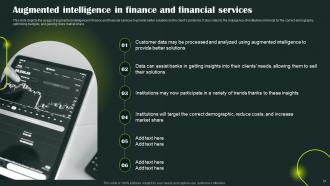
Slide 31: This slide depicts the usage of augmented intelligence in finance and financial services.
Slide 32: This slide outlines the augmented intelligence solutions to problems that the healthcare industry is experiencing right now.
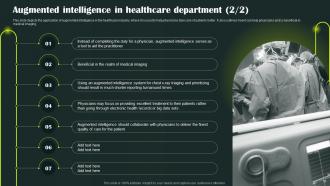
Slide 33: This slide continues the Augmented intelligence in healthcare department.
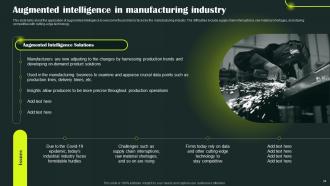
Slide 34: This slide talks about the application of augmented intelligence to overcome the problems faced by the manufacturing industry.
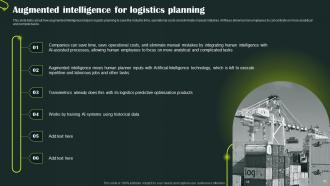
Slide 35: This slide showcases how augmented intelligence helps in logistic planning.
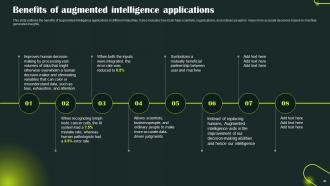
Slide 36: This slide outlines the benefits of augmented intelligence applications in different industries.
Slide 37: This slide displays the Title for the Ideas to be discussed next.
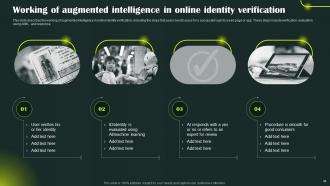
Slide 38: This slide describes the working of augmented intelligence in online identity verification.
Slide 39: This slide depicts the cost of the manual review process in the absence of augmented intelligence in artificial intelligence verification.
Slide 40: This slide reveals the Heading for the Ideas to be covered in the following template.
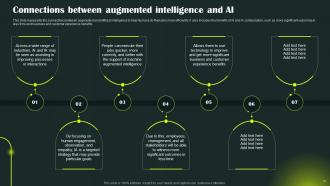
Slide 41: This slide represents the connections between augmented and artificial intelligence.
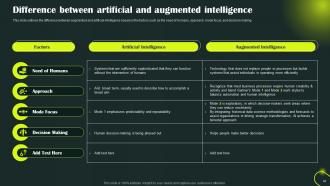
Slide 42: This slide shows the difference between augmented and artificial intelligence.
Slide 43: This slide elucidates the Title for the Contents to be discussed in the forth-coming template.
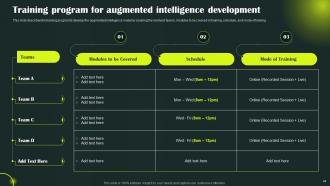
Slide 44: This slide describes the training program to develop the augmented intelligence model.
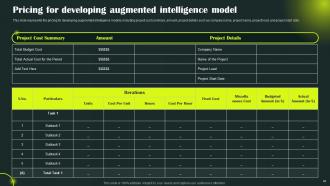
Slide 45: This slide reveals the pricing for developing augmented intelligence models.
Slide 46: This slide displays the Heading for the Topics to be covered next.
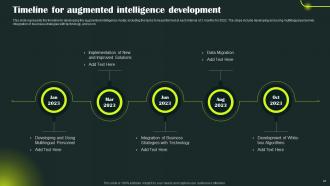
Slide 47: This slide represents the timeline for developing the augmented intelligence model.
Slide 48: This slide incorporates the Title for the Topics to be discussed next.
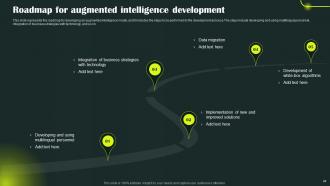
Slide 49: This slide displays the Roadmap for augmented intelligence development.
Slide 50: This slide mentions the Heading for the Contents to be covered further.
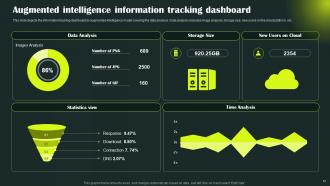
Slide 51: This slide depicts the information tracking dashboard by augmented intelligence model covering the data analysis.
Slide 52: This is the Icons slide containing all the Icons used in the plan.
Slide 53: This slide is used for showcasing some Additional information.
Slide 54: This is Our target slide. State your company targets here.
Slide 55: This slide contains the Post it notes for reminders and deadlines.
Slide 56: This slide highlights the SWOT analysis.
Slide 57: This is Our team slide. State your team-related information here.
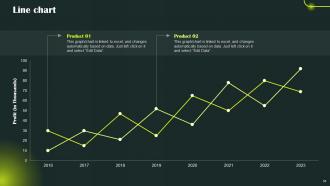
Slide 58: This slide portrays the Line chart.
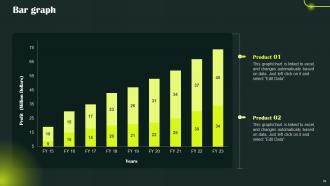
Slide 59: This slide displays the Bar graph.
Slide 60: This is the 30-60-90 days plan slide for effective planning.
Slide 61: This slide elucidates the Venn diagram.
Slide 62: This is the Thank You slide for acknowledgement.
Enhanced Intelligence IT Powerpoint Presentation Slides with all 67 slides:
Use our Enhanced Intelligence IT Powerpoint Presentation Slides to effectively help you save your valuable time. They are readymade to fit into any presentation structure.










FAQs for Enhanced Intelligence IT
Honestly, I think of AI like having a super smart research assistant who never gets tired. Instead of spending hours sorting through data or staring at a blank page, you can dump the boring stuff on AI and use your brain for the fun creative parts. Try it for small things first - maybe research for a project or brainstorming when you're stuck. I've found it's crazy good at spotting patterns I'd totally miss. The goal isn't to replace your thinking, just free up headspace so you can focus on the stuff that actually matters.
Honestly, the biggest advantage is how it lets you juggle way more information at once. You'll start seeing patterns and connections you'd normally miss - like having extra brains working on the same problem. Risks become obvious earlier, opportunities jump out faster. Where it really shines though? Complex strategic stuff where you're trying to balance market trends, what competitors are doing, plus your own team's strengths. I'd say start with decisions that feel too big for just going with your gut - those moments when you know there's too much to consider properly.
Honestly, the big stuff you should worry about is job displacement, privacy, and fairness. Will AI actually replace people or just shift what they do? How much employee data is it hoarding? Not everyone gets equal access either, which sucks. Oh, and there's this annoying "black box" thing - AI makes decisions but can't explain why. Super problematic for hiring or reviews. Just be upfront about what tools you're using. Get employees involved early - they'll hate surprises. Keep humans making the final calls on important stuff. That's probably the smartest move.
So this is actually pretty interesting - different cultures have totally different ideas about what "enhanced intelligence" even means. Like, we're obsessed with IQ tests and analytical stuff here, but Eastern cultures put way more weight on emotional intelligence and group problem-solving. Indigenous communities? They measure smarts through environmental knowledge and spiritual insight, which honestly seems way more practical. Then there's African ubuntu philosophy that's all about intelligence strengthening community bonds. The whole thing's kind of eye-opening. Bottom line: there's no universal definition, so you'll need to adjust your approach depending on who you're working with.
So there's basically three main routes people are taking - brain-computer interfaces like Neuralink, nootropics (those "smart drugs"), and AI tools. BCIs are super early but could be game-changing down the road. Modafinil and similar nootropics are popular with the biohacker crowd, though honestly nobody really knows what taking them for years does to you. My take? Skip messing with your brain chemistry for now. AI tools are way safer and you can start using them today - stuff like advanced language models, memory apps, decision-support systems. They won't turn you into Einstein but they'll definitely boost your performance.
So basically, schools can use AI to create custom learning paths for each kid and spot where they're struggling in real time. Pretty neat, right? The AI tutors adapt to however students learn best - some need visual stuff, others learn by doing. Teachers get help too since the system analyzes performance data and flags which students might need extra attention. Honestly, it frees up faculty from boring admin work so they can focus on actual teaching. Oh, and definitely start with just one department first - don't go crazy implementing everything at once.
Honestly, getting smarter usually makes you MORE creative, not less. You'll spot connections between random ideas that most people miss. Complex problems? You can attack them from way more angles. I know some folks think being logical kills creativity - total myth though. Your brain just processes more possibilities faster, then figures out what might actually work. The real trick is asking better questions and questioning assumptions instead of just tweaking what already exists. Think of it like having a bigger toolbox - more tools means more ways to build something cool.
So enhanced intelligence isn't just your typical IQ test stuff - it's way more about adapting and learning as you go. Traditional intelligence measures things like math skills or pattern recognition, but that's pretty static. Enhanced intelligence is different because it includes emotional awareness, creative problem-solving, connecting dots between totally random topics. You can actually develop it your whole life instead of being stuck with whatever you tested at 16 (thank god). I'd say start noticing when you link ideas from different areas - like applying something from a podcast to work drama. That's the good stuff right there.
Honestly, the biggest thing I've noticed is you start depending on it too much - like your brain gets lazy and stops working through problems on its own. Your confidence in making decisions without help kinda tanks over time. There's this weird thing where having ALL the information actually makes you more anxious about picking the "right" answer. Analysis paralysis is so real. But it does free up headspace for more creative stuff, which is nice. I think the trick is treating it like a really good tool instead of letting it think for you entirely. Does that make sense?
Honestly, just build on what you've got instead of starting over. Your current LMS can handle AI personalization - it'll adjust content for different learning styles and track how people are doing. Chatbots are pretty useful for answering questions during training too. The analytics part is where it gets interesting though - you can actually spot skill gaps before they become real issues. I'd probably test it with just one team first since you never know how these things will actually play out. Then expand from there if it works. Smart quizzes and content suggestions are solid features to start with.
Healthcare's crushing it with AI - faster drug development, better diagnoses, personalized treatments. Finance is obsessed with it too for fraud detection and trading algorithms. Manufacturing uses it for predicting when machines will break (actually pretty smart). Even creative fields are getting into it now, which honestly surprised me. Supply chain stuff, risk assessment, basically anything with tons of data to crunch. If your industry makes decisions based on patterns or large datasets, you'll probably find some way to use it. The pattern recognition capabilities are insane.
So basically, enhanced AI could process thousands of climate scenarios at once - stuff that would take human scientists decades to figure out. We're talking better energy grid optimization, crazy accurate weather predictions, and finding new materials for carbon capture. These systems don't need sleep, right? They could work on all these connected problems 24/7. Honestly, the research happening in AI climate science right now is where things get really interesting. You should check out what they're doing with renewable tech breakthroughs - it's pretty insane how fast things are moving.
Honestly, you could end up losing your ability to think for yourself if you're not careful. Your problem-solving skills might get rusty - kinda like how we all forgot how to navigate without GPS lol. AI can miss subtle stuff that matters, plus there's bias baked into these algorithms that could mess with your judgment. Don't let it make all your decisions for you. I'd say use it more like a research assistant than a brain replacement. Maybe practice going without it sometimes? Just so you don't become one of those people who can't function when the tech breaks.
Yeah, social media totally warps how we see this stuff. The algorithms just show you flashy "genius hack" headlines that make everything look either mind-blowing or scary as hell. You're getting fed content that already matches what you think about brain enhancement anyway. Plus it's all highlight reels - nobody posts about the boring failed experiments or slow progress. Honestly reminds me of fitness influencers promising instant abs, you know? Try following actual research labs instead of tech bros hyping the latest thing. Way more realistic picture of what's actually happening.
So you'll need both hard numbers and user feedback to get the full picture. Start with baseline metrics before rolling anything out - productivity rates, how fast decisions get made, error counts. That stuff's pretty straightforward to compare. But honestly? The user interviews and surveys are where you'll find the real gold. People will tell you if their job actually got easier or if they're just dealing with different headaches now. A/B testing works well if you can swing it. Oh, and set up regular check-ins from the start - don't wait months to see how it's going.
-
What a stunning collection of customizable templates! Really a time-saver..
-
I joined SlideTeam last month and there’s no doubt that I tend to find our bond only strengthening over time. Best place to find world-class themes, templates, and icons.