Enhancing overall project security it project management activities tracking dashboard
Try Before you Buy Download Free Sample Product
Audience
Editable
of Time
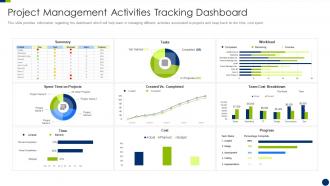
This slide provides information regarding the dashboard which will help team in managing different activities associated to projects and keep track on the time, cost spent.
People who downloaded this PowerPoint presentation also viewed the following :
Enhancing overall project security it project management activities tracking dashboard with all 7 slides:
Use our Enhancing Overall Project Security It Project Management Activities Tracking Dashboard to effectively help you save your valuable time. They are readymade to fit into any presentation structure.
FAQs for Enhancing overall project security it project management
Key metrics include vulnerability counts by severity, patch deployment rates, security incident response times, compliance status indicators, and threat detection accuracy scores. These metrics enhance project oversight by streamlining risk assessment, accelerating remediation workflows, and ensuring regulatory adherence, with many organizations finding that comprehensive dashboards ultimately deliver improved security posture and stakeholder confidence.
Real-time data visualization enhances project security dashboards by enabling immediate threat detection, continuous monitoring of security metrics, and instant alert notifications when anomalies occur. This approach allows security teams to identify potential breaches within minutes rather than hours, streamline incident response workflows, and maintain comprehensive visibility across all project assets, ultimately delivering faster threat mitigation and enhanced organizational security posture.
User roles and permissions serve as the foundation for dashboard security by controlling data access, defining viewing privileges, restricting editing capabilities, and ensuring information segregation based on organizational hierarchy. These access controls enable organizations to maintain data confidentiality while providing relevant project insights, with many enterprises finding that granular permission systems significantly reduce security breaches while enhancing operational transparency.
Integration with existing project management tools enhances security dashboard functionality by centralizing threat data, automating risk assessments, and streamlining vulnerability tracking across project lifecycles. This strategic combination enables teams to correlate security metrics with project milestones, delivery timelines, and resource allocation, ultimately delivering faster incident response and improved project visibility while maintaining operational efficiency.
Best practices for designing an intuitive project security dashboard interface include clear visual hierarchy, real-time data visualization, customizable alert systems, role-based access controls, and streamlined navigation workflows. These design principles enhance operational efficiency by reducing response times, minimizing security blind spots, and enabling faster threat identification, with many organizations finding that intuitive dashboards ultimately deliver improved incident management and stronger overall security posture.
A project security dashboard should consolidate data from frameworks like NIST, ISO 27001, and SOC 2 through unified APIs, standardized risk scoring, and centralized mapping that translates different compliance requirements into common metrics. This strategic integration enables organizations to streamline auditing processes, reduce compliance overhead, and maintain comprehensive security visibility, with many enterprises finding that consolidated dashboards ultimately deliver faster incident response and simplified regulatory reporting.
A project security dashboard should incorporate real-time threat alerts, vulnerability notifications, compliance violation warnings, access anomaly detections, and incident escalation triggers. These automated notifications enable security teams to respond within minutes rather than hours, with organizations in finance and healthcare finding that immediate alerts reduce breach response time by 60%, ultimately delivering enhanced protection and regulatory compliance.
Historical data trends on project security dashboards inform future security strategies by identifying recurring threat patterns, vulnerability hotspots, attack timing cycles, and response effectiveness metrics. Through predictive analytics and trend analysis, organizations can proactively allocate resources, strengthen weak points, and develop targeted countermeasures, ultimately enabling more strategic security investments and faster incident response capabilities.
**INPUT**: What tools or technologies are commonly used for developing a robust project security dashboard? **OUTPUT**: Project security dashboards commonly utilize SIEM platforms, vulnerability scanners, threat intelligence feeds, compliance monitoring tools, and real-time analytics engines. These technologies streamline security oversight by consolidating alerts, automating threat detection, and providing centralized visibility, with many organizations finding that integrated dashboards significantly enhance incident response times while delivering comprehensive risk management across complex project environments. [Word count: 58 words]
A project security dashboard facilitates incident response by providing real-time threat monitoring, automated alert systems, centralized tracking workflows, and comprehensive remediation progress visualization. Through integrated reporting tools, security teams can streamline response times, coordinate cross-functional remediation efforts, and maintain detailed audit trails, with many organizations finding that centralized dashboards reduce incident resolution times while enhancing overall security posture and compliance tracking.
Common security vulnerabilities include SQL injection attacks, cross-site scripting (XSS), authentication failures, insecure direct object references, and configuration vulnerabilities. These dashboards streamline monitoring by consolidating threat detection, access anomalies, and compliance metrics, with many organizations finding that real-time visibility enables faster incident response, minimizes security breaches, and ultimately delivers enhanced protection across development environments.
Securing stakeholder buy-in requires demonstrating clear ROI through risk reduction metrics, compliance benefits, and operational efficiency gains. Present specific scenarios showing how dashboards prevent costly breaches, streamline audit processes, and enhance decision-making speed, with many organizations finding that visual security insights ultimately deliver faster incident response and reduced regulatory penalties.
Data accuracy on security dashboards can be ensured through automated data validation, real-time monitoring systems, multi-source verification, regular auditing protocols, and standardized data collection frameworks. These methods work together by cross-referencing information from multiple security tools, implementing automated error detection, and establishing continuous quality checks, with many organizations finding that this multi-layered approach significantly enhances decision-making reliability and operational security effectiveness.
Privacy regulations significantly impact project security dashboards by requiring data anonymization, consent management, access controls, and retention policies that limit certain data collection methods. While these regulations present compliance challenges, they ultimately enhance data governance and stakeholder trust, with many organizations finding that privacy-compliant dashboards deliver more strategic value through improved data quality, reduced legal risks, and stronger customer confidence in an increasingly regulated business environment.
Project security dashboards can be customized through industry-specific threat monitoring, compliance framework integration, regulatory reporting modules, sector-relevant risk metrics, and tailored alert systems. Financial services organizations focus on fraud detection and PCI compliance, while healthcare institutions emphasize HIPAA requirements and patient data protection, with manufacturing sectors prioritizing operational technology security and supply chain vulnerabilities, ultimately delivering targeted protection strategies.
-
Excellent design and quick turnaround.
-
Unique and attractive product design.