

Ensuring Healthy Sales Pipeline Powerpoint Presentation Slides





Try Before you Buy Download Free Sample Product
 Impress Your
Audience
 100%
Editable
 Save Hours
of Time


Optimizing the sales pipeline is essential for overall business growth and is considered a lifeline for business health. It is a lucrative way to manage the sales process and win more deals. Check out our professionally designed template on Ensuring Healthy Sales Pipeline to leverage sales processes and boost sales performance. The deck focuses on enhancing the overall sales process to improve sales and business growth through lead optimization, allowing sales managers to enhance forecasting and better understand deals progress. It will cover slides about leveraging sales pipeline through formalizing sales process by addressing pipeline stages, conversion rates at different stages, comparing win and lost opportunities, etc. It will cater slides to ensure handling of potential leads through information gathering and lead qualification process, active vs. latent lead buying behavior. It covers slides about enhancing the overall customer experience, churned customer treatment framework, etc. The deck will cover slides about improving pipeline experience through critical meetings, tracking essential pipeline metrics, etc. It caters to slides about sales tracking solutions, impact assessment with a reduction in sales cycle duration, dashboard related to tracking customer sales funnel activities, etc. Get access now.
People who downloaded this PowerPoint presentation also viewed the following :
Content of this Powerpoint Presentation
Slide 1: This slide displays the title Ensuring Healthy Sales Pipeline.
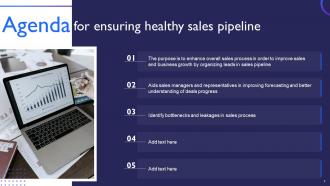
Slide 2: This slide displays the title Agenda.
Slide 3: This slide exhibit table of content.
Slide 4: This slide exhibit table of content- Assessing Present Scenario
Slide 5: This slide provides information regarding the key concerns that have raised in context to sales pipeline.
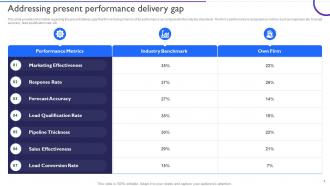
Slide 6: This slide provides information regarding the present delivery gap that firm is facing in terms of its performance as compared to the industry standards.
Slide 7: This slide exhibit table of content- Moving Towards Pipeline Management, How to Strengthen Sales Pipeline
Slide 8: This slide provides information regarding formalizing of sales process by addressing pipeline stages such as leads, prospects, qualification, meeting and quote.
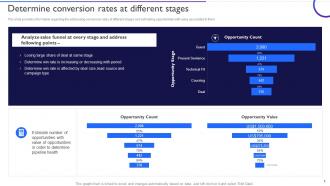
Slide 9: This slide provides information regarding the addressing conversion rates at different stages and estimating opportunities with value associated to them.
Slide 10: This slide provides information regarding the comparison of win and lost opportunities in terms of duration associated to them.
Slide 11: This slide provides information regarding average sales cycle existing in sales pipeline.
Slide 12: This slide provides information regarding monitoring of different sales representative’s performance by determine sales duration at various pipeline stages.
Slide 13: This slide provides information regarding prioritizing high probability opportunities in sales pipeline by addressing deal size, enhance engagement, etc.
Slide 14: This slide provides information regarding monitoring of changes in opportunities in sales pipeline.
Slide 15: This slide provides information regarding various through which sales pipeline is managed such as tactical outbound messaging, automating email marketing, etc.
Slide 16: This slide provides information regarding various through which sales pipeline is managed such as analyzing ROI, address closed loop feedback.
Slide 17: This slide provides information regarding different rules for contacting prospects through sales pipeline such as immediacy, persistency, etc.
Slide 18: This slide exhibit table of content- Handling of Potential Leads
Slide 19: The sales department will generate crucial information of potential lead through webinar by collecting the relevant data from prospective leads.
Slide 20: Essential information is to be collected from potential lead in order to determine their status in sales funnel.
Slide 21: Budget, Authority, Need, Timeframe are considered as essential attributes to analyze sales readiness.
Slide 22: Lead scoring plays vital role in boosting the power of content marketing by converting random actions into well defined sales buying patterns.
Slide 23: This slide depicts information regarding comparison of active or latent buying behavior.
Slide 24: This slide exhibit table of content- Enhancing Overall Customer Experience.
Slide 25: This slide portrays information about various marketing campaigns in order to retain its customers from churning and to enhance customer engagement.
Slide 26: The firm will target its customers by testing various strategies in terms of offers and will check their performance through feedback.
Slide 27: This slide provides information regarding the handling of referral prospects in sales pipeline by determining them on importance and productivity.
Slide 28: This slide exhibit table of content- How to Improve Overall Pipeline Experience.
Slide 29: This slide provides information regarding the comparison of critical meetings for pipeline management and forecast review.
Slide 30: This slide provides information regarding various limitations associated to pipeline coverage ratio.
Slide 31: This slide provides information regarding the essential pipeline metrics such as opportunity dollar size vs. average won deal size, opportunity age vs. win cycle and win rate.
Slide 32: This slide provides information regarding how sales department will be able to incur bigger revenue and profits by catering more deals, higher conversion, etc.
Slide 33: This slide exhibit table of content- Essential Activities Reporting.
Slide 34: This slide provides information regarding how prospect is nurtured in sales funnel through various marketing activities.
Slide 35: This slide provides information regarding key activities that are performed by prospects on various campaign.
Slide 36: This slide provides information regarding maintenance of prospects records that are existing in sales pipeline with deal name, customer contact, lead source, etc.
Slide 37: This slide provides information regarding tracking of opportunities in various stages of sales pipeline.
Slide 38: This slide exhibit table of content- Selecting Sales Tracking in Pipeline Solution
Slide 39: This slide will help firm in choosing the suitable automated sales pipeline solution.
Slide 40: This slide exhibit table of content- Impact Assessment
Slide 41: The successful optimization of effective pipeline management solution results in improving sales cycle duration.
Slide 42: This slide portrays the overall impact of successful implementation of pipeline management in terms of benefits including monetary benefits.
Slide 43: This slide exhibit table of content- Dashboard.
Slide 44: This slide covers information regarding the customer sales funnel tracking with sales volume and total market.
Slide 45: This slide covers information regarding dashboard associated to tracking lead activity across sales pipeline.
Slide 46: This slide covers information regarding dashboard for tracking various customer deals in sales pipeline.
Slide 47: This is the icons slide.
Slide 48: This slide presents title for additional slides.
Slide 49: This slide depicts 30-60-90 days plan for projects.
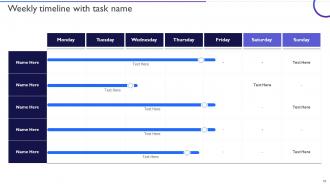
Slide 50: This slide display Weekly timeline with task name.
Slide 51: This slide display Roadmap for process flow.
Slide 52: This slide exhibits ideas generated.
Slide 53: This slide display Financial.
Slide 54: This slide display Staked column chart for different products.
Slide 55: This slide shows details of team members like name, designation, etc.
Slide 56: This slide presents your company's vision, mission and goals.
Slide 57: This is thank you slide & contains contact details of company like office address, phone no., etc.
Ensuring Healthy Sales Pipeline Powerpoint Presentation Slides with all 62 slides:
Use our Ensuring Healthy Sales Pipeline Powerpoint Presentation Slides to effectively help you save your valuable time. They are readymade to fit into any presentation structure.

















FAQs for Ensuring Healthy Sales Pipeline
Key stages of an effective sales pipeline include lead generation, qualification, needs assessment, proposal presentation, negotiation, and closing. These stages streamline the sales process by providing clear progression milestones, enabling better forecasting accuracy, and helping sales teams identify bottlenecks, with many organizations finding that structured pipelines increase conversion rates and revenue predictability significantly.
Sales pipeline management improves forecasting accuracy by providing real-time visibility into deal progression, standardizing stage definitions, and tracking historical conversion rates at each phase. Through consistent data collection and stage-gate processes, sales teams can identify patterns, predict revenue timing more precisely, and adjust projections based on pipeline velocity, ultimately enabling more reliable quarterly planning and resource allocation decisions.
Key sales pipeline health metrics include conversion rates between stages, average deal size, sales velocity, pipeline coverage ratio, and win/loss ratios by source or rep. These metrics enable sales teams to identify bottlenecks, forecast revenue accuracy, and optimize resource allocation, with many organizations finding that tracking stage-specific conversion rates ultimately delivers predictable growth and enhanced sales performance.
Sales pipelines should be evaluated weekly for deal progression and monthly for process optimization, with quarterly comprehensive reviews for strategic adjustments. Regular evaluation enables sales teams to identify bottlenecks, update deal probabilities, and refine forecasting accuracy, while many organizations find that consistent pipeline maintenance ultimately delivers improved conversion rates and more predictable revenue outcomes.
CRM software serves as the central hub for sales pipeline management, tracking leads, automating follow-ups, analyzing conversion rates, and providing real-time visibility into deal progression. These systems streamline sales processes by organizing customer data, scheduling touchpoints, and generating predictive analytics, with many organizations finding that integrated CRM platforms ultimately deliver faster deal closures and enhanced revenue forecasting.
Sales teams identify bottlenecks by analyzing conversion rates between stages, tracking time spent in each phase, and monitoring deal velocity metrics. Through CRM analytics and pipeline reporting, organizations can pinpoint where prospects stall most frequently, enabling targeted interventions that streamline the sales process and ultimately accelerate revenue generation across their operations.
Lead nurturing strategies include personalized email sequences, targeted content delivery, progressive profiling, behavioral trigger campaigns, and multi-channel touchpoint coordination. These approaches enhance engagement by delivering relevant messaging based on prospect behavior, purchase intent, and stage-specific needs, with many sales organizations finding that systematic nurturing increases conversion rates while reducing sales cycle length.
Effective sales pipeline management strengthens customer relationships by providing systematic touchpoint tracking, personalized communication timing, and comprehensive interaction history. Through structured pipeline processes, sales teams deliver more relevant follow-ups, anticipate customer needs more accurately, and maintain consistent engagement throughout lengthy sales cycles, ultimately building deeper trust and long-term partnerships.
Common mistakes include poor lead qualification, inconsistent data entry, neglecting follow-up schedules, lack of pipeline reviews, and failing to define clear stage criteria. These oversights lead to inaccurate forecasting, missed opportunities, and reduced conversion rates, with many sales teams finding that systematic processes and regular pipeline audits ultimately enhance visibility and accelerate deal closure.
Data analytics enhances sales pipeline performance by identifying bottlenecks, predicting conversion probabilities, and optimizing resource allocation across different pipeline stages. Through predictive modeling and real-time dashboards, sales teams can prioritize high-value prospects, accelerate deal closure rates, and ultimately increase revenue conversion, with many organizations finding that data-driven approaches deliver 15-20% improvements in sales efficiency.
Lead segmentation best practices include categorizing by demographics, behavioral data, lead source, engagement level, and buying stage progression. These segmentation approaches streamline sales processes by enabling personalized outreach, prioritizing high-value prospects, and optimizing resource allocation, with many sales organizations finding that strategic segmentation ultimately delivers higher conversion rates and improved sales efficiency.
Sales teams can balance lead generation and prospect follow-up by implementing structured time allocation, typically dedicating 60% to nurturing existing prospects and 40% to new leads, using CRM automation for systematic follow-ups, and establishing clear qualification criteria. This strategic approach enables teams to maintain momentum with warm prospects while continuously filling their pipeline, ultimately delivering higher conversion rates and more predictable revenue growth.
Visualizing the sales pipeline enables sales teams to identify bottlenecks, track deal progression, prioritize high-value opportunities, and forecast revenue more accurately. Through visual dashboards and pipeline mapping, teams streamline resource allocation, enhance collaboration between sales representatives, and accelerate deal closure rates, with many organizations finding that visual pipeline management ultimately delivers improved quota attainment and strategic sales forecasting capabilities.
Sales training programs enhance pipeline management skills by teaching lead qualification techniques, opportunity scoring methods, forecasting accuracy, and systematic follow-up processes. Through role-playing scenarios and CRM system training, sales teams develop better prospect prioritization, deal progression tracking, and conversion optimization strategies, ultimately delivering higher close rates and more predictable revenue outcomes.
Sales pipeline transparency significantly enhances team collaboration by providing shared visibility into prospect status, deal progress, and resource allocation needs across departments. This visibility enables marketing to adjust lead generation strategies, sales managers to provide targeted coaching, and customer success teams to prepare for onboarding, ultimately delivering coordinated efforts and improved conversion rates.
-
Their designing team is so expert in making tailored templates. They craft the exact thing I have in my mind…..really happy.
-
Definitely a time saver! Predesigned and easy-to-use templates just helped me put together an amazing presentation.