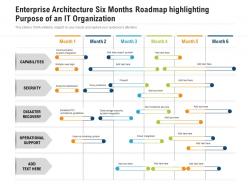
Enterprise architecture six months roadmap highlighting purpose of an it organization
Try Before you Buy Download Free Sample Product
Audience
Editable
of Time
A well thought out action plan makes execution easier and increases the possibility of success significantly. Ensure hitting all the milestones within the deadlines by introducing our fully customizable Enterprise Architecture Six Months Roadmap Highlighting Purpose Of An IT Organization. Streamline the work related information, budget, timeframe, key deliverable, landmarks, and major steps involved, all in one place to give an organized overview of the project by utilizing our PowerPoint theme. Minimize time lag and increase work efficiency by providing insight into the process with our comprehensively researched roadmap PowerPoint layout. Color coding helps in highlighting the process and grabs the attention of the audience. Download our handy Enterprise Architecture Six Months Roadmap Highlighting Purpose Of An IT Organization to identify the possible problem areas in a much shorter time and propose solutions. Have a productive brainstorming session with your workforce by utilizing our action plan visualization tool.
People who downloaded this PowerPoint presentation also viewed the following :
Enterprise architecture six months roadmap highlighting purpose of an it organization with all 2 slides:
Use our Enterprise Architecture Six Months Roadmap Highlighting Purpose Of An IT Organization to effectively help you save your valuable time. They are readymade to fit into any presentation structure.
FAQs for Enterprise architecture six months roadmap highlighting purpose of
Key components include current state assessment, future state vision, gap analysis, migration strategy, governance framework, and stakeholder alignment processes. These elements work together by establishing baseline architecture understanding, defining strategic technology direction, and creating structured transformation pathways, with many organizations finding that comprehensive roadmaps ultimately deliver reduced complexity, improved operational efficiency, and stronger competitive positioning.
Organizations align their Enterprise Architecture Roadmap with business goals by establishing clear strategic objectives, conducting thorough capability assessments, and creating detailed implementation timelines that prioritize high-impact initiatives. Through regular stakeholder collaboration and iterative planning cycles, companies across sectors like banking and manufacturing streamline operations, enhance customer experiences, and optimize resource allocation, ultimately delivering measurable competitive advantage and sustainable growth outcomes.
Stakeholder engagement ensures Enterprise Architecture Roadmaps align with business priorities, technical constraints, and operational realities across departments. Through collaborative workshops, interviews, and feedback sessions, organizations capture diverse perspectives from IT leaders, business units, and end-users, ultimately delivering roadmaps that balance strategic vision with practical implementation requirements.
Enterprise Architecture Roadmaps should be reviewed quarterly and updated annually, with major revisions triggered by significant business changes, technology shifts, or strategic pivots. This balanced approach enables organizations to maintain strategic alignment while adapting to market dynamics, with many enterprises finding that regular reviews enhance operational efficiency, reduce technical debt, and ultimately deliver sustained competitive advantage.
Effective Enterprise Architecture Roadmap tools include TOGAF-compliant platforms like Sparx Enterprise Architect, Archimate-based solutions, Microsoft Visio, LucidChart, and specialized EA tools like BiZZdesign or MEGA. These platforms streamline roadmap creation by enabling comprehensive modeling, stakeholder collaboration, and timeline visualization, with many organizations finding that integrated toolsets ultimately deliver enhanced strategic alignment and accelerated transformation outcomes.
An Enterprise Architecture Roadmap facilitates digital transformation by providing structured integration pathways, technology alignment frameworks, and phased implementation strategies that minimize operational disruption. Through strategic sequencing of system modernization, data architecture evolution, and process automation, organizations streamline legacy transitions, enhance operational efficiency, and accelerate innovation adoption, ultimately delivering competitive advantage in increasingly digital markets.
Common pitfalls include lack of stakeholder engagement, unrealistic timelines, insufficient change management, poor governance structures, and inadequate resource allocation. These challenges can derail implementation, with many organizations finding that successful roadmaps require executive sponsorship, cross-functional collaboration, and phased approaches that balance ambitious transformation goals with practical constraints, ultimately delivering sustainable architectural evolution.
Measuring Enterprise Architecture Roadmap effectiveness involves tracking business alignment metrics, implementation timeline adherence, cost optimization achievements, and stakeholder satisfaction scores. Through regular assessments of project delivery rates, technology standardization progress, and operational efficiency gains, organizations streamline governance processes, reduce integration complexities, and enhance decision-making capabilities, ultimately delivering measurable ROI and strategic competitive advantage.
Regulatory compliance requirements significantly influence Enterprise Architecture Roadmaps by mandating specific security protocols, data governance frameworks, and audit capabilities throughout system design. Financial services, healthcare, and manufacturing organizations increasingly integrate compliance-driven architecture decisions early in roadmap planning, ensuring seamless regulatory adherence while minimizing costly retrofitting and enabling competitive advantage through trustworthy operations.
Prioritization techniques include value-stream mapping, business impact assessment, dependency analysis, resource capacity evaluation, and risk-adjusted scoring matrices. These methods enable organizations to balance strategic objectives with operational constraints, with many enterprises finding that combining quantitative scoring with stakeholder input delivers optimal resource allocation and accelerated time-to-value across transformation initiatives.
Organizations ensure agility within their Enterprise Architecture Roadmap by implementing modular frameworks, establishing iterative review cycles, and maintaining flexible technology stacks that adapt to changing business requirements. Through cloud-native architectures and API-first approaches, enterprises streamline integration processes, accelerate deployment timelines, and enhance scalability, while enabling rapid pivots in response to market demands, ultimately delivering competitive advantage in increasingly dynamic business environments.
Enterprise Architecture Roadmap milestones typically span 1-3 years, with quick wins achieved within 6-12 months, major transformations requiring 18-36 months, and strategic initiatives extending beyond three years. This phased approach enables organizations to demonstrate value early, secure ongoing stakeholder support, and adapt to evolving business requirements, ultimately delivering measurable improvements in operational efficiency and competitive positioning.
A well-defined Enterprise Architecture Roadmap enhances IT investment decision-making by providing strategic alignment frameworks, standardized evaluation criteria, and clear technology migration paths that prioritize business value delivery. Through comprehensive roadmapping, organizations streamline resource allocation, minimize redundant investments, and accelerate digital transformation initiatives, with many enterprises finding that structured architecture planning delivers measurable ROI improvements and competitive advantages.
A phased approach in creating an Enterprise Architecture Roadmap enables organizations to manage complexity, reduce risks, and ensure stakeholder alignment through incremental progress and continuous feedback. This methodology allows companies to prioritize critical systems first, validate solutions before full-scale implementation, and adapt to changing business requirements, ultimately delivering measurable outcomes while maintaining operational stability throughout the transformation process.
Cross-departmental collaboration in Enterprise Architecture Roadmap development can be fostered through structured workshops, shared governance committees, regular stakeholder meetings, and unified communication platforms. These approaches streamline alignment by creating transparent decision-making processes, establishing common business vocabularies, and ensuring diverse departmental perspectives, with many organizations finding that collaborative frameworks ultimately deliver faster consensus and more comprehensive architectural strategies.
No Reviews