Executive summary ppt slide

Rating:
90%
Slide 1 of 5
Favourites Favourites

Try Before you Buy Download Free Sample Product

Audience Impress Your
Audience
Editable 100%
Editable
Time Save Hours
of Time
The Biggest Sale is ending soon in
0
0
:
0
0
:
0
0
Rating:
90%
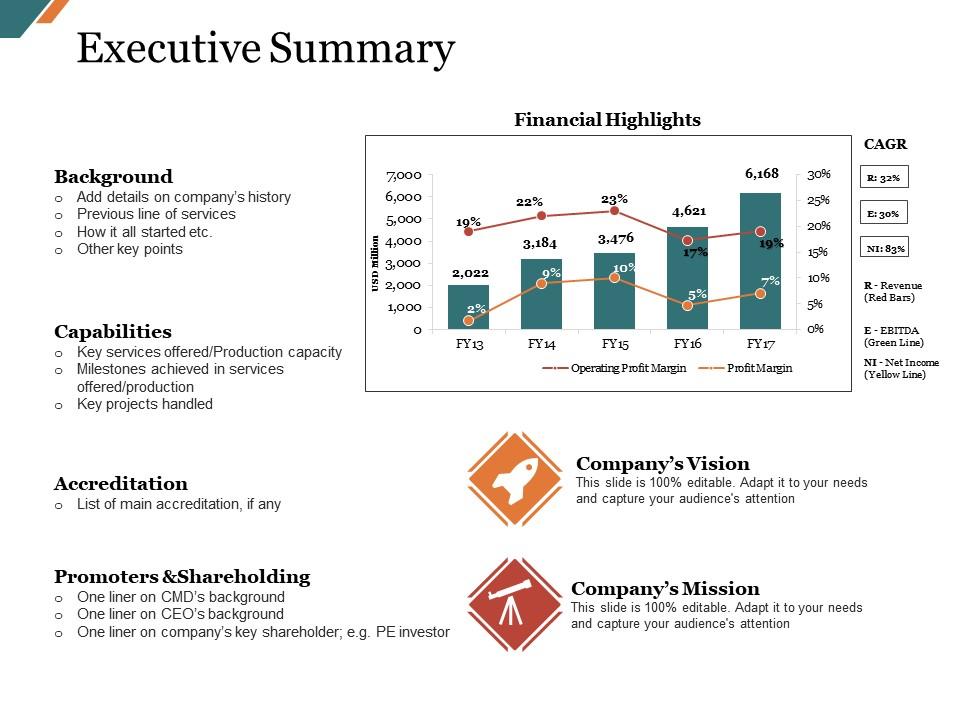
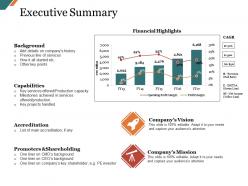
Presenting this set of slides with name - Executive Summary Ppt Slide. This is a two stage process. The stages in this process are Background, Capabilities, Accreditation, Promoters And Shareholding, Company Vision.

FAQs for Executive

An effective executive summary includes a clear problem statement, proposed solution, market opportunity, competitive advantages, and financial projections. These components work together by immediately capturing stakeholder attention, demonstrating strategic value, and providing essential decision-making information, with many investors and executives finding that concise summaries featuring quantifiable outcomes and scalable business models ultimately deliver faster approvals and stronger organizational buy-in.

Executive summary length significantly impacts clarity and engagement by balancing comprehensive coverage with reader attention spans, with optimal lengths typically ranging from one to two pages depending on document complexity. Shorter summaries enhance readability and maintain focus, while longer versions risk losing busy executives' attention, though they allow for more detailed value propositions, with many organizations finding that concise, well-structured summaries ultimately deliver better stakeholder engagement and faster decision-making.

Visuals enhance executive summary effectiveness by improving comprehension, accelerating decision-making, and highlighting key metrics through charts, graphs, infographics, and data visualizations. These elements streamline complex information processing, enable faster stakeholder buy-in, and create memorable presentations, with many executives finding that visual summaries deliver clearer strategic insights and more compelling business cases.

Common pitfalls include being overly detailed, burying key insights, lacking clear value propositions, using excessive jargon, and failing to align with audience needs. While many executives focus on comprehensive coverage, the most effective summaries prioritize strategic clarity, measurable outcomes, and actionable recommendations, with successful organizations finding that concise, results-focused summaries drive faster decision-making and stakeholder buy-in.

The target audience significantly shapes an executive summary's content depth, technical language, and persuasive approach, with executives requiring high-level strategic insights while investors focus on financial projections and growth potential. Through audience-specific customization, organizations streamline decision-making processes, enhance stakeholder engagement, and accelerate approval timelines, with many finding that tailored summaries deliver more compelling presentations and ultimately stronger business outcomes.

Storytelling transforms executive summaries by creating narrative flow that connects market problems to strategic solutions, weaving data into compelling business cases, and establishing emotional resonance with stakeholders. Through strategic narrative structure, organizations enhance investor engagement, simplify complex concepts, and build credibility, with many finding that story-driven summaries generate stronger stakeholder buy-in and faster decision-making.

Data and statistics enhance executive summaries by providing quantifiable evidence for key findings, supporting strategic recommendations with concrete metrics, and demonstrating measurable business impact through performance indicators. These elements should be strategically positioned to reinforce critical points, with financial services and healthcare organizations finding that well-integrated data significantly strengthens stakeholder confidence and accelerates decision-making processes.

Effective executive summary strategies include prioritizing key findings first, using bullet points for complex data, limiting length to one page, focusing on actionable insights, and tailoring content to specific stakeholder needs. These approaches streamline communication by eliminating unnecessary details, highlighting critical business outcomes, and presenting information hierarchically, with many organizations finding that well-structured summaries accelerate decision-making and enhance strategic alignment.

Executive summaries differ across industries through varying emphasis on sector-specific metrics, regulatory requirements, stakeholder priorities, and operational challenges. While healthcare summaries focus on patient outcomes and compliance, financial services emphasize risk management and regulatory adherence, and manufacturing highlights operational efficiency and supply chain optimization, ultimately delivering tailored insights that resonate with each sector's unique decision-making frameworks.

Attention-grabbing techniques include compelling statistics, provocative questions, bold statements about market opportunities, surprising industry insights, and quantified problem statements that demonstrate urgency. These approaches work by immediately establishing relevance and stakes, with many executives finding that data-driven openings or contrarian perspectives create memorable first impressions, ultimately encouraging deeper engagement with the full proposal.

Including a call to action in an executive summary is crucial for driving decision-making and securing stakeholder commitment to proposed initiatives. It transforms passive reading into active engagement by clearly outlining next steps, required resources, and expected timelines, while establishing accountability and momentum. This strategic approach enables organizations to move from analysis to implementation more efficiently, ultimately delivering faster project approvals and better business outcomes.

Best practices for revising and editing an executive summary include ensuring clarity and conciseness, verifying alignment with main document findings, strengthening opening and closing statements, and eliminating jargon or redundancies. These practices streamline communication by enhancing readability, maintaining strategic focus, and delivering compelling narratives, with many organizations finding that well-edited summaries significantly improve stakeholder engagement and decision-making outcomes.

Stakeholder feedback enhances executive summary quality by identifying clarity gaps, ensuring key concerns are addressed, validating strategic priorities, and confirming messaging resonates with target audiences. This collaborative approach enables organizations to refine content accuracy, strengthen persuasive elements, and eliminate jargon, with many executives finding that stakeholder input ultimately delivers more compelling, actionable summaries that drive faster decision-making.

Digital tools that streamline executive summary creation include business plan software like LivePlan, presentation platforms such as Canva and SlideTeam, AI writing assistants like Jasper, and template libraries from Microsoft Office and Google Workspace. These platforms enhance efficiency by providing structured frameworks, professional formatting, and collaborative features, enabling teams to produce compelling summaries faster while maintaining consistency and strategic focus across organizational communications.

Cultural awareness significantly enhances executive summary effectiveness by ensuring appropriate communication styles, decision-making preferences, and cultural sensitivities are reflected throughout the document. International organizations find that culturally-adapted summaries resonate better with diverse stakeholders, facilitate smoother cross-border negotiations, and ultimately deliver stronger engagement and faster approvals in global markets.

Ratings and Reviews

90% of 100
Review Form
Write a review
Most Relevant Reviews
  1. 100%

    by Dong Santos

    Qualitative and comprehensive slides.
  2. 80%

    by Thomas Garcia

    Appreciate the research and its presentable format.

2 Item(s)

per page: