Expected result optimizing enterprise application performance ppt background image

Rating:
87%
Expected result optimizing enterprise application performance ppt background image
Slide 1 of 2
Favourites Favourites

Try Before you Buy Download Free Sample Product

Audience Impress Your
Audience
Editable 100%
Editable
Time Save Hours
of Time
The Biggest Sale is ending soon in
0
0
:
0
0
:
0
0
Rating:
87%
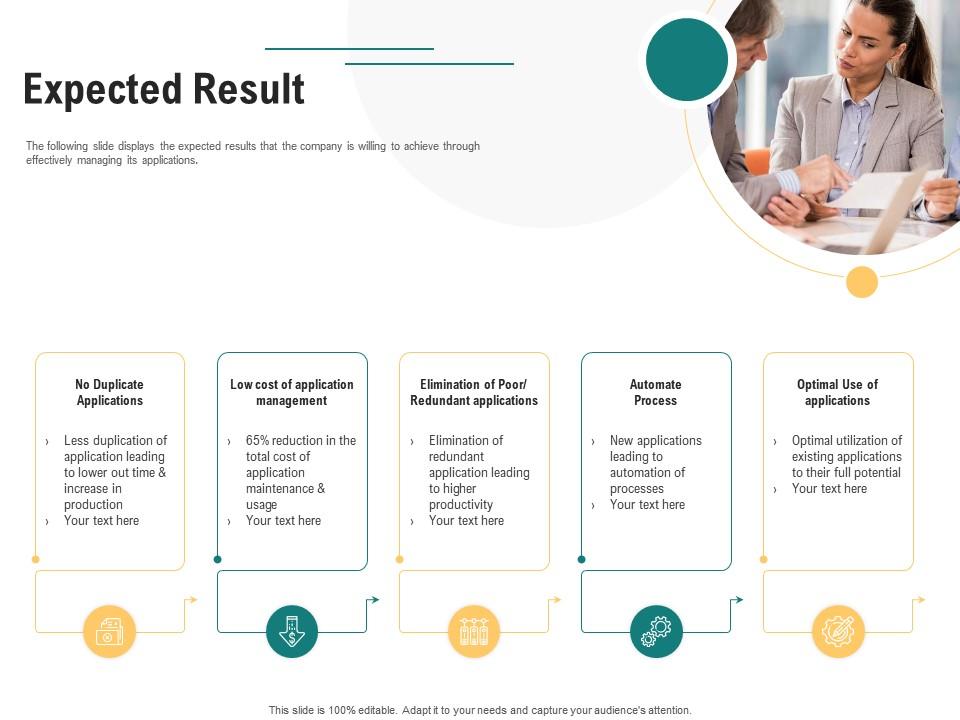
The following slide displays the expected results that the company is willing to achieve through effectively managing its applications. Introducing Expected Result Optimizing Enterprise Application Performance Ppt Background Image to increase your presentation threshold. Encompassed with five stages, this template is a great option to educate and entice your audience. Dispence information on No Duplicate Applications, Low Cost Of Application Management, Elimination Of Poor Or Redundant Applications, Automate Process, Optimal Use Of Applications, using this template. Grab it now to reap its full benefits.

People who downloaded this PowerPoint presentation also viewed the following :

FAQs for Expected result optimizing enterprise application performance

Key performance metrics for enterprise applications include response time, throughput, error rates, CPU and memory utilization, database query performance, and user satisfaction scores. These metrics enable organizations to identify bottlenecks, optimize resource allocation, and enhance user experiences across sectors like banking and healthcare, with many enterprises finding that comprehensive monitoring ultimately delivers improved operational efficiency and competitive advantage.

Load testing helps identify potential bottlenecks by simulating realistic user loads, monitoring system response times, and analyzing resource utilization across servers, databases, and networks. Through strategic load testing, organizations can pinpoint memory leaks, database query inefficiencies, and server capacity limitations before deployment, ultimately enabling proactive optimization and ensuring seamless user experiences during peak usage periods.

Database optimization serves as a critical foundation for enterprise application efficiency by reducing query response times, minimizing resource consumption, and eliminating performance bottlenecks that slow system operations. Through strategic indexing, query tuning, and connection pooling, organizations streamline data retrieval processes, enhance user experiences, and deliver faster transaction processing, with many financial services and e-commerce platforms finding significant competitive advantages.

Caching strategies enhance application speed by storing frequently accessed data in memory, reducing database queries, and minimizing server processing time. These approaches streamline performance through strategic data placement, automated cache management, and intelligent content delivery, with many organizations finding that effective caching delivers faster response times, improved user experiences, and reduced infrastructure costs.

API optimization best practices include implementing caching strategies, database query optimization, load balancing, rate limiting, and asynchronous processing. These approaches streamline performance by reducing response times, minimizing server load, and enhancing scalability, with many financial services and e-commerce platforms finding that strategic API management ultimately delivers faster customer experiences and operational efficiency.

Microservices architecture enhances application performance by enabling independent scaling, reducing single points of failure, and allowing parallel processing of different services. This approach streamlines resource allocation, minimizes bottlenecks, and accelerates deployment cycles, with many enterprises finding that distributed services ultimately deliver faster response times and improved system resilience.

Cloud resources enable performance scalability through auto-scaling infrastructure, distributed computing clusters, content delivery networks, and elastic load balancing. These technologies streamline resource allocation by automatically adjusting capacity based on demand, minimizing latency through geographic distribution, and optimizing costs, with many enterprises finding that hybrid cloud strategies deliver both operational flexibility and competitive advantage.

Methods for analyzing slow response times include application performance monitoring (APM) tools, database query analysis, server resource monitoring, network latency testing, and code profiling techniques. These approaches streamline identification by tracking user interactions, isolating bottlenecks, and measuring system components, with many enterprises finding that combining real-time monitoring with proactive optimization ultimately delivers faster customer experiences and improved operational efficiency.

Performance tuning for on-premises applications focuses on hardware optimization, network configuration, and resource allocation within fixed infrastructure constraints, while cloud-based tuning emphasizes auto-scaling, distributed architecture optimization, and leveraging managed services. Cloud environments enable dynamic resource adjustment and geographic distribution, with many enterprises finding that hybrid approaches deliver cost efficiency and scalability advantages.

Performance monitoring and analytics tools include application performance monitoring (APM) platforms, real-time analytics dashboards, synthetic monitoring solutions, log management systems, and infrastructure monitoring tools. These technologies enhance operational efficiency by identifying bottlenecks, predicting failures, and optimizing resource allocation, with many enterprises finding that integrated monitoring delivers faster issue resolution and significantly improved user experiences.

User experience directly drives application performance optimization by identifying critical pain points, establishing performance benchmarks based on user expectations, and prioritizing optimization efforts around user-facing features. Through UX analytics and feedback, organizations can focus resources on bottlenecks that most impact customer satisfaction, such as page load times and transaction speeds, ultimately delivering faster services and enhanced competitive advantage.

Application architecture fundamentally determines performance optimization potential by establishing data flow patterns, resource allocation methods, scalability frameworks, and integration capabilities. Well-designed architectures enable organizations to streamline processing bottlenecks, enhance user response times, and optimize resource utilization across systems, with many enterprises finding that strategic architectural decisions ultimately deliver competitive advantages through faster services and reduced operational costs.

Performance reviews for enterprise applications should be conducted monthly for baseline monitoring, quarterly for comprehensive assessments, and immediately following major deployments or system changes. This strategic combination of regular scheduled reviews and event-driven evaluations enables organizations to identify bottlenecks proactively, optimize resource allocation continuously, and maintain competitive advantage through consistently superior application performance.

Common pitfalls include premature optimization without proper monitoring, focusing solely on code improvements while ignoring infrastructure bottlenecks, inadequate load testing under realistic conditions, and neglecting database query optimization. These oversights often result in wasted resources and persistent performance issues, with many organizations finding that comprehensive monitoring and systematic bottleneck identification deliver more sustainable performance gains than quick fixes.

DevOps practices enable continuous performance optimization through automated monitoring, continuous integration pipelines, and rapid deployment cycles that identify bottlenecks early. By integrating performance testing into CI/CD workflows, organizations streamline issue detection, accelerate resolution times, and maintain consistent application quality, with many enterprises finding that this approach ultimately delivers enhanced user experiences and reduced operational costs.

Ratings and Reviews

87% of 100
Write a review
Most Relevant Reviews
  1. 100%

    by Dewey Stephens

    Awesome presentation, really professional and easy to edit.
  2. 80%

    by Joe Thomas

    Unique design & color.
  3. 80%

    by Christopher Wood

    Out of the box and creative design.

3 Item(s)

per page: