Factors affecting advertising budget ppt powerpoint presentation infographic template show cpb

Factors affecting advertising budget ppt powerpoint presentation infographic template show cpb
Slide 1 of 5
Favourites Favourites

Try Before you Buy Download Free Sample Product

Audience Impress Your
Audience
Editable 100%
Editable
Time Save Hours
of Time
The Biggest Sale is ending soon in
0
0
:
0
0
:
0
0
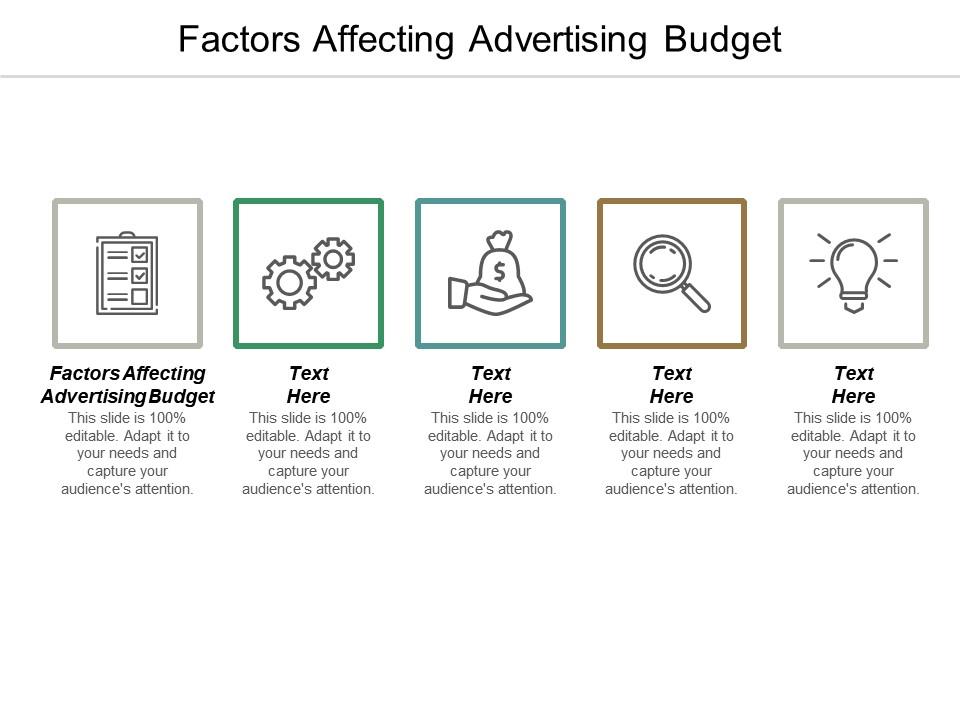
Presenting this set of slides with name Factors Affecting Advertising Budget Ppt Powerpoint Presentation Infographic Template Show Cpb. This is an editable Powerpoint five stages graphic that deals with topics like Factors Affecting Advertising Budget to help convey your message better graphically. This product is a premium product available for immediate download, and is 100 percent editable in Powerpoint. Download this now and use it in your presentations to impress your audience.

People who downloaded this PowerPoint presentation also viewed the following :

FAQs for Factors affecting advertising budget ppt powerpoint presentation infographic

Primary advertising budget components include target audience analysis, media channel costs, campaign objectives, competitive landscape assessment, and geographic market considerations. These strategic elements work together by optimizing resource allocation, maximizing reach effectiveness, and ensuring measurable ROI, with many organizations finding that balanced multi-channel approaches deliver superior customer acquisition and brand visibility.

Market research influences advertising budget effectiveness by identifying target audience preferences, optimal channel allocation, competitive pricing strategies, and messaging resonance testing. Through comprehensive market analysis, companies streamline budget distribution across high-performing platforms, minimize wasteful spending on ineffective campaigns, and maximize ROI by targeting demographics most likely to convert, ultimately delivering enhanced customer acquisition and sustainable competitive advantage.

Target audience significantly influences advertising budget by determining channel selection, message complexity, geographic reach, and campaign frequency requirements. Different demographics require varying investment levels, with younger audiences often needing digital-heavy campaigns while professional segments may demand premium placements, ultimately enabling businesses to allocate resources strategically and maximize return on advertising investment.

When choosing between digital and traditional advertising, assess audience demographics, budget constraints, campaign objectives, measurability requirements, and geographic reach needs. Digital advertising offers precise targeting, real-time analytics, and cost-effectiveness, while traditional media delivers broader reach and brand credibility, with many organizations finding that strategic combinations of both channels maximize market penetration and customer engagement across diverse demographics.

Seasonal trends significantly impact advertising budgets by creating demand fluctuations, shifting consumer behaviors, and altering competitive landscapes throughout the year. Retail businesses often allocate 40-60% of annual budgets to holiday seasons, while travel companies maximize spending during peak booking periods, ultimately requiring flexible budget structures that accommodate revenue peaks and optimize ROI timing.

Key ROI metrics include conversion rates, customer acquisition cost, lifetime value, click-through rates, and cost per acquisition across different channels. These measurements enable businesses to optimize campaign performance, reallocate resources strategically, and maximize advertising effectiveness, with many organizations finding that tracking multiple metrics simultaneously delivers clearer insights into overall marketing profitability.

Competitor advertising strategies significantly influence budget allocation by revealing market spending benchmarks, identifying underutilized channels, and highlighting messaging gaps that create opportunities. Through competitive analysis, companies can strategically redistribute resources toward high-impact platforms, adjust campaign timing to maximize share of voice, and ultimately gain competitive advantage while optimizing spend efficiency.

Brand recognition significantly influences advertising budget allocation by determining maintenance versus growth spending, channel selection priorities, and competitive positioning requirements. Companies with strong brand recognition can allocate more resources toward retention and premium messaging, while emerging brands must invest heavily in awareness campaigns across multiple touchpoints, ultimately requiring 2-3 times higher budget percentages to achieve comparable market visibility.

Changing economic conditions significantly impact advertising budgets through altered consumer spending patterns, modified market competition levels, and shifted resource allocation priorities. During economic uncertainty, many organizations find themselves balancing reduced marketing investments with the strategic need to maintain brand visibility, while economic growth periods enable increased spending for market expansion and competitive advantage.

Advertising budget allocation typically ranges from 2-10% of revenue, depending on industry maturity, growth stage, competition levels, and business objectives. Startups and rapidly growing companies often invest 10-20%, while established businesses in mature markets like manufacturing allocate 2-5%, with retail and consumer goods companies finding that 5-8% delivers optimal market presence and customer acquisition.

Cross-channel advertising strategies significantly reshape budget distribution by requiring allocation across multiple platforms, demanding integrated campaign management, and necessitating sophisticated tracking systems. This approach enables organizations to maximize reach while optimizing cost-per-acquisition, with many brands finding that strategic diversification across digital, social, and traditional channels ultimately delivers enhanced audience engagement and improved ROI.

Short-term advertising investments deliver immediate visibility and quick conversions but require continuous spending, while long-term campaigns build sustainable brand equity, customer loyalty, and market positioning. Strategic organizations increasingly balance both approaches, with retail and technology companies finding that combining tactical promotions with consistent brand messaging ultimately reduces acquisition costs and enhances competitive advantage.

Product lifecycle stage significantly impacts advertising budget allocation, with new launches requiring substantial investment for awareness building, while mature products need maintenance-level spending for retention and differentiation. Growth-stage products typically receive increased funding to capitalize on momentum, whereas declining products see reduced budgets focused on specific segments, with many companies finding that strategic timing of budget adjustments ultimately delivers better ROI and market positioning.

Creative costs significantly impact advertising expenditure through design fees, video production expenses, copywriting services, photography shoots, and ongoing content updates. These investments can range from minimal for simple campaigns to substantial for premium productions, with many companies finding that higher creative investments often deliver stronger engagement rates and better return on advertising spend, ultimately enhancing campaign effectiveness.

Flexibility in advertising budgets is crucial for responding to market shifts, consumer behavior changes, competitive pressures, and emerging opportunities effectively. Strategic budget allocation enables companies to reallocate resources quickly, capitalize on trending platforms, adjust messaging during crises, and scale successful campaigns, with many organizations finding that adaptable spending ultimately delivers better ROI and sustained competitive advantage.

Ratings and Reviews

0% of 100
Write a review
Most Relevant Reviews

No Reviews