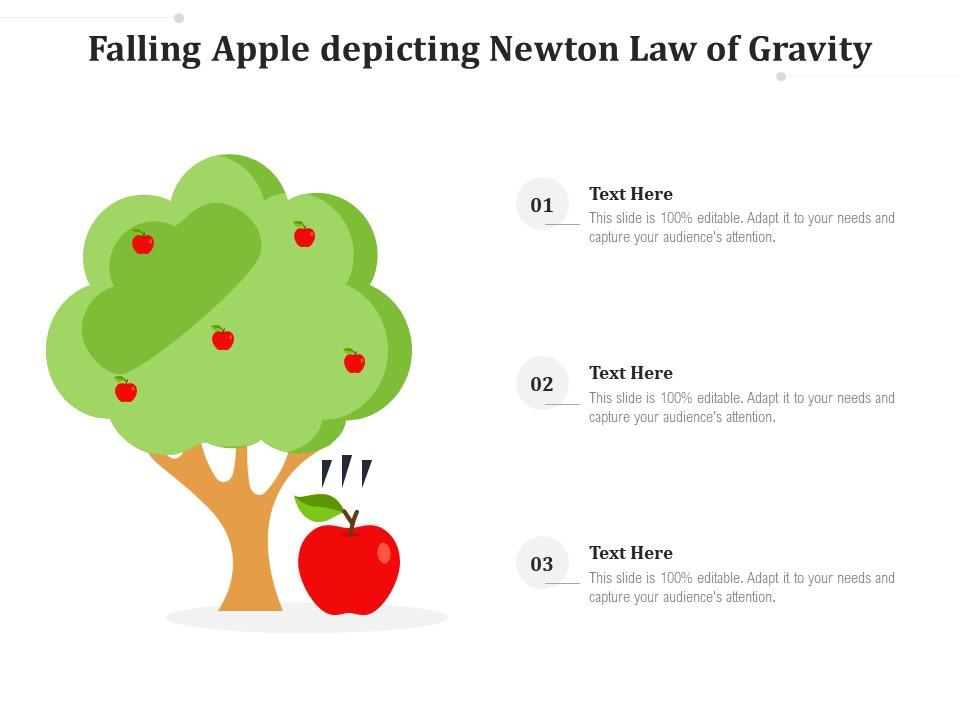
Falling apple depicting newton law of gravity

Rating:
85%
Falling apple depicting newton law of gravity
Slide 1 of 2
Favourites Favourites

Try Before you Buy Download Free Sample Product

Audience Impress Your
Audience
Editable 100%
Editable
Time Save Hours
of Time
The Biggest Sale is ending soon in
0
0
:
0
0
:
0
0
Rating:
85%
Presenting this set of slides with name Falling Apple Depicting Newton Law Of Gravity. This is a three stage process. The stages in this process are Falling Apple Depicting Newton Law Of Gravity. This is a completely editable PowerPoint presentation and is available for immediate download. Download now and impress your audience.

People who downloaded this PowerPoint presentation also viewed the following :

FAQs for Falling apple depicting newton

Newton's gravitational force formula is F = G(m₁m₂)/r², where G represents the gravitational constant, m₁ and m₂ are object masses, and r is distance between centers. This equation, derived from Newton's law of universal gravitation and observational data, enables engineers and scientists to calculate orbital mechanics, structural loads, and planetary motion with remarkable precision, ultimately delivering accurate predictions for aerospace projects, satellite positioning, and construction engineering applications.

Gravity varies significantly based on each celestial body's mass and radius, with Earth's gravity being 9.8 m/s², the Moon's approximately one-sixth of Earth's, and Jupiter's about 2.5 times stronger. These gravitational differences present both challenges and opportunities for space exploration missions, with aerospace organizations finding that understanding these variations enables more precise spacecraft navigation, efficient fuel calculations, and successful planetary landings, ultimately delivering enhanced mission success rates and reduced operational costs.

Gravity serves as the fundamental force driving cosmic structure formation, pulling together dark matter, gas, and dust to create galaxies, star clusters, and planetary systems. Through gravitational collapse and accretion processes, matter concentrates into increasingly dense regions, with galaxies like the Milky Way forming hierarchically from smaller structures, ultimately enabling star formation and the complex stellar systems we observe today.

Einstein's General Relativity redefines gravity as spacetime curvature rather than a force, where massive objects bend the fabric of space and time itself. This revolutionary framework enables precise predictions for GPS satellites, gravitational wave detection, and black hole behavior, with modern physics, astronomy, and technology sectors finding that this geometric understanding delivers unprecedented accuracy in navigation systems and cosmological research.

Gravitational waves are ripples in spacetime caused by accelerating massive objects, such as colliding black holes, neutron star mergers, and supernovae explosions. These phenomena enable astronomers to observe cosmic events previously invisible through traditional telescopes, ultimately delivering unprecedented insights into stellar evolution, dark matter distribution, and universe formation, with astrophysics institutions finding that gravitational wave detection revolutionizes our understanding of cosmic dynamics.

Gravity influences transportation through vehicle stability, braking systems, and fuel efficiency calculations, while engineering applications include structural load distribution, foundation design, and water flow systems. Through gravitational principles, architects design stable buildings, engineers optimize bridge construction and pipeline networks, and transportation systems achieve better safety margins, ultimately delivering more reliable infrastructure and efficient operational performance across industries.

Gravity and time dilation are intrinsically linked through Einstein's general relativity, where stronger gravitational fields cause time to pass more slowly relative to weaker fields. This phenomenon enables precise applications in GPS satellites, financial trading systems, and telecommunications networks, with many technology companies finding that accounting for gravitational time effects delivers enhanced accuracy and competitive operational advantage.

Microgravity affects human health through bone density loss, muscle atrophy, cardiovascular deconditioning, and fluid redistribution throughout the body. These physiological changes present significant challenges for astronauts on extended missions, with space agencies increasingly developing countermeasure technologies like resistance exercise equipment and artificial gravity systems to minimize health impacts and enable longer exploration missions.

Gravity influences tectonic plate movement through slab pull, ridge push, and mantle convection processes that drive continental drift and seafloor spreading. These gravitational forces enable subduction at oceanic trenches, mountain formation at convergent boundaries, and rift valley creation, with many geological studies finding that gravitational dynamics ultimately control earthquake patterns and volcanic activity worldwide.

Gravity influences weather patterns by pulling air masses downward, creating pressure differentials that drive wind systems, precipitation cycles, and atmospheric circulation patterns. This gravitational force also drives ocean currents by pulling denser, saltier water downward while enabling lighter water to rise, ultimately creating global circulation systems that regulate climate, distribute heat across continents, and influence regional weather conditions worldwide.

Gravity experiments in space include drop tower tests, parabolic flight studies, satellite-based measurements, International Space Station microgravity research, and lunar surface investigations. These controlled environments enable scientists to examine gravitational effects on biological systems, material properties, and fluid dynamics, with aerospace, pharmaceutical, and manufacturing industries finding that microgravity research delivers enhanced product development and competitive technological advantages.

Quantum physics explains gravity through gravitons, theoretical particles that mediate gravitational force, though they remain undetected experimentally. This approach attempts to unify gravity with other fundamental forces by treating gravitational interactions as particle exchanges, similar to electromagnetic photons, while research in quantum field theory and string theory continues exploring these mechanisms, ultimately seeking to resolve inconsistencies between general relativity and quantum mechanics.

Technology harnesses gravitational effects through physics engines, haptic feedback systems, motion simulators, augmented reality platforms, and centrifugal force generators. These technologies enable realistic simulations by calculating gravitational interactions, providing tactile responses, and creating immersive experiences, with gaming studios, training facilities, and aerospace organizations finding that accurate gravity simulation enhances user engagement and educational outcomes.

Measuring gravitational forces presents challenges including extremely weak signal detection, environmental vibration interference, temperature fluctuation effects, electromagnetic noise isolation, and precise instrument calibration requirements. These measurement difficulties require sophisticated laboratory environments, advanced shielding technologies, and ultra-sensitive detection equipment, with many research institutions finding that collaborative approaches and specialized facilities ultimately deliver more accurate data and enhanced scientific understanding.

Gravity creates these extreme cosmic phenomena through intense mass concentration, with black holes forming when gravity becomes so strong that nothing, including light, can escape their event horizons. Neutron stars result from gravitational collapse compressing stellar matter to extraordinary densities, ultimately delivering some of the universe's most powerful magnetic fields and energy emissions that astronomers increasingly study.

Ratings and Reviews

85% of 100
Write a review
Most Relevant Reviews
  1. 100%

    by Joe Thomas

    The content is very helpful from business point of view.
  2. 80%

    by Clement Patel

    Use of different colors is good. It's simple and attractive.

  3. 80%

    by Don Hansen

    Content of slide is easy to understand and edit.
  4. 80%

    by Desmond Garza

    Use of different colors is good. It's simple and attractive.

4 Item(s)

per page: