


Five year cyber information security career growth roadmap




Try Before you Buy Download Free Sample Product
 Impress Your
 Audience
 100%
100% Editable
 Save Hours
 of Time


Our Five Year Cyber Information Security Career Growth Roadmap are topically designed to provide an attractive backdrop to any subject. Use them to look like a presentation pro.
People who downloaded this PowerPoint presentation also viewed the following :
Content of this Powerpoint Presentation
Description:
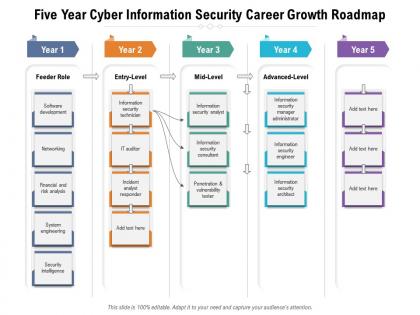
The image is a PowerPoint slide titled "Five Year Cyber Information Security Career Growth Roadmap." It outlines a progression plan for a career in information security, segmented into five years. Each year highlights key roles within the field:
Year 1:
Feeder Role – Includes foundational roles like software development, networking, financial and risk analysis, system engineering, and security intelligence.
Year 2:
Entry-Level – Positions such as information security technician, IT auditor, and incident analyst responder are typical starting points for security professionals.
Year 3:
Mid-Level – Progression to roles like information security analyst, information security consultant, and penetration & vulnerability tester.
Year 4:
Advanced-Level – These are more senior roles, including information security manager/administrator, information security engineer, and information security architect.
Year 5:
Further Development – This column has placeholders to add additional advanced roles or specializations.
Use Cases:
This career roadmap can be used across various industries, particularly those where cybersecurity is crucial:
1. Technology:
Use: Planning career paths for IT security teams.
Presenter: Chief Information Security Officer (CISO).
Audience: IT professionals, HR managers.
2. Finance:
Use: Developing cybersecurity expertise in banking and finance.
Presenter: Security Compliance Manager.
Audience: Financial analysts, cybersecurity staff.
3. Healthcare:
Use: Ensuring patient data protection through advanced security roles.
Presenter: Health Information Manager.
Audience: IT staff, healthcare administrators.
4. Government:
Use: Structuring the growth of personnel in charge of protecting sensitive government data.
Presenter: Government IT Security Head.
Audience: Public sector IT workers, policy makers.
5. Education:
Use: Creating academic programs for cybersecurity careers.
Presenter: Academic Dean of Computer Science.
Audience: Students, academic advisors.
6. Retail:
Use: Safeguarding customer data and financial transactions.
Presenter: Retail Data Protection Officer.
Audience: Retail management, security teams.
7. Telecommunications:
Use: Protecting infrastructure and customer data from cyber threats.
Presenter: Telecom Network Security Manager.
Audience: Network engineers, cybersecurity specialists.
Five year cyber information security career growth roadmap with all 2 slides:
Use our Five Year Cyber Information Security Career Growth Roadmap to effectively help you save your valuable time. They are readymade to fit into any presentation structure.
FAQs for Five year cyber information security
Start with networking basics - TCP/IP, how data moves around, that kind of stuff. You'll want to get comfortable with Linux and Windows systems too. Python or PowerShell scripting helps a ton (I was terrified of coding at first but honestly it's not that bad). Problem-solving skills matter just as much as the tech side since you're constantly figuring out what went wrong or spotting weird patterns. CompTIA Security+ is a solid first cert. After that, pick something specific like incident response or pen testing - way better than trying to learn everything at once.
Honestly, just compare your skills to what's actually posted in job descriptions - that'll tell you everything. Build a home lab and mess around with real scenarios. CTF competitions are gold for this stuff, way better than just cramming theory. I'd also check out some open source security projects if you have time (though those can be intimidating at first). The real test? Can you explain WHY something works, not just HOW. If you're solving actual problems and not just memorizing definitions, you're probably ready to start throwing applications out there.
Dude, Security+ is where you wanna start - seriously, government jobs eat that stuff up. CISSP is the holy grail but you'll need some actual work experience first, which is annoying. CEH rocks if you're into the hacker side of things. Oh and cloud stuff is everywhere now, so AWS Security or Azure certs are clutch. My buddy just landed a sweet gig with his AWS cert actually. Don't go overboard though - I see people collecting certs like Pokemon cards. Pick 2-3 max and really know your shit inside out.
Honestly, just start somewhere in IT - help desk might sound boring but you'll learn tons about how stuff actually breaks. SOC analyst jobs are perfect for beginners since you see real attacks happen daily. Network admin or IT support roles work too. Don't sleep on junior pen testing or compliance gigs either. The trick is not waiting around for that "perfect" cybersecurity position. Jump into any tech role first, then pivot once you've got some credibility. I know people who started fixing printers and ended up in incident response lol.
Dude, networking is huge in cybersecurity - maybe even more than your actual tech skills tbh. Most good jobs don't even hit job boards. Check out your local ISACA or OWASP meetups, and BSides conferences are usually dirt cheap. Twitter and LinkedIn work too, but you can't just scroll endlessly (guilty of this myself). Actually comment on stuff and share things that don't suck. People in cybersec are pretty cool if you're not trying to sell them something. Just pick one meetup and go this month.
Dude, you absolutely have to keep learning in cybersecurity - like, it's make or break for your career. New threats pop up literally every day and hackers are constantly switching up their methods. I've watched good people get left behind because they thought their current skills were enough. Bad move. You need fresh certifications, read security blogs, maybe join some communities online. Oh and actually practice with new tools too - that's huge. Even setting aside like 30 minutes weekly helps. The field moves so fast that if you're not growing, you're basically going backwards.
Honestly, just spend like 15 minutes a day scrolling through security news and you'll get the hang of it pretty quick. I follow a bunch of security researchers on Twitter - they're always posting about the latest stuff. SANS newsletters are solid, and Krebs on Security is basically required reading. Reddit's cybersecurity community is surprisingly decent too. Set up some Google Alerts for threats that actually matter to your company. Oh, and I'm totally guilty of refreshing CVE databases way too much, but whatever - it works! Local meetups are clutch for networking if you can swing it.
So Security+ is perfect if you're just starting out - covers all the fundamentals and actually gets you hired. CEH is more about the hacking side, penetration testing and all that (though the day-to-day reality isn't as exciting as it sounds, trust me). CISSP though? That's the heavy hitter for management positions. You can't even sit for it without 5 years of experience first. It's less about technical stuff and more governance, risk assessment, big picture strategy. I'd say start with Security+ no matter what, then decide if you want the technical route with CEH or aim for leadership with CISSP down the road.
So there are four main paths - security analyst, pen tester, security engineer, and incident responder. Different day-to-day stuff but similar growth potential. You'll usually start as an analyst or some junior role, then specialize in areas like cloud security or compliance before hitting senior positions. Honestly, the field's pretty chill about switching between paths if you get bored. Most people end up doing management, consulting, or going super technical after like 5-7 years. Really depends if you want to stay hands-on or deal with managing people (ugh). Just pick one to start, grab some certs, and pivot later once you figure out what doesn't make you want to quit.
Dude, soft skills are literally what make or break cybersecurity careers. When you're explaining threats to executives, they don't care about technical jargon - they want to know how it affects business. Critical thinking helps you spot patterns that tools miss. You'll constantly work with different teams during incidents, so being collaborative matters more than you'd think. Plus attackers change tactics all the time, so adaptability is huge. Honestly, I'd start practicing now by volunteering for presentations or maybe leading some cross-department stuff. It's way harder to develop these skills later when you're already buried in work.
Dude, you gotta get some hands-on stuff on your resume - internships, home labs, whatever. Cybersecurity isn't one of those fields where you can just memorize theory and call it a day. Real experience separates you from everyone else who only has certs. That vulnerability scanner you set up at home? Perfect. Document it. Your GitHub should actually show what you can do, not just sit there empty. Even small projects work. These give you stories for interviews instead of just rambling about textbook scenarios. Honestly, employers can smell the difference between someone who's actually touched the tools versus someone who hasn't.
So they'll usually start with the resume thing, then a quick phone call to make sure you're not totally weird. Technical stuff comes next - labs, scenarios, whiteboard nonsense (ugh). Panel interviews are pretty common too, which can be intimidating but whatever. Whole thing takes like 2-4 weeks if they don't drag their feet. Definitely review your basics beforehand. Have some good stories ready about security problems you've actually fixed. Oh, and flip the script - ask them about their security setup during the interview. Shows you're thinking strategically.
Honestly, the field feels massive and you won't know where to start - like should I do penetration testing or maybe incident response? Then there's that stupid catch-22 where everyone wants experience but won't hire you to get it. New threats pop up constantly too, so you're always playing catchup. Imposter syndrome is real when everyone around you seems like a walking encyclopedia. But here's what worked for me: just pick ONE thing to focus on first. Build a home lab, mess around with some tools. Don't overlook help desk or IT support roles either - they're actually solid stepping stones.
Dude, your IT background is honestly perfect for this. You already get networks and systems, plus you know how stuff breaks - that's literally half of cybersecurity right there. I'd jump into TryHackMe or Hack The Box to learn the attacker side of things. Security+ is probably worth getting too, just to prove you're not messing around. The cool thing is there's usually a natural path - network guys often slide into network security, sysadmins end up doing incident response. Oh, and definitely volunteer for any security stuff at work if you can. Experience beats everything else in this field.
Dude, get yourself a mentor ASAP. They're like having cheat codes for this field. Mine saved me from so many stupid mistakes early on and actually taught me what skills companies care about (spoiler: half the stuff you think matters doesn't). They'll hook you up with real opportunities too, not just the ones posted on LinkedIn. Plus someone who's been around can give you the honest take on salaries and which companies are actually decent to work for. I probably wouldn't have figured out incident response was my thing without that guidance. Start reaching out to people you respect and join some communities - most cybersec folks love helping newbies out.
-
Illustrative design with editable content. Exceptional value for money. Highly pleased with the product.
-
Wonderful templates design to use in business meetings.
-
Unique research projects to present in meeting.
-
Informative presentations that are easily editable.
-
Qualitative and comprehensive slides.
-
Excellent products for quick understanding.