

Fix And Flip Process For Property Renovation Powerpoint Presentation Slides





Try Before you Buy Download Free Sample Product
 Impress Your
 Audience
 100%
100% Editable
 Save Hours
 of Time


House flipping refers to buyers buying distressed properties, renovating them, and then selling them for a profit in the market. They find these properties through foreclosures, short bank sales, or property auctions. This PowerPoint Execution of Successful Fix and Flip Process for Property Renovation represents an overview of the house flipping market, such as an overview of statistics for investors and the real estate property market. It also covers primary classes for flippers, strategies, challenges, mistakes, financial risks, processes, and timelines for house flipping projects. This PPT highlights research on the real estate market through rental market analysis, neighbor analysis, property assessment, and comparative market analysis. It showcases fund allocation, budgeting expenditures, estimated costs, and the online listing for a real estate property, professionals, and marketing platforms. It also covers costing, steps for fix and flip, key members, types of loans and significant lenders, hiring contractors, and a checklist for contractor activities. Lastly, this PowerPoint PPT depicts steps for selling properties, key documents required, a checklist for house flipping, section highlights for home flipping business plan, and real estate flipping impact on the local community and personal growth. Download it now.
People who downloaded this PowerPoint presentation also viewed the following :
Content of this Powerpoint Presentation
Slide 1: This slide displays the title Fix and Flip Process for Property Renovation.
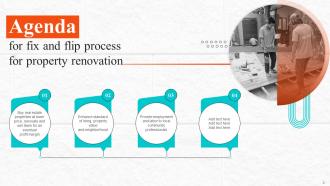
Slide 2: This slide displays the title Agenda for fix and flip process for property renovation.
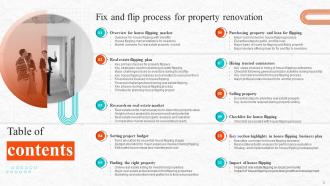
Slide 3: This slide exhibit table of content.
Slide 4: This slide showcase table of content that is to be discuss further.
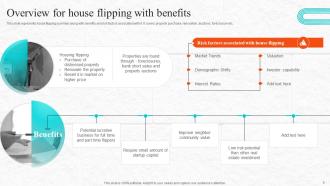
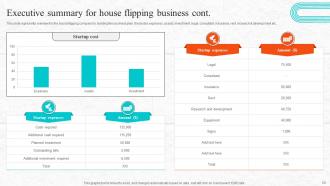
Slide 5: This slide represents house flipping summary along with benefits and risk factors associated with it.
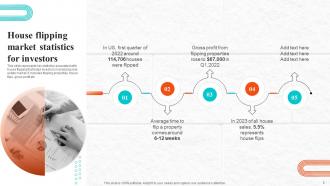
Slide 6: This slide represents key statistics associated with house flipping that helps investors in analyzing real estate market.
Slide 7: This slide represents real estate market summary that helps investors in decision making.
Slide 8: This slide represents real estate market summary that helps investors in decision making.
Slide 9: This slide showcase table of content that is to be discuss further.
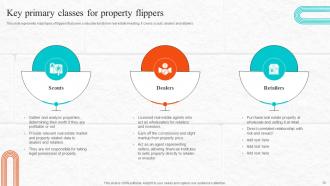
Slide 10: This slide represents major types of flippers that serve a valuable function in real estate investing.
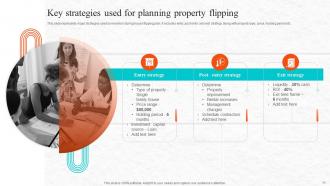
Slide 11: This slide represents major strategies used by investors during house flipping plan.
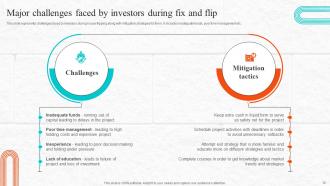
Slide 12: This slide represents challenges faced by investors during house flipping along with mitigation strategies for them.
Slide 13: This slide represents key mistake made by house flippers during fix and flip process along with remedies.
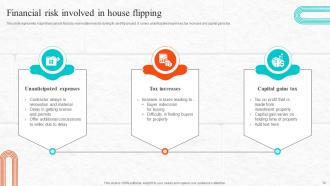
Slide 14: This slide represents major financial risk faced by real estate investor during fix and flip project.
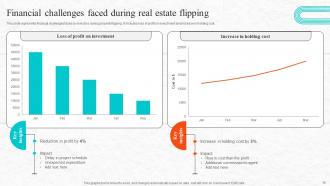
Slide 15: This slide represents financial challenges faced by investors during property flipping.
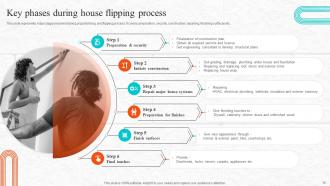
Slide 16: This slide represents major stages involved during property fixing and flipping process.
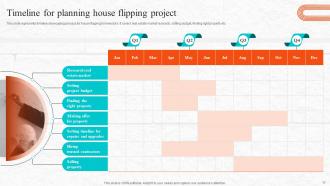
Slide 17: This slide represents timeline showcasing process for house flipping for investors.
Slide 18: This slide showcase table of content that is to be discuss further.
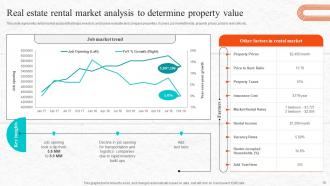
Slide 19: This slide represents rental market analysis that helps investors and buyers evaluate and compare properties.
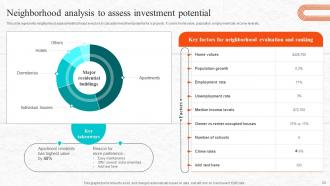
Slide 20: This slide represents neighborhood assessment that helps investors to calculate investment potential for a property.
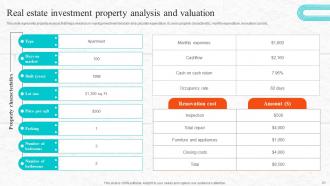
Slide 21: This slide represents property analysis that helps investors in making investment decision and calculate expenditure.
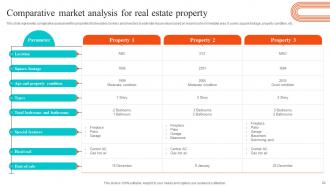
Slide 22: This slide represents comparative assessment for properties that enables brokers and investors to estimate house value based on recent sod in immediate area.
Slide 23: This slide showcase table of content that is to be discuss further.
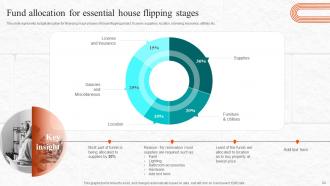
Slide 24: This slide represents budget allocation for financing major phases of house flipping project.
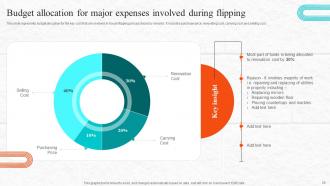
Slide 25: This slide represents budget allocation for the key cost that are involved in house flipping process faced by investor.
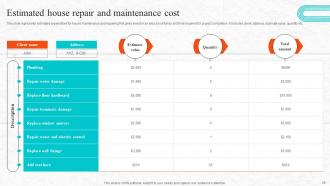
Slide 26: This slide represents estimated expenditure for house maintenance and repairing that gives investor an idea about funds and time required for project completion.
Slide 27: This slide showcase table of content that is to be discuss further.
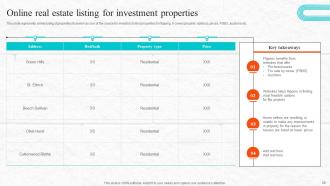
Slide 28: This slide represents online listing of properties that work as one of the source for investors to find properties for flipping.
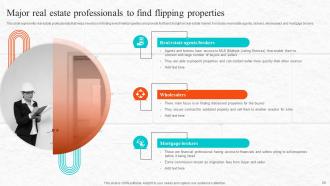
Slide 29: This slide represents real estate professionals that helps investors in finding investment properties and provide firsthand insight on real estate market.
Slide 30: This slide represents major marketing platforms used by buyers to connect and find homeowners willing to sell properties.
Slide 31: This slide showcase table of content that is to be discuss further.
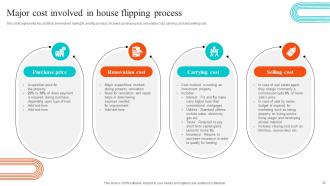
Slide 32: This slide represents key cost that are involved during fix and flip process.
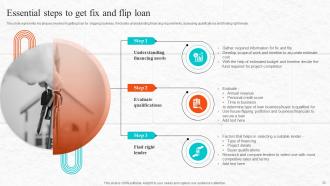
Slide 33: This slide represents key phases involved in getting loan for slipping business.
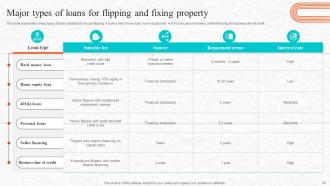
Slide 34: This slide represents various types of loans available for house flipping.
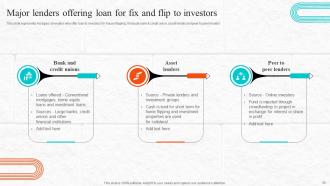
Slide 35: This slide represents key types of lenders who offer loan to investors for house flipping.
Slide 36: This slide showcase table of content that is to be discuss further.
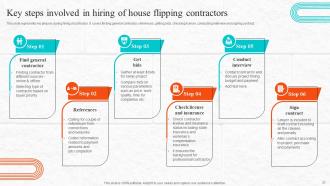
Slide 37: This slide represents key phases during hiring of contractor.
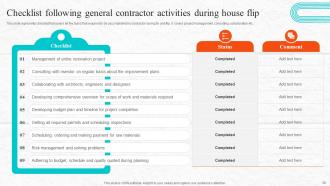
Slide 38: This slide represents checklist that covers all the tasks that required to be accomplished by contractor during fix and flip.
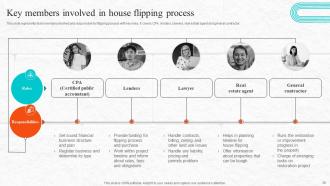
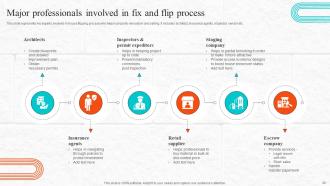
Slide 39: This slide represents team members involved and responsible for flipping process with key roles.
Slide 40: This slide represents key experts involved in house flipping process who help in property renovation and selling.
Slide 41: This slide showcase table of content that is to be discuss further.
Slide 42: This slide represents key steps to market house and reach out to potential buyers.
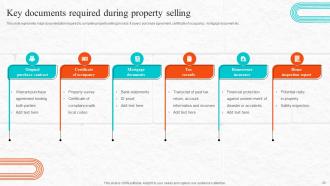
Slide 43: This slide represents major documentation required to complete property selling process.
Slide 44: This slide showcase table of content that is to be discuss further.
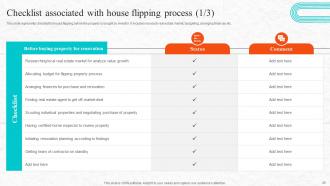
Slide 45: This slide represents checklist for house flipping before the property is bought by investor.
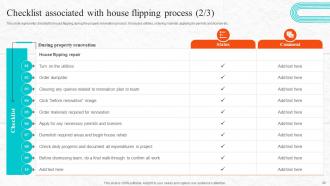
Slide 46: This slide represents checklist for house flipping during the property renovation process.
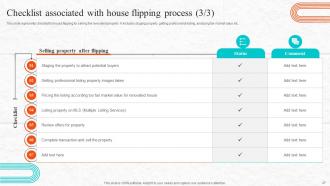
Slide 47: This slide represents checklist for house flipping for selling the renovated property.
Slide 48: This slide showcase table of content that is to be discuss further.
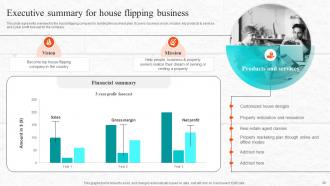
Slide 49: This slide represents overview for the house flipping company for building the business plan.
Slide 50: This slide represents overview for the house flipping company for building the business plan.
Slide 51: This slide represents industry analysis and performance assessment for real estate market to build business plan.
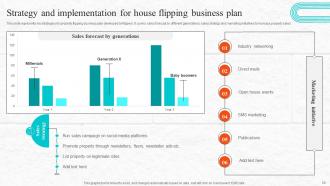
Slide 52: This slide represents key strategies for property flipping business plan developed by flippers.
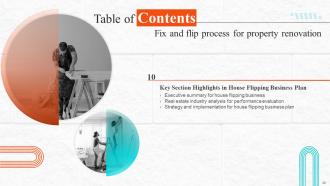
Slide 53: This slide showcase table of content that is to be discuss further.
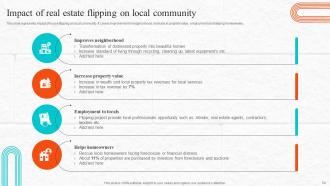
Slide 54: This slide represents impact of house flipping on local community.
Slide 55: This slide represents impact of property flipping on individual growth and development.
Slide 56: This is the icons slide.
Slide 57: This slide presents title for additional slides.
Slide 58: This slide shows about your company, target audience and its client's values.
Slide 59: This slide presents your company's vision, mission and goals.
Slide 60: This slide showcase the title Our team.
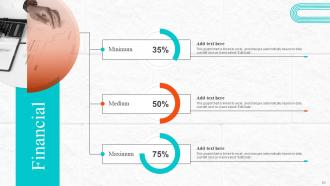
Slide 61: This slide display Financial.
Slide 62: This slide shows puzzle for displaying elements of company.
Slide 63: This slide display Venn diagram.
Slide 64: This slide depicts posts for past experiences of clients.
Slide 65: This slide depicts 30-60-90 days plan for projects.
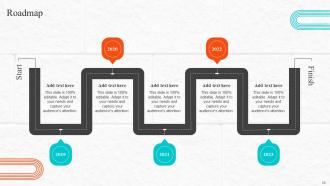
Slide 66: This slide showcase Roadmap.
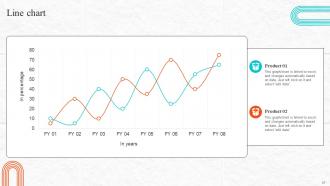
Slide 67: This slide exhibits yearly profits stacked line charts for different products.
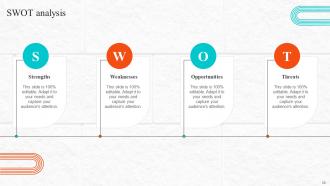
Slide 68: This slide display SWOT analysis.
Slide 69: This is thank you slide & contains contact details of company like office address, phone no., etc.
Fix And Flip Process For Property Renovation Powerpoint Presentation Slides with all 74 slides:
Use our Fix And Flip Process For Property Renovation Powerpoint Presentation Slides to effectively help you save your valuable time. They are readymade to fit into any presentation structure.























FAQs for Fix And Flip Process For Property Renovation
Okay so first figure out these four numbers: ARV (what it'll sell for fixed up), renovation costs, what you're paying for it, and monthly holding costs. Never pay more than 70% of ARV minus repairs - that's like the golden rule. Here's the thing though - everyone screws up repair estimates when they start out, so add at least 20% to whatever you think it'll cost. Calculate your monthly burn rate too because these projects drag on forever. My buddy learned that the hard way. If you're not looking at 15-20% profit after everything, just pass and find something better.
Look for comps from the last 3-6 months, quarter-mile radius max. Similar square footage and bed/bath count matter most. I usually cross-reference MLS with Zillow or Redfin - gives you better coverage. Ignore listing prices though, they're basically fantasy numbers half the time. Focus on actual sales and check days on market too. Quick sales? Those prices were probably realistic. If you can swing it, walk around the neighborhood a bit. Gets you a better sense of where things are headed. Oh and always lowball your estimates rather than getting excited about best-case scenarios. Trust me on that one.
Dude, biggest mistake is totally underestimating costs and time - add like 20-30% to whatever you think. Don't over-improve either, you'll never get that money back if you're putting marble counters in a neighborhood of laminate. Skip the inspection at your own risk. Oh and here's what kills people - they get emotionally attached and hold onto places way too long instead of flipping fast. I've seen it happen so many times. Set your budget and timeline upfront, then actually stick to them. Cash flow beats everything else in this game.
So here's what I do - start with that 70% rule everyone talks about. Take your ARV, multiply by 0.7, subtract what you're paying and your profit margin. Whatever's left? That's your reno budget max. But honestly, add another 15-20% cushion because something always breaks or costs more than expected. Three contractor quotes minimum to make sure you're not living in fantasy land. Focus on stuff that actually sells houses - kitchens and bathrooms are your best bet. Skip the fancy marble counters unless you're flipping in Beverly Hills or something.
Dude, location is EVERYTHING - seriously can't stress this enough. Buy in neighborhoods that are already decent or clearly getting better. Good schools, low crime rates, nice amenities nearby. I totally screwed this up on my second flip and learned the hard way lol. Even if you do the most amazing renovation, nobody's gonna buy if it's in a sketchy area that's going downhill. Cheap doesn't always mean profitable, you know? Always check recent comps and how long houses sit on the market first. You need buyers fast or your margins disappear.
Focus on kitchens and bathrooms first - that's where you'll see the biggest return. Buyers obsess over these spaces, and good updates can bump your value 15-25%. New flooring throughout is your next move, hardwood or luxury vinyl makes everything look pulled together. Obviously paint is a must since it's dirt cheap but totally changes how a place feels. Honestly, I'd skip the fancy crown molding and expensive fixtures unless you're flipping in a really upscale area. Those four things should eat up most of your budget anyway.
Dude, market conditions totally control your flip timeline and budget. Hot markets? You can get away with lighter renos - buyers will snatch up anything with fresh paint, it's crazy. Slow markets mean you gotta go all out to beat the competition. Higher interest rates shrink your buyer pool, so expect longer holding times or aggressive pricing. I always pull local market data first before deciding how deep to go with renovations. Oh, and your exit strategy might need tweaking based on what's happening in your area too.
For fix and flips, hard money loans are basically made for this stuff. Yeah, you'll pay 10-15% interest which sucks, but the speed is worth it since they're asset-based. Private lenders work great too if you know anyone with cash sitting around. Some people I know use business credit lines or team up with other investors to split everything. Cash would be amazing obviously, but who has that kind of money lying around? Just make sure you factor in all those financing costs upfront when you're running your numbers - I've seen too many people get screwed because they didn't account for the higher rates properly.
Honestly, your team will make or break everything. I learned this when my contractor literally disappeared halfway through my second flip - nightmare! You want people who actually show up and don't blow your budget. Good contractors, agents, inspectors who get that you're working fast. The cool part? Once you find solid people, they'll hook you up with other reliable pros they know. So start building those connections now, even before your first deal. Interview a few contractors, check their references, maybe grab coffee. Trust me, having that network ready is huge when you're scrambling to close on time.
Honestly, start with MLS searches and filter for stuff like "TLC" or "handyman special" - that's where I found my first flip. Drive around neighborhoods you're targeting too. Sounds boring but you'll spot houses with overgrown yards that aren't listed yet. Build relationships with wholesalers and agents who do investment deals - they get first dibs on everything. Probate records are gold if you can handle the paperwork headache. Direct mail to absentee owners works but takes forever to see results. Oh, and set Google alerts for estate sales nearby. Don't try everything at once though. Pick two methods, actually get good at them, then add more.
Break it into phases first - demo, structural, mechanicals, finishes, staging. Can't do electrical before framing's done (trust me on this one). I always add like 20-30% extra time because contractors are way too optimistic and random stuff breaks. Oh and permits - get those rolling early or they'll murder your timeline. Simple spreadsheet works fine for tracking start/end dates per trade. The trick is being honest about what can actually overlap vs what has to happen in order. Most people mess this up and wonder why everything's delayed.
First thing - get your permits sorted before doing anything major. Electrical, plumbing, structural stuff all needs paperwork. Your purchase contract should have inspection contingencies so you can bail if there's serious problems. Title insurance is a must (trust me on this one). Check zoning restrictions too - they might block what you want to do. Oh, and contractors need to be licensed and insured or you're screwed if something goes wrong. Document everything for taxes. I know it sounds like a lot but it'll save you headaches later.
Dude, don't skip staging - I've watched so many people make that mistake. You'll get 5-10% more on your sale price, sometimes even higher. Empty rooms just look weird and smaller than they actually are. Buyers end up noticing every little flaw instead of picturing their stuff in there. Basic rental furniture and some decent decor totally changes how a place feels. Yeah, you're looking at maybe 1-2% of your sale price upfront, but honestly? The return is almost always worth it. Makes your listing pop compared to all those sad empty houses online.
Look, DIY cuts labor costs but man does it chew through your time. Paint and flooring? Go for it. But electrical and plumbing? Don't even think about it unless you actually know your stuff. Professionals cost way more - we're talking 20-30% of your budget just for labor, which honestly hurts. They're faster though, and they won't accidentally flood your basement or burn the place down. I learned that one the hard way on my second flip. Stick to cosmetic work yourself, hire pros for anything structural or safety-related. You'll save decent money without totally screwing your margins.
Know your numbers cold first - max price based on ARV, rehab costs, profit margin. Cash offers are gold even when they're lower than financed ones. Always start below your max since you can go up but never down. I'd hunt for motivated sellers - estates, divorces, people in financial trouble. Bring comps and repair estimates to back up your lowball offer. Honestly, the hardest part is not falling in love with a property. You'll want to justify overpaying because the kitchen's gorgeous or whatever, but stick to your spreadsheet no matter what. Keep multiple deals in your pipeline so you won't get desperate and make stupid decisions.
-
I’m not a design person, so I couldn’t make a presentation to save my life. Thankfully, they have all kinds of templates that I regularly use for my work.
-
I loved the hassle-free signup process. A few minutes and, I had this giant collection of beautiful designs.