Fixed investment analysis powerpoint presentation slides

Rating:
88%
Fixed investment analysis powerpoint presentation slides
Slide 1 of 39
Favourites Favourites

Try Before you Buy Download Free Sample Product

Audience Impress Your
Audience
Editable 100%
Editable
Time Save Hours
of Time
The Biggest Sale is ending soon in
0
0
:
0
0
:
0
0
Rating:
88%
Presenting this set of slides with name - Fixed Investment Analysis Powerpoint Presentation Slides. Putting forth our PPT deck comprises of thirty-nine slides. Our tailor-made Fixed Investment Analysis Powerpoint Presentation Slides editable presentation deck assists planners in the segment and expounds the topic with brevity. The advantageous slides on Fixed Investment Analysis Powerpoint Presentation Slides are braced with multiple charts and graphs, overviews, analysis templates agenda slides, etc. to help boost important aspects of your presentation. Download PowerPoint templates in both widescreen and standard screen. The presentation is fully supported by Google Slides. It can be easily converted into JPG or PDF format.

Content of this Powerpoint Presentation


Slide 1: This slide introduces Fixed Investment Analysis. State Your Company Name and begin.
Slide 2: This slide shows Content of the presentation.
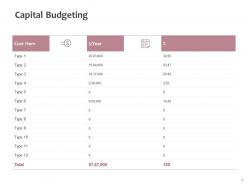
Slide 3: This slide presents Capital Budgeting in tabular form.
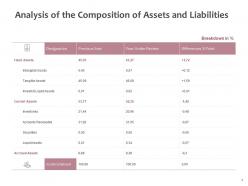
Slide 4: This slide displays Analysis of the Composition of Assets and Liabilities.
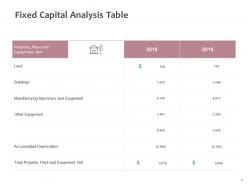
Slide 5: This slide represents Fixed Capital Analysis Table with previous and curent year.
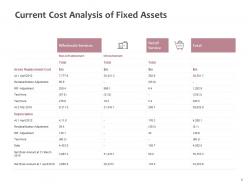
Slide 6: This slide showcases Current Cost Analysis of Fixed Assets including wholesale and retail services.
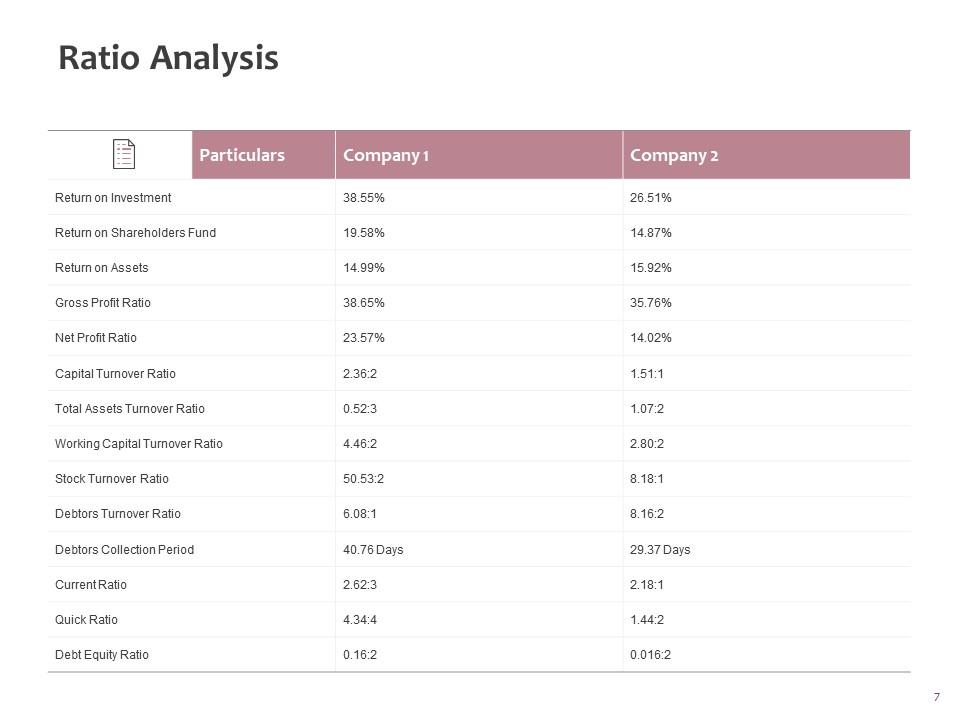
Slide 7: This slide shows Ratio Analysis in tabular form.
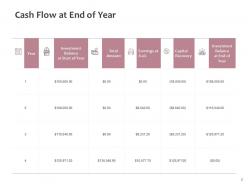
Slide 8: This slide presents Cash Flow at End of Year with investment balance, earning rate and capital recovery.
Slide 9: This slide displays Fixed Assets Annual Report with depriciation included.
Slide 10: This is another slide continuing Fixed Assets Annual Report.
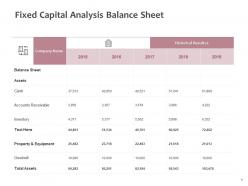
Slide 11: This slide represents Fixed Capital Analysis Balance Sheet.
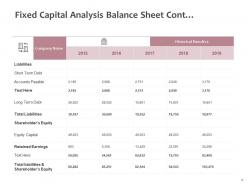
Slide 12: This is another slide continuing Fixed Capital Analysis Balance Sheet.
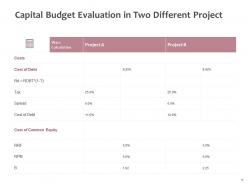
Slide 13: This slide showcases Capital Budget Evaluation in Two Different Project.
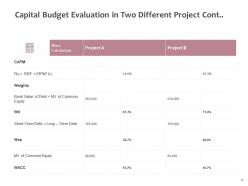
Slide 14: This is another slide continuing Capital Budget Evaluation in Two Different Project.
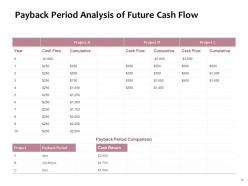
Slide 15: This slide shows Payback Period Analysis of Future Cash Flow.
Slide 16: This slide presents Marketing Return on Investment (ROI).
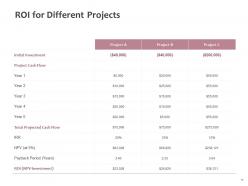
Slide 17: This slide displays ROI for Different Projects.
Slide 18: This slide represents Cost Summary Roi Analysis Example.
Slide 19: This slide showcases Four Stages of Return Investment Model as- Exposure, Engagement, Influence, Action.
Slide 20: This slide shows ROI Calculation Tables on yearly basis.
Slide 21: This slide presents Payback Table with working capital, cash profit, loss of income, net cash flow etc.
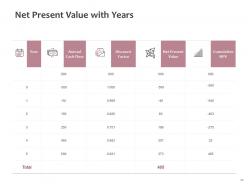
Slide 22: This slide displays Net Present Value with Years.
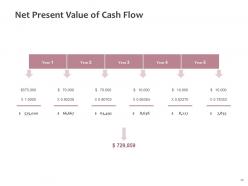
Slide 23: This slide represents Net Present Value of Cash Flow.
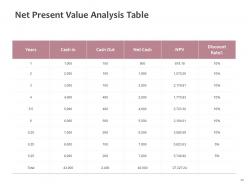
Slide 24: This slide showcases Net Present Value Analysis Table.
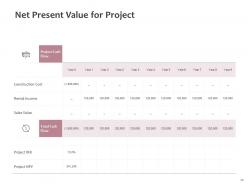
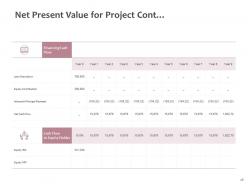
Slide 25: This slide shows Net Present Value for Project.
Slide 26: This is another slide continuing Net Present Value for Project.
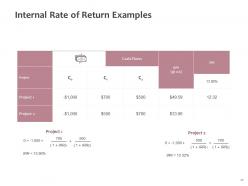
Slide 27: This slide presents Internal Rate of Return Examples.
Slide 28: This slide reminds about 15 minutes Coffee Break.
Slide 29: This slide displays Fixed Investment Analysis Icons.
Slide 30: This slide is titled as Additional Slides for moving forward.
Slide 31: This is About Us slide to show company specifications etc.
Slide 32: This is Meet Our Team slide with names and designation.
Slide 33: This is Our Mission slide with related imagery and text.
Slide 34: This is an Idea Generation slide to state a new idea or highlight information, specifications etc.
Slide 35: This is Meet Our Team slide with names and designation.
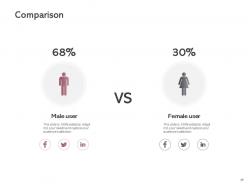
Slide 36: This is a Comparison slide to state comparison between commodities, entities etc.
Slide 37: This slide shows Company Goal. State your main goals here.
Slide 38: This is a Puzzle slide with text boxes.
Slide 39: This is a Thank You slide with address, contact numbers and email address.

FAQs for Fixed investment analysis

Fixed investment analysis includes initial capital costs, projected cash flows, depreciation schedules, tax implications, and risk assessments. These components work together by evaluating asset acquisition costs, operational returns, and strategic value, with many manufacturing and technology companies finding that comprehensive analysis streamlines resource allocation, minimizes financial risk, and ultimately delivers measurable ROI and competitive advantage.

Fixed investment drives economic growth by expanding productive capacity, creating employment opportunities, and stimulating demand across supply chains. Through infrastructure development, manufacturing expansion, and technology adoption, countries experience multiplier effects where initial investments generate additional economic activity, with many economies finding that sustained capital formation in sectors like transportation, energy, and industrial facilities ultimately delivers higher productivity, increased competitiveness, and accelerated GDP growth rates.

Common methods for evaluating fixed investment risk include sensitivity analysis, scenario analysis, Monte Carlo simulation, break-even analysis, and value-at-risk assessments. These approaches enable organizations to quantify potential volatility, model different market conditions, and assess downside exposure, with many financial institutions finding that combining multiple risk evaluation techniques ultimately delivers more robust investment decisions and enhanced portfolio management.

Interest rates significantly influence fixed investment decisions by affecting borrowing costs, project profitability calculations, and competitive return thresholds for capital allocation. When rates are low, companies find financing expansion, equipment purchases, and infrastructure projects more attractive, while higher rates often delay investments as organizations reassess ROI expectations, ultimately impacting strategic growth timing and resource deployment across industries.

Depreciation reduces taxable income while providing tax shields, significantly impacting cash flow calculations and investment returns in fixed investment analysis. This non-cash expense affects project valuation through lower tax obligations, with many organizations finding that accelerated depreciation methods enhance early-year cash flows, ultimately improving net present value and investment attractiveness.

Fixed investment can be modeled through capital expenditure forecasting, depreciation schedules, asset replacement cycles, and capacity planning models that align with business growth projections. These approaches enable organizations to integrate fixed asset investments with cash flow projections, budget planning, and strategic resource allocation, while manufacturing and retail companies increasingly find that systematic modeling delivers improved capital efficiency and more accurate long-term financial planning.

Underestimating fixed investment needs leads to cash flow shortages, project delays, compromised quality standards, and potential business interruptions that can damage competitiveness. Organizations often face costly emergency financing, reduced operational efficiency, and missed market opportunities, with many companies finding that inadequate initial investment planning ultimately increases total project costs significantly.

Market trends significantly influence fixed investment strategies by affecting asset valuations, interest rate environments, and sector performance expectations across different economic cycles. Financial institutions and portfolio managers increasingly adapt their fixed investment approaches by reallocating resources toward resilient sectors, adjusting duration strategies based on rate forecasts, and incorporating ESG considerations, ultimately delivering more responsive portfolios that capitalize on emerging opportunities while maintaining long-term stability.

Essential metrics for assessing fixed investment performance include return on investment (ROI), net present value (NPV), internal rate of return (IRR), payback period, and profitability index. These financial indicators enable organizations to evaluate project viability, compare investment alternatives, and optimize capital allocation decisions, with many companies finding that comprehensive metric analysis ultimately delivers better resource management and enhanced competitive positioning.

Fixed investment varies significantly across industries based on capital intensity, regulatory requirements, and operational needs. Manufacturing and utilities require substantial machinery and infrastructure investments, while service sectors like consulting focus more on technology and human capital, with industries like healthcare balancing equipment costs against regulatory compliance demands for optimal resource allocation.

Fixed investments present both challenges and opportunities through depreciation deductions, capital gains treatment, and potential tax credits for qualifying assets. These benefits streamline tax planning by reducing taxable income through annual depreciation, enabling deferred taxation on asset appreciation, and delivering immediate credits for energy-efficient equipment, with many organizations finding strategic timing enhances overall investment returns.

Technology advancements enhance fixed investment planning through AI-powered predictive analytics, real-time data integration, automated risk assessment tools, and cloud-based portfolio management platforms. These technologies streamline decision-making by identifying optimal investment opportunities, minimizing operational costs, and accelerating project evaluation timelines, with financial institutions and manufacturing companies finding that automated analysis delivers significantly improved resource allocation and competitive advantage.

Government policy significantly influences fixed investment analysis through tax incentives, regulatory frameworks, infrastructure spending, interest rate policies, and depreciation schedules. These policy tools directly impact project cash flows, risk assessments, and return calculations, with many organizations finding that policy changes can transform investment viability, ultimately requiring businesses to continuously monitor regulatory environments for strategic advantage.

Companies quantify fixed investment returns through net present value (NPV), internal rate of return (IRR), payback period calculations, and return on investment (ROI) metrics. These financial tools enable organizations to compare investment opportunities systematically, with manufacturing and healthcare sectors particularly finding that comprehensive analysis streamlines capital allocation decisions, ultimately delivering measurable competitive advantage and improved operational efficiency.

Monitoring fixed investment challenges include data fragmentation across systems, tracking depreciation accurately, ensuring compliance with changing regulations, managing asset lifecycle complexities, and maintaining real-time visibility into performance metrics. These obstacles often result in delayed decision-making, inefficient resource allocation, and missed optimization opportunities, with many organizations finding that streamlined monitoring systems ultimately deliver better asset utilization and improved financial forecasting.

Ratings and Reviews

88% of 100
Review Form
Write a review
Most Relevant Reviews
  1. 80%

    by Smith Gomez

    The Designed Graphic are very professional and classic.
  2. 80%

    by Dusty Hoffman

    Unique and attractive product design.
  3. 80%

    by Daren Henry

    Appreciate the research and its presentable format.
  4. 100%

    by Dominique Vazquez

    Qualitative and comprehensive slides.
  5. 100%

    by Danny Kennedy

    Enough space for editing and adding your own content.

5 Item(s)

per page: