Four financial planning strategies in roadmap

Rating:
100%
Four financial planning strategies in roadmap
Slide 1 of 2
Favourites Favourites

Try Before you Buy Download Free Sample Product

Audience Impress Your
Audience
Editable 100%
Editable
Time Save Hours
of Time
The Biggest Sale is ending soon in
0
0
:
0
0
:
0
0
Rating:
100%
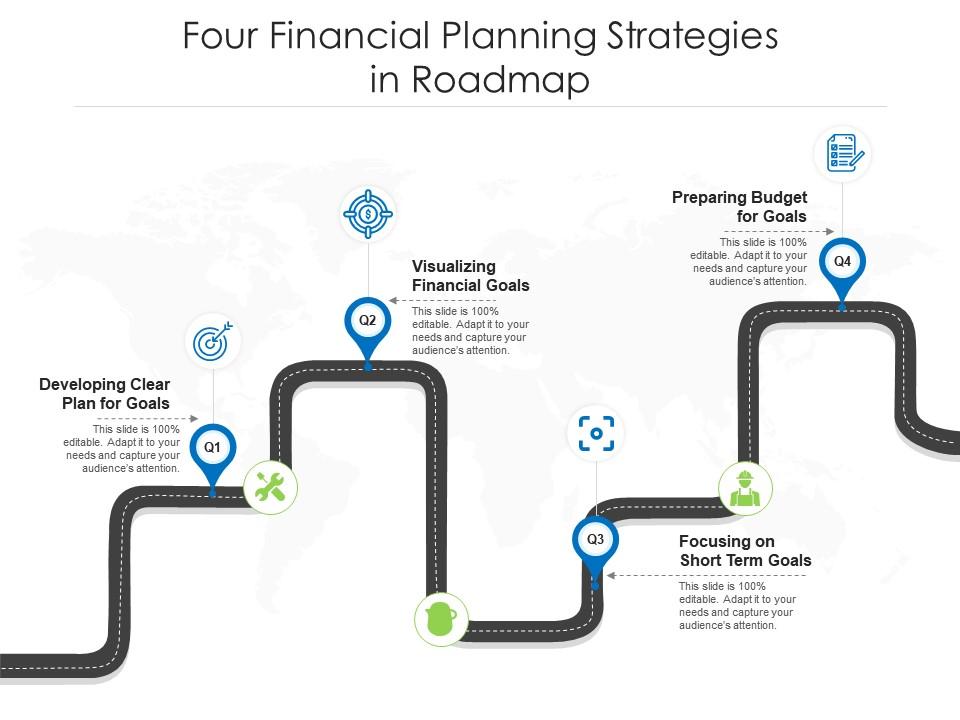
Presenting our set of slides with Four Financial Planning Strategies In Roadmap. This exhibits information on four stages of the process. This is an easy-to-edit and innovatively designed PowerPoint template. So download immediately and highlight information on Visualizing Financial Goals, Preparing Budget For Goals.

FAQs for Four financial planning

A successful financial plan includes clear goal setting, comprehensive budgeting, strategic investment allocation, risk management through insurance, and regular performance monitoring. These components work together by establishing financial objectives, tracking income and expenses, diversifying portfolios across asset classes, and protecting against unforeseen circumstances, with many organizations finding that integrated planning ultimately delivers sustainable growth and long-term financial stability.

Individuals can effectively set financial goals by categorizing them into short-term, medium-term, and long-term objectives, establishing specific timelines, and quantifying target amounts for each priority. This strategic approach enables systematic resource allocation across emergency funds, debt repayment, and investment portfolios, with many finding that automated savings and regular progress reviews ultimately deliver greater financial security and accelerated wealth building.

Effective debt management strategies include debt consolidation, the avalanche method targeting high-interest debts first, snowball approach focusing on smallest balances, refinancing options, and strategic budget reallocation. These approaches streamline repayment by reducing interest costs, accelerating payoff timelines, and improving cash flow management, with many individuals and businesses finding that combining multiple strategies delivers faster debt elimination and enhanced financial stability.

Budgeting methods adapt through flexible frameworks like zero-based budgeting for detailed trackers, envelope systems for cash-preferred households, and percentage-based approaches for variable incomes. These strategies accommodate diverse lifestyles by scaling expense categories, adjusting savings rates, and incorporating lifestyle-specific priorities, with many individuals finding that personalized approaches ultimately deliver better financial discipline and long-term wealth building.

An emergency fund serves as a financial safety net, protecting against unexpected expenses, job loss, or economic downturns while preventing debt accumulation and preserving long-term investments. This strategic cash reserve enables individuals and families to maintain financial stability during crises, avoid liquidating retirement accounts or investments at unfavorable times, and ultimately pursue growth opportunities with greater confidence and security.

Retirement planning approaches evolve significantly across life stages, with twenties focusing on establishing emergency funds and maximizing employer matches, thirties emphasizing debt reduction and increased contributions, forties accelerating savings and diversifying investments, and fifties prioritizing catch-up contributions. These strategic phases enable individuals to build substantial wealth systematically, with many financial advisors finding that early, consistent planning delivers significantly better outcomes than aggressive late-stage efforts.

Effective long-term wealth accumulation strategies include diversified portfolio investing, dollar-cost averaging, index fund investing, compound interest maximization, and consistent retirement account contributions. These approaches streamline wealth building by reducing market timing risks, minimizing fees, and leveraging time horizons, with many financial advisors finding that disciplined, diversified strategies ultimately deliver superior returns and financial security.

Tax-advantaged accounts like IRAs and 401(k)s enhance financial planning by reducing current tax burdens, enabling compound growth through tax-deferred earnings, and providing strategic withdrawal flexibility in retirement. These accounts streamline wealth accumulation by maximizing contributions through employer matching, minimizing tax drag on investments, and delivering long-term financial security, with many professionals finding significant advantages in retirement readiness.

Planning for major life events requires evaluating timeline flexibility, income stability, existing debt obligations, emergency fund adequacy, and insurance coverage needs. These financial considerations enable couples and families to strategically allocate resources for wedding expenses, childcare costs, and housing upgrades, while maintaining long-term savings goals, ultimately delivering financial security and reduced stress during significant transitions.

Portfolio diversification involves spreading investments across asset classes like stocks, bonds, real estate, commodities, and international markets, along with varying sectors and company sizes. This strategic approach minimizes risk by ensuring that poor performance in one area doesn't devastate overall returns, with many financial advisors finding that diversified portfolios deliver more consistent long-term growth and stability.

Effective financial progress tracking includes regular budget reviews, cash flow analysis, variance reporting, key performance indicator monitoring, and goal-versus-actual comparisons. These methods enhance decision-making by identifying spending patterns, optimizing resource allocation, and measuring goal achievement, with many organizations finding that consistent financial assessment ultimately delivers improved profitability and strategic planning capabilities.

Financial planners help clients navigate market fluctuations by developing diversified portfolios, implementing risk management strategies, and providing behavioral coaching during volatile periods. Through strategic asset allocation and regular rebalancing, planners enable clients to maintain long-term perspectives, minimize emotional decision-making, and capitalize on market opportunities, ultimately delivering more stable returns and enhanced financial security.

Financial planning tools include budgeting software, investment platforms, tax preparation applications, retirement calculators, and automated savings programs. These technologies streamline financial management by providing real-time tracking, predictive analytics, and personalized recommendations, with many individuals and businesses finding that integrated platforms deliver enhanced decision-making capabilities and long-term wealth optimization.

Risk tolerance significantly influences investment decisions by determining asset allocation, diversification strategies, and timeline considerations within financial planning frameworks. Conservative investors typically favor bonds and stable securities, while aggressive investors pursue growth stocks and emerging markets, with financial advisors finding that aligning risk capacity with investment choices ultimately delivers better long-term outcomes and client satisfaction.

Inflation significantly impacts financial planning by eroding purchasing power, reducing real investment returns, and increasing the cost of future goals like retirement and education. Strategic responses include diversifying into inflation-resistant assets like real estate and commodities, adjusting savings rates upward, and emphasizing growth investments over fixed-income securities, ultimately preserving long-term wealth.

Ratings and Reviews

100% of 100
Review Form
Write a review
Most Relevant Reviews
  1. 100%

    by Earle Willis

    Professional and unique presentations.
  2. 100%

    by Demetrius Boyd

    Perfect template with attractive color combination.

2 Item(s)

per page: