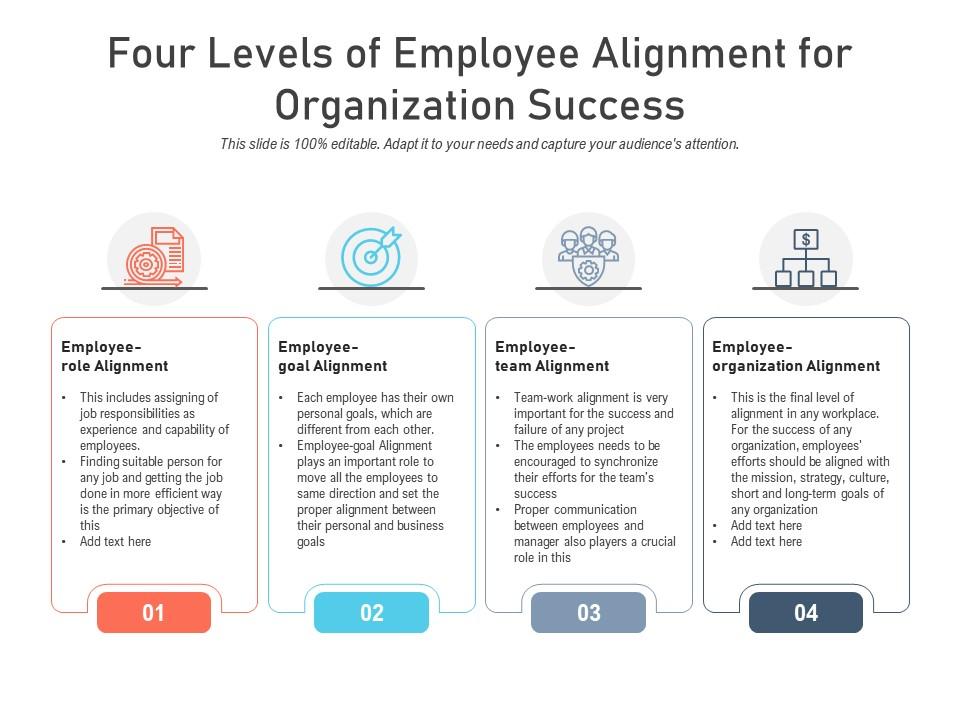
Four levels of employee alignment for organization success

Rating:
90%
Four levels of employee alignment for organization success
Slide 1 of 2
Favourites Favourites

Try Before you Buy Download Free Sample Product

Audience Impress Your
Audience
Editable 100%
Editable
Time Save Hours
of Time
The Biggest Sale is ending soon in
0
0
:
0
0
:
0
0
Rating:
90%
Introducing our premium set of slides with Four Levels Of Employee Alignment For Organization Success. Ellicudate the four stages and present information using this PPT slide. This is a completely adaptable PowerPoint template design that can be used to interpret topics like Alignment, Goal, Organization. So download instantly and tailor it with your information.

FAQs for Four levels of employee alignment

Honestly, most companies overcomplicate this stuff. Make your goals actually readable first - ditch the corporate speak that nobody understands anyway. Check in with people regularly so they can see how their daily work connects to the bigger picture. When managers explain the "why" behind projects, it makes a huge difference. Got someone who's always asking great questions? Get them involved in the goal-setting process. People care way more about things they helped build. The whole thing falls apart if it doesn't feel relevant to what they're actually doing every day.

Honestly, good communication from leaders is what keeps teams moving in the same direction. When you're upfront about goals and expectations, people know what they're working toward. But the second leaders go quiet or send mixed signals? That's when things fall apart - everyone starts guessing what they should be doing. I've seen it happen so many times. Teams end up scattered because nobody explained the "why" behind decisions. My take? Always err on the side of saying too much rather than too little. Connect people's daily tasks to the bigger mission so they actually understand their role.

Honestly, culture is what gets everyone rowing in the same direction. When people actually believe in your company's values (not just those cheesy posters in the break room), they'll naturally make decisions that align with bigger goals. But here's the thing - you can't fake it. Your day-to-day operations have to match what you say you stand for. Otherwise people see right through it and you've lost them. I'd start by looking at whether what you preach actually matches what happens around there. Strong culture gives people that sense of belonging and purpose they're craving.

Honestly, feedback only works if you actually do something with it - otherwise people just get cynical. Set up anonymous surveys and regular one-on-ones to hear what's really going on. The magic happens when you close the loop though. Share what you learned and tell them exactly what you're changing because of their input. I've seen teams totally flip once they realize their voices actually matter. Don't try to boil the ocean here - pick one feedback method this week and commit to reporting back within two weeks. People get way more bought-in when they see real changes happen.

Honestly, most alignment issues come down to people not knowing what they're actually supposed to do. Communication gets messy fast. Different teams get pulled in totally opposite directions, which is maddening for everyone. Plus when leadership says one thing but does another? Game over for trust. Oh, and trying to align people when there's no budget or resources to back it up is basically pointless. Start by getting super clear on goals first - like ridiculously clear. Then make sure your managers can explain WHY decisions matter, not just what needs doing.

So when everyone's personal goals actually match up with what the team's trying to do, it's like magic happens. No more people working against each other or doing the same stuff twice. Think of it like a rowing team - way better when everyone rows together instead of just splashing around randomly! Decisions get made faster, resources don't get wasted, and honestly? People just work together better because everyone wins when the team wins. Employees actually care more too since they can see how their daily work matters for the big picture. I'd start by just mapping out how each person's main goals connect to what the team needs to hit.

Honestly, Asana or Monday.com have saved my butt so many times for keeping track of who's doing what. For bigger picture stuff, OKR tools like Lattice are solid - though I'll admit the setup can be annoying at first. Slack's obviously great if you organize channels by project instead of just having one chaotic general chat. Oh, and don't sleep on simple Google Docs for meeting notes - sounds basic but it works. Culture Amp's pulse surveys catch problems before they explode. My advice? Pick whatever fixes your worst alignment headache first. Don't try implementing five new tools at once or you'll hate yourself.

Honestly, you've gotta hit them with your culture stuff right away - don't wait. Tell actual stories about how your values show up day-to-day, not just some generic slide presentation. Pair new people with someone who actually gets your company vibe (not whoever happens to be free that week). Give them real work in week one that ties to something bigger. I've watched so many places mess this up and then act surprised when new hires feel totally lost! The whole point is making them feel like they're already part of the team.

Look at engagement scores first - they're your foundation. Goal completion rates matter too, plus how well people's day-to-day work actually connects to bigger company stuff. Retention tells you a lot honestly, because if people don't feel aligned they just leave. Survey employees about whether they even understand the strategy (you'd be surprised how many don't). Here's the thing though - satisfaction isn't the same as alignment, so dig deeper. Quarterly pulse surveys work great. Ask specific questions about role clarity and strategic understanding. That should give you solid data to start with.

Yeah, remote work totally messes with team alignment! You miss all those random coffee conversations and quick "hey, are we still doing this?" moments. Honestly, you have to overcommunicate like crazy - it feels weird at first but trust me, it works. Schedule more one-on-ones than you think you need. Set super clear goals upfront. Oh, and document everything because nobody can just walk over to ask "wait, what did we decide about X again?" Create some kind of virtual hangout space too - maybe a slack channel for random stuff. Basically, you can't just assume everyone's aligned anymore.

Honestly, start with onboarding - that's where you'll make the biggest impact. Get deep into your mission and values right from day one. Throughout the year, throw in some refresher workshops so people don't forget. Your managers are key here since they're the ones actually living this stuff daily, so leadership training is a must. One thing that really works? Have leaders tell actual stories about times when someone nailed your values. Way better than boring slide decks. Oh, and mentorship programs are gold because people keep talking about this stuff naturally instead of it being this one-time thing.

Honestly, those departmental silos are the worst productivity killers. People end up working toward completely different goals without even realizing it. Monthly cross-team check-ins work wonders though - suddenly everyone gets how their stuff connects to what other teams actually need. You'll catch conflicting priorities way earlier instead of finding out halfway through a project that marketing and dev had totally different timelines in mind (been there!). Start small with joint planning for your next big thing. Once teams talk regularly, that "wait, what are we even doing?" confusion basically disappears.

So here's the thing - when you reward specific behaviors, people do more of those behaviors. Pretty straightforward, right? You've gotta connect your rewards to actual outcomes though, not just throw out random "great work!" comments. Want better customer service? Call out those wins specifically. More teamwork? Stop celebrating the lone wolves and start recognizing group achievements instead. I learned this the hard way at my last job - we kept saying we valued collaboration but only promoted the people who hogged all the credit. Mixed messages much?

Look, when people clash at work, you've gotta jump on it fast before teams start picking sides. I've seen whole departments basically split in half over stuff that could've been solved with one good conversation. Most of the time people aren't even really disagreeing - they're just confused about what they're supposed to prioritize. Train your managers to actually listen instead of just waiting for their turn to talk. Oh, and make sure there's always someone people can escalate to when things get messy. Honestly, it's pretty similar to debugging - find the root issue before everything breaks.

Honestly? Weekly team meetings are a game-changer, but skip the boring status updates - those can just be emails. Focus on actual roadblocks and what's coming next. Keep your goals somewhere everyone can see them, like a shared dashboard or whatever tool you guys already use. The biggest thing though is making sure people feel comfortable speaking up when something feels off. Oh, and when priorities inevitably shift (because they always do), don't just announce the change - explain why it's happening. People won't push back as much if they actually get the reasoning behind it.

Ratings and Reviews

90% of 100
Review Form
Write a review
Most Relevant Reviews
  1. 80%

    by Thomas Hill

    Understandable and informative presentation.
  2. 100%

    by Chet Cox

    Enough space for editing and adding your own content.

2 Item(s)

per page: