


Gender Diversity Management To Enhance Employee Retention DTE CD




Try Before you Buy Download Free Sample Product
 Impress Your
 Audience
 100%
100% Editable
 Save Hours
 of Time


Grab our professionally created Gender Diversity Management to Enhance Employee Retention PowerPoint presentation. This enlightening PPT deck is a powerful tool for encouraging inclusivity and equality within your organization. This presentation addresses crucial aspects of recruitment diversity, guiding your team through effective strategies for building a diverse workforce. Moreover, the Gender Equality PPT slides present the secrets of leadership development, specifically tailored to empower and elevate women within your organization. Navigate the delicate balance of work-life harmony with proven approaches prioritizing employee well-being and satisfaction. Furthermore, this Diversity and Inclusion PPT templates explore effective measures for fair compensation and promotion, fostering an equitable environment where meritocracy reigns. Embrace diversity with our Gender Diversity PowerPoint presentation, where strategies meet impact. Download our 100 percent editable and customizable template, which is also compatible with Google Slides.
People who downloaded this PowerPoint presentation also viewed the following :
Content of this Powerpoint Presentation
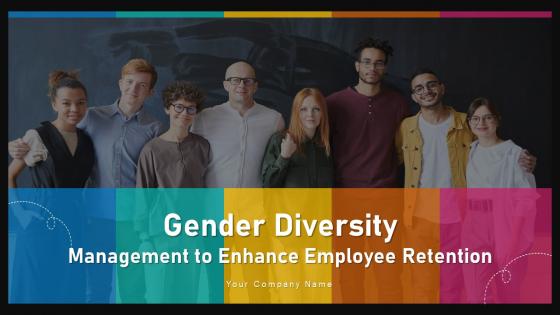
Slide 1: This slide introduces Gender Diversity Management to Enhance Employee Retention. State your company name and begin.
Slide 2: This is an Agenda slide. State your agendas here.
Slide 3: This slide shows Table of Content for the presentation.
Slide 4: This slide shows Table of Content for the presentation.
Slide 5: This slide provides information about the current employee base gender diversity in numbers by total workforce, managerial level, and executive level professionals.
Slide 6: This slide demonstrates male and female gender wise applications for various departments to determine differences in the employment rate.
Slide 7: This slide outlines major issues faced by business in providing equal opportunities to workforce. It includes issues promotional discrimination, work like imbalance etc.
Slide 8: This slide shows title for topics that are to be covered next in the template.
Slide 9: This slide provides information about various survey questionnaire which can be leveraged by company to determine employee satisfaction.
Slide 10: This slide displays information about business survey questions which can be leveraged to identify areas of improvement for human resources.
Slide 11: This slide demonstrates result of the employee satisfaction survey questionnaire. It includes questions related to hiring gender distribution, diverse interviewers panel etc.
Slide 12: This slide highlights employee satisfaction survey assessment results including flexible working hours, current work-from-home policy, transparent employee promotional process, etc.
Slide 13: This slide outlines information about various solutions related to gender diversity and inclusion management to increase employee satisfaction.
Slide 14: This slide shows title for topics that are to be covered next in the template.
Slide 15: This slide provides information about various updated guidelines in recruitment and selection policy to enhance talent sourcing.
Slide 16: This slide displays information about various strategies which can be adopted by HR managers for job posting. It includes job description, convey job benefits etc.
Slide 17: This slide provides information about various strategies that can be leveraged by recruitment teams such as LinkedIn talent acquisition, women referrals, and career fairs.
Slide 18: This slide displays information about various strategies to be adopted throughout the interview process. It includes strategies such as setting diverse interview panel etc.
Slide 19: This slide provides information about new candidate evaluation checklist which can be leveraged by recruiters. It includes key assessment criteria such as general assessment, soft skills etc.
Slide 20: This slide shows title for topics that are to be covered next in the template.
Slide 21: This slide outline newly introduced mentorship program that can be leveraged by different business departments for leadership development.
Slide 22: This slide presents business newly build leadership development training course to enhance women participation in top positions.
Slide 23: This slide demonstrates monthly timeline for providing leadership skills development training timeline comprising training areas such as foundation, team building etc.
Slide 24: This slide shows title for topics that are to be covered next in the template.
Slide 25: This slide provides information about various strategies adopted by HR managers for managing workforce compensation. It includes strategies such as setting compensation parameters etc.
Slide 26: This slide provides information about compensation criteria for employee to avoid gender biasing. It includes compensation types such as basic salary compensation, bonus etc.
Slide 27: This slide displays information about increment based on performance metrics. It includes performance rating such as exceed targets, meet targets, partially achieved targets etc.
Slide 28: This slide outlines inspection checklist which can be used by managers to determine pay scale equability. It includes key elements such as performance rating biases and more.
Slide 29: This slide provides information about the flexible working arrangements set by company. It includes strategies such as flexible working schedules and updated maternity policies.
Slide 30: This slide shows title for topics that are to be covered next in the template.
Slide 31: This slide provides information about various strategies adopted by company to increase gender inclusive culture.
Slide 32: This slide displays information about various policies to be adopted by company. It includes policies related to anti harassment and non discrimination, parental level policy etc.
Slide 33: This slide shows title for topics that are to be covered next in the template.
Slide 34: This slide provides information about impact of gender diversification management on business employee base split by total workforce, manager level and executive level.
Slide 35: This slide shows title for topics that are to be covered next in the template.
Slide 36: This slide provides information about business new gender diverse team structure for creating innovative and creative environment.
Slide 37: This slide outlines current employee count distribution by various departments such as finance, HR, marketing, sales & IT, and further split by gender.
Slide 38: This slide shows title for topics that are to be covered next in the template.
Slide 39: This slide provides information about projected budget plan for increasing female employee engagement. It includes key areas such as recruitment, training, payroll, and compensation.
Slide 40: This slide shows title for topics that are to be covered next in the template.
Slide 41: This slide demonstrates the KPI dashboard to track diversity and inclusion which can be used by managers to develop a workforce for business.
Slide 42: This slide provides information about business gender diversity data by different parameters such as yearly percentage, function base, promotion percentage by gender etc.
Slide 43: This slide shows all the icons included in the presentation.
Slide 44: This slide is titled as Additional Slides for moving forward.
Slide 45: This slide outlines case study related to managing gender diversity at top positions comprising challenges, goals, solutions, and results.
Slide 46: This slide provides gender diversity and inclusion case study related to Google. It includes goals, adopted solutions, and results.
Slide 47: This slide demonstrates newly selected recruitment and selection team and structure to increase talent sourcing of well suited candidates.
Slide 48: This slide outlines various recruitment channels which can be leveraged by the company for the future hiring of diversified job professionals.
Slide 49: This slide outlines various promotional criteria which can be leveraged by the human resource managers. It includes promotion criteria such as education, experience etc.
Slide 50: This slide showcases the key elements that can assist human resource (HR) professionals in building policies for remote and long-distance employees.
Slide 51: This slide demonstrates impact of implementing gender equality management strategies and policies on employee engagement and retention rate with respective key insights.
Slide 52: This slide presents Bar Graph with two products comparison.
Slide 53: This slide describes Line chart with two products comparison.
Slide 54: This slide depicts Venn diagram with text boxes.
Slide 55: This is Our Team slide with names and designation.
Slide 56: This slide provides 30 60 90 Days Plan with text boxes.
Slide 57: This is a Timeline slide. Show data related to time intervals here.
Slide 58: This slide presents Roadmap with additional textboxes. It can be used to present different series of events.
Slide 59: This is a Thank You slide with address, contact numbers and email address.
Gender Diversity Management To Enhance Employee Retention DTE CD with all 67 slides:
Use our Gender Diversity Management To Enhance Employee Retention DTE CD to effectively help you save your valuable time. They are readymade to fit into any presentation structure.










FAQs for Gender Diversity Management To Enhance Employee
Honestly, the biggest wins are smarter decision-making and better financial results. Teams with mixed gender perspectives just think through problems differently - they catch stuff others miss. Revenue actually goes up too, which is pretty wild when you see the numbers. Attracting good people becomes way easier since everyone wants to work somewhere that feels inclusive. Your innovation will probably spike because diverse groups come up with more creative ideas. I'd start by checking your current gender split at different company levels. Figure out where the biggest imbalances are and tackle those first.
Honestly, you've gotta measure both the hard numbers and the soft stuff to really see what's working. Get your baseline first - revenue per employee, innovation scores, team performance - before you change anything. Those quarterly check-ins are crucial for tracking progress, but don't expect miracles overnight since culture shifts take forever. Employee surveys and exit interviews will tell you way more about how diversity actually impacts collaboration than spreadsheets ever will. Oh, and focus groups are gold for understanding decision-making changes. Just pick your KPIs early and stick with them consistently.
Start by fixing your job postings - ditch the usual boring language and post on boards where diverse candidates actually hang out. Build real relationships with organizations supporting underrepresented groups and universities with solid diversity programs. Career fairs help too. Honestly? Skip referral programs if your team's already pretty homogeneous - that'll just create more of the same. Mix up your interview panels and actually show your inclusion efforts on the careers page. The bottom line is you gotta be strategic about sourcing. Diverse talent won't just show up.
Having mixed-gender teams is honestly a game changer for creativity. Different perspectives and problem-solving styles just make everything better. Teams with gender diversity challenge assumptions way more effectively than when everyone thinks alike - and trust me, homogeneous groups fall into groupthink so fast it's not even funny. Studies show diverse teams beat uniform ones by around 15% on innovation stuff. The trick is making sure everyone feels safe speaking up. Oh, and next time you're brainstorming, actively ask the quieter people what they think. Sometimes they have the best ideas but won't jump in without being invited.
Honestly, leadership makes or breaks gender diversity efforts. Your executives have to actually care - not just talk about it in meetings. They need to put real money behind initiatives and start holding managers accountable for who they're hiring and promoting. I've seen too many companies with beautiful diversity policies that collect dust while nothing changes. Track your gender metrics religiously and tie diversity goals to performance reviews. That's when people suddenly pay attention. Leaders also can't be part of the problem themselves - they have to call out bias when they see it and model the behavior they want.
Honestly, I'd start with your job postings - strip out any gendered language and make your interview questions consistent across candidates. Track your diversity numbers at every stage too. Pay audits are probably the biggest thing though - you'd be surprised how often gaps hide in plain sight. Flexible work and decent parental leave (not just the legal bare minimum) matter way more than people think. Oh, and train your managers properly on this stuff or they'll just wing it. Pick one thing like recruiting first, nail that down, then move on to retention. Don't try to fix everything at once or you'll burn out.
Ugh, gender diversity rollouts are rough. Most companies face three big issues. Unconscious bias is huge - everyone thinks they're being fair while doing the exact opposite. Then there's this obsession with hitting quotas instead of fixing the actual culture (which honestly never works). Middle managers are usually clueless about implementation too, so stuff just dies there. My advice? Start small with bias training first. Don't try changing everything overnight - it backfires. Focus on accountability measures that actually stick rather than grand gestures.
Unconscious bias training is actually pretty eye-opening - even leaders who think they're doing everything right get surprised. Focus on the practical stuff like fair hiring and performance reviews, plus creating that psychological safety everyone talks about. Mentorship programs are clutch for breaking down barriers that people don't even realize exist. Role-playing scenarios work way better than just lecturing about theory, trust me on that. Oh, and definitely start with your leadership team first, then work your way down. It's one of those things where you really need buy-in from the top or it just becomes another HR checkbox exercise.
Look, having diverse teams just makes business sense - they actually get your customers better. Different perspectives help you avoid those cringe marketing fails that completely miss the mark with certain groups. Customers notice when companies don't reflect their values around inclusion, and honestly? It's becoming a real differentiator. Your diverse employees bring their own networks too, which opens up new market opportunities. Oh and they're way better at spotting blind spots in product development. I'd start by checking out who's on your customer-facing teams and see what perspectives you might be missing.
Mix up your meeting times so you're not always screwing over the same time zones. Some people are way more comfortable typing in chat than unmuting - especially parents dealing with chaos at home. Async tools are your friend here since not everyone can be "on" at the same time. The tricky part? You've got to actively create those random coffee chat moments that happen naturally in offices. Otherwise remote folks miss out on all the good relationship stuff that builds careers. Short meetings, long meetings - just keep switching it up.
Honestly, don't make it a separate "initiative" - that's where companies mess up. Bake gender diversity straight into your hiring process, promotion reviews, all that regular business stuff. Track real numbers obsessively because otherwise it just becomes empty talk. I've seen too many programs die when the one person championing it leaves or when budgets get slashed. Connect it to actual business results so leadership can't just axe it later when things get tight. The key is making it part of how you operate, not some feel-good project on the side.
Honestly, the data on this is pretty convincing - gender diversity really does boost satisfaction and retention. You'll notice higher engagement when teams are more balanced. People just feel more included, you know? Communication gets better too, which makes sense if you think about it. The retention piece is huge though - employees stick around way longer in inclusive environments. I'd start by actually tracking your gender breakdown by department (most companies don't even do this basic step). Then set some real targets. It's one of those changes that sounds simple but actually moves the needle on workplace culture.
Honestly, think of it like being a detective for workplace bias. Pull your hiring and promotion data by gender first - the patterns that pop up might shock you. Track where your best female candidates actually come from, then see if certain job descriptions are scaring women away. Interview panels can be sneaky biased too, so the numbers will show if they're consistently picking guys over equally qualified women. Oh, and don't forget retention rates and pay gaps - those tell a whole story on their own. Data doesn't have feelings or excuses, which is why I love this approach. You'll spot stuff that wasn't obvious before.
Oh man, this is so tricky but super important. You can't just copy-paste the same approach everywhere - what works in progressive places like Sweden would be a total disaster in more conservative countries. I learned this the hard way when I saw a company try to rush things without understanding local attitudes first. Start by connecting with your regional HR people since they actually get the cultural nuances. They'll help you figure out realistic timelines too - some places need baby steps while others are ready for bigger changes. Also don't forget to research the legal side of things in each country before you launch anything.
Look, the numbers don't lie - mixed-gender tech teams just crush it when it comes to innovation and revenue from new products. Different perspectives = better problem-solving, which honestly makes total sense when you think about it. Companies with gender diversity are 15% more likely to beat their competition. Pretty crazy, right? But here's the thing - you can't just hire women and call it a day. Creating an environment where people actually feel heard in meetings and decision-making? That's where the real magic happens. Otherwise you're just checking boxes.
-
Unique research projects to present in meeting.
-
A fantastic collection of templates. I'll likely use this as my go-to resource for future templates and support.