Global challenges and solutions powerpoint slide designs
You must be logged in to download this presentation.
Try Before you Buy Download Free Sample Product
Audience
Editable
of Time
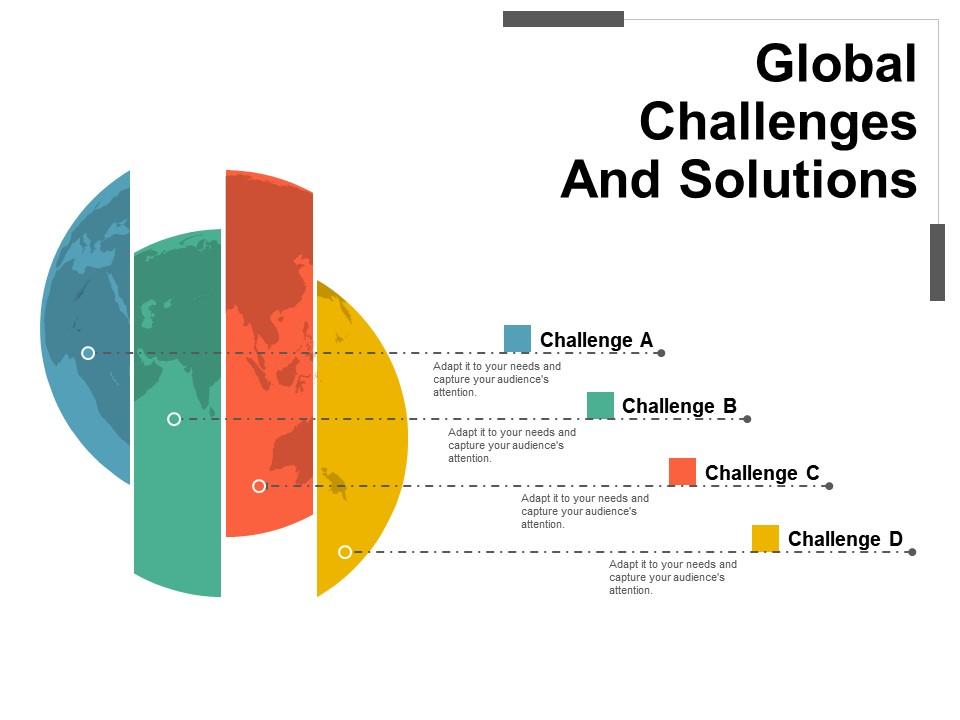
Built your audience through our, global challenges and solutions PowerPoint slide designs. Address and resolve complex ideas through the help of this PowerPoint layout. We have shown the graphic of a sphere split up into four sections in distinct colors, depicting the design of our earth to address global challenges and networking. Four stages shown here are, challenges 1, challenges 2, challenges 3 and challenges 4. Adjust the stages and text to include your company data, discuss various issues and solutions, problem and solution. Download this presentation and solve the most constraining problems faced by modern societies. Engaging visuals make it easier for your audience to make a decision and rely on. Edit the text and practice a set of tasks and techniques that are used to improve your business richness. Expand your business to get new consumers and retain existing customers through this captivating industry analysis PPT. Preserve your ideas through your clients and apply our, global challenges and solutions PowerPoint slide designs to be productive. Indulge in aesthetic analysis with our Global Challenges And Solutions Powerpoint Slide Designs. Highlight good interior designs.
People who downloaded this PowerPoint presentation also viewed the following :
Global challenges and solutions powerpoint slide designs with all 5 slides:
Our Global Challenges And Solutions Powerpoint Slide Designs ensure impressive gains. Be able to accelerate financial growth.
FAQs for Global challenges and solutions
Dude, carbon capture tech is wild - it literally pulls CO2 straight from the air. Floating solar farms are popping up everywhere now, and green hydrogen might totally change energy storage. Vertical farming's cutting agriculture's carbon footprint too. Oh and cities are using AI to optimize their power grids, which honestly seems like something from a sci-fi movie but it's happening. Most of this stuff is already going commercial, not just lab experiments anymore. You should definitely look into what companies near you are working on this - could be some solid partnership opportunities there.
Honestly, mobile-first is where it's at for fighting poverty in developing countries. Smartphones let people skip right past building expensive infrastructure - pretty wild when you think about it. Mobile banking helps folks who've never had bank accounts, while farmers can sell directly to markets through apps. Telemedicine reaches crazy remote places too. Digital ID systems are huge because they actually let people access government services they couldn't before. Oh, and e-learning platforms can train people fast. The key is figuring out what's causing the most poverty in your specific country, then match tech solutions to those problems. That's where you'll see real results.
Honestly, pandemics are global problems that need global solutions - you can't just close borders and hope for the best. Look at COVID's early days when everyone was doing their own thing with travel bans and info sharing. Total mess. Countries need to actually talk to each other, share data fast, and work together on vaccines and treatments. The WHO isn't perfect (understatement of the year) but at least it gives countries a way to coordinate. When they pool resources and research, stuff gets done way quicker. Bottom line? We should push for stronger international health partnerships because if one country's struggling, we're all at risk.
Honestly, we gotta stop making kids memorize random facts and teach them to actually think through problems instead. Climate change is the perfect example - it's not just science, right? Economics, politics, social stuff all mixed in. The whole system feels so behind the times sometimes. What actually works is having students dive into real community issues through projects. Teach them to spot BS online and understand media manipulation. Oh, and emotional intelligence matters just as much as the technical stuff these days. Maybe start small - pick one subject you can totally redesign around solving actual problems instead of just textbook exercises.
So basically sustainable farming helps with food security by growing more food without trashing the soil. Crop rotation and cutting back on chemicals keeps the land healthy, which means better harvests long-term. It handles climate disasters way better than industrial farming too. Local food systems get stronger, so communities don't have to rely on crazy expensive imports - huge deal in developing countries. The whole point is feeding people now AND later, you know? Oh, and check out regenerative farming if this interests you, that stuff is pretty cool.
Honestly, tackling plastic pollution works best when you hit it from both ends - stopping it at the source plus cleaning up what's already out there. Cut back on single-use stuff and push for better waste systems, especially in developing countries where most ocean plastic comes from. Those fancy ocean cleanup machines are pretty neat, but preventing waste is way cheaper than scooping it out later. Bottle deposits and plastic bag bans actually work too. My advice? Start local - advocate for better recycling in your area and swap to reusable options when you can. Small changes add up faster than you'd think.
Three big things to tackle: recycling water, smart infrastructure, and managing demand better. Singapore's absolutely nailing it with greywater systems - they treat wastewater for stuff like irrigation. Smart meters are game-changers too, cutting usage by like 10-15% just because people can see their consumption in real-time. Rainwater harvesting and permeable pavement help capture runoff instead of wasting it. Policy matters though - tiered pricing where heavy users pay more actually works. Oh, and definitely audit your current sources first to see where you're bleeding water. The tech stuff is cool but honestly the behavioral changes might be easier to implement right away.
Yeah, so basically when wealth gets super concentrated, countries fall apart. Look at history - most revolutions happen when people are fed up with the rich hoarding everything while they can't afford basic stuff. It kills economic growth too since nobody has money to actually buy things. Pretty obvious when you think about it. Best fixes? Tax the wealthy more, protect workers better, and invest heavily in education plus infrastructure that creates decent jobs. Universal healthcare and stuff like that helps. Honestly, we just need policies that don't let all the growth go straight to billionaires. Start local though - support anything that builds up your middle class.
Policy support plus private money - that's what'll really move things. Tax breaks need to expand and permitting has to get way easier. Plus we desperately need grid upgrades because renewables are useless without decent storage and distribution. The tech side is actually progressing faster than I thought it would, which is cool. International cooperation would be massive too - sharing standards and tech, especially with developing countries. Honestly though? Start local. Push for renewable mandates in your area. That's how policy pressure builds up from the bottom.
Social media turns boring global issues into stories people give a damn about. Look at
-
Very well designed and informative templates.
-
Excellent products for quick understanding.