


Guide For International Marketing Management Powerpoint Presentation Slides MKT CD





Try Before you Buy Download Free Sample Product
 Impress Your
 Audience
 100%
100% Editable
 Save Hours
 of Time


International marketing is promoting products or services outside the brands domestic audience. Check out our Guide for International Marketing Management template. It is professionally curated, enabling marketers to reach the audience and expand brand visibility worldwide. Our International Marketing Management deck represents an overview of international marketing along with its key trends, characteristics, participants, and risks. Additionally, it covers the global marketing plan, which follows performing market research, setting SMART goals, developing a localization strategy, delivering product information, utilizing marketing material, and selecting marketing software. Our Global Marketing PPT showcases various types of international marketing like exporting, licensing, franchising, joint venture, and much more. Further, it showcases the process, risk, key documents, checklist, strategies, model, fundamentals, contract, etc. Lastly, our Franchising module depicts an international marketing campaign plan, roles, responsibilities for the marketing team, training plan, impact, and case study for global advertising. Download our 100 percent editable and customizable template, also compatible with Google Slides.
People who downloaded this PowerPoint presentation also viewed the following :
Content of this Powerpoint Presentation
Slide 1: This slide introduces Guide for International Marketing Management. Commence by stating Your Company Name.
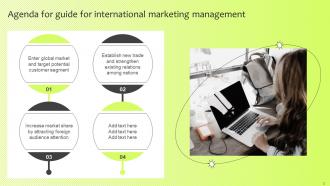
Slide 2: This slide depicts the Agenda of the presentation.
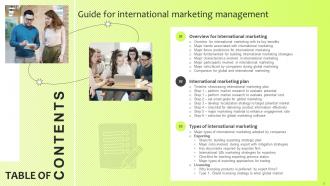
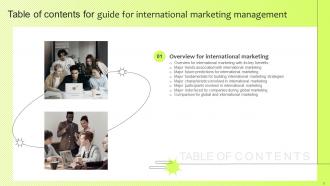
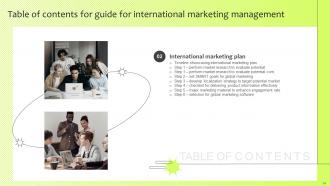
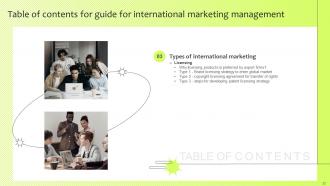
Slide 3: This slide incorporates the Table Of Contents.
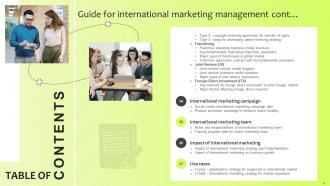
Slide 4: This is yet another slide continuing the Table Of Contents.
Slide 5: This slide highlights the Title for the Topics to be covered further.
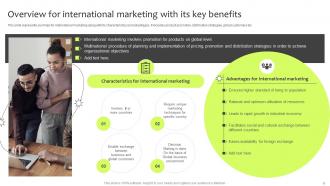
Slide 6: This slide represents summary for international marketing along with its characteristics and advantages.
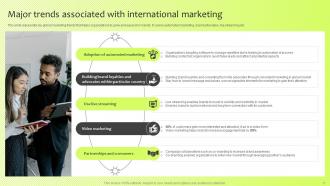
Slide 7: This slide exhibits the Major trends associated with international marketing.
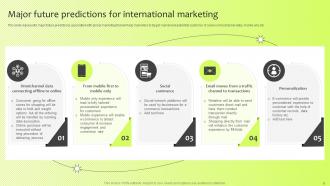
Slide 8: This slide focuses on the Major future predictions for international marketing.
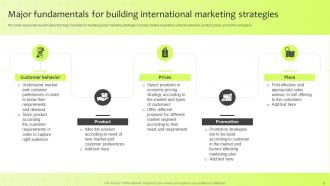
Slide 9: This slide states the Major fundamentals for building international marketing strategies.
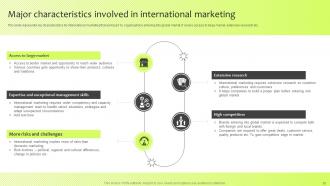
Slide 10: This slide represents key characteristics for international marketing that are faced by organizations entering into global market.
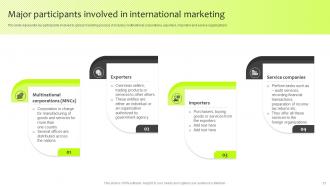
Slide 11: This slide reveals the Major participants involved in international marketing.
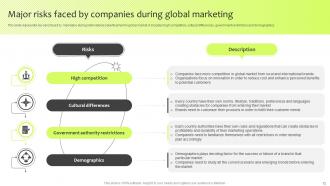
Slide 12: This slide showcases the Major risks faced by companies during global marketing.
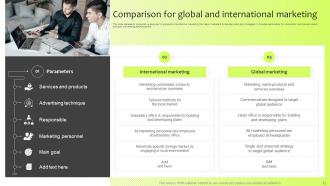
Slide 13: This slide shows the comparative analysis for global and international marketing that helps marketers to develop plans and strategies.
Slide 14: This slide mentions the Heading for the Contents to be discussed further.
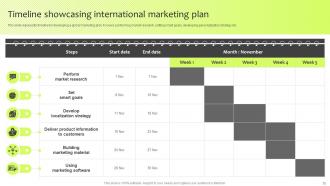
Slide 15: This slide indicates the Timeline showcasing international marketing plan.
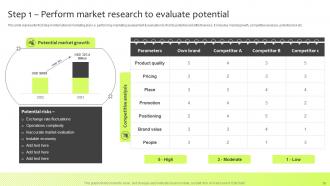
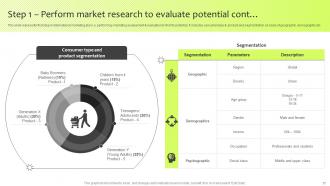
Slide 16: This slide represents first step in international marketing plan i.e. performing marketing assessment & evaluation to find its potential and effectiveness.
Slide 17: This slide elucidates the first step in international marketing plan i.e. performing marketing assessment & evaluation to find its potential.
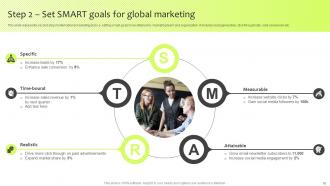
Slide 18: This slide includes the second step in international marketing plan i.e. setting smart goals to be attained by marketing team and organization.
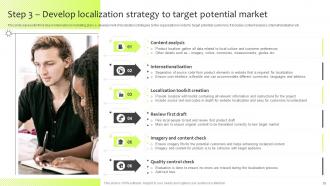
Slide 19: This slide contains the third step in international marketing plan i.e. development of localization strategies by the organization in order to target potential customers.
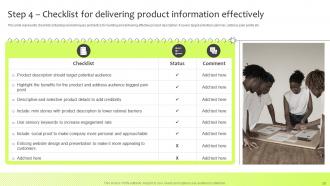
Slide 20: This slide reveals the checklist containing key techniques and tactics for building and delivering effective product description. It covers target potential customer, address pain points etc.
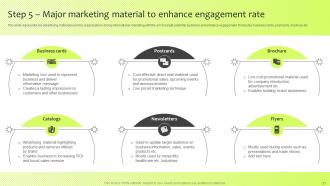
Slide 21: This slide indicates the key advertising materials used by organizations during international marketing with the aim to target potential audience and enhance engagement.
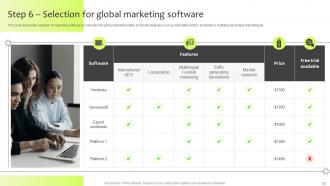
Slide 22: This slide elucidates the selection of marketing software by marketers for global advertisements.
Slide 23: This slide mentions the Title for the Ideas to be discussed further.
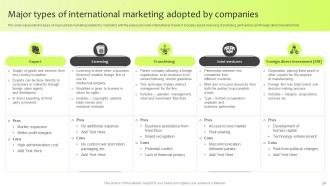
Slide 24: This slide states the five types of major global marketing adopted by marketers with the purpose to enter international market.
Slide 25: This slide incorporates the Heading for the Ideas to be covered in the following template.
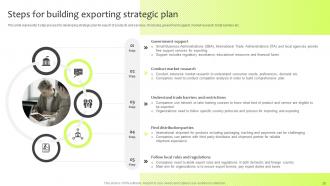
Slide 26: This slide highlights the Steps for building exporting strategic plan.
Slide 27: This slide talks about the Major risks involved during export with mitigation strategies.
Slide 28: This slide represents major documents required by exporters for shipment of goods and services.
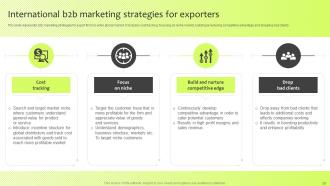
Slide 29: This slide covers the International b2b marketing strategies for exporters.
Slide 30: This slide showcases the Checklist for tracking exporting process status.
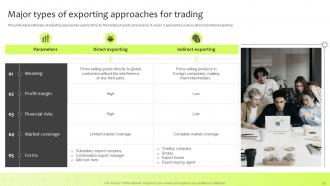
Slide 31: This slide lists the Major types of exporting approaches for trading.
Slide 32: This slide mentions the Title for the Components to be covered in the upcoming template.
Slide 33: This slide presents the major reasons for which export ventures license the products before entering in global market.
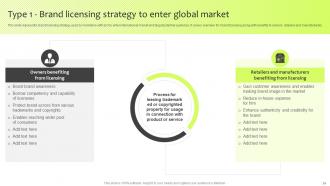
Slide 34: This slide portrays brand licensing strategy used by marketers with aim to enter international market and target potential audience.
Slide 35: This slide depicts the copyright licensing agreement used by export venture firms for transferring the rights.
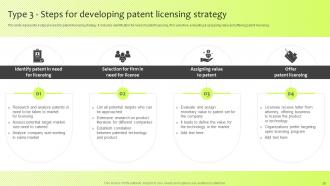
Slide 36: This slide shows the 4 step process for patent licensing strategy.
Slide 37: This slide includes the Heading for the Topics to be discussed in the following template.
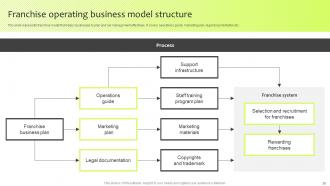
Slide 38: This slide deals with the Franchise operating business model structure.
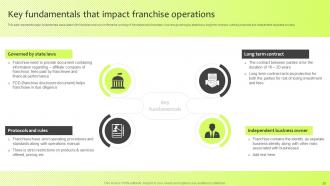
Slide 39: This slide displays the Key fundamentals that impact franchise operations.
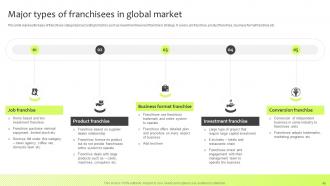
Slide 40: This slide mentions the Major types of franchisees in global market.
Slide 41: This slide talks about the Franchise agreement contract with key fundamental provisions.
Slide 42: This slide indicates the Title for the Topics to be covered next.
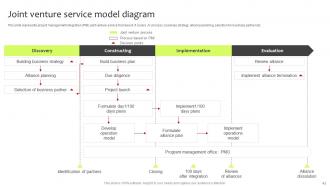
Slide 43: This slide illustrates the Joint venture service model diagram.
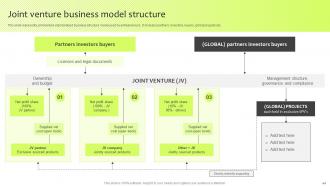
Slide 44: This slide elucidates the Joint venture business model structure.
Slide 45: This slide incorporates the Major types of joint venture businesses.
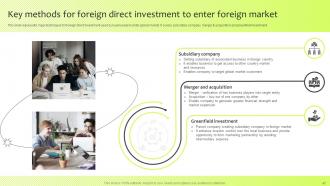
Slide 47: This slide focuses on the Key methods for foreign direct investment to enter foreign market.
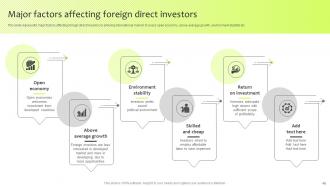
Slide 48: This slide presents the Major factors affecting foreign direct investors.
Slide 49: This slide indicates the Heading for the Contents to be covered in the forth-coming template.
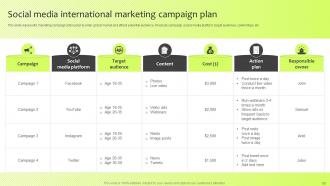
Slide 50: This slide represents marketing campaign action plan to enter global market and attract potential audience.
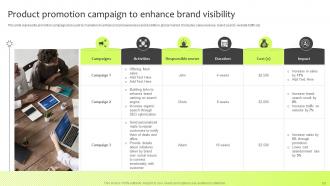
Slide 51: This slide focuses on the Product promotion campaign to enhance brand visibility.
Slide 52: This slide elucidates the Title for the Ideas to be covered next.
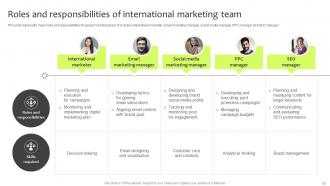
Slide 53: This slide exhibits the Roles and responsibilities of international marketing team.
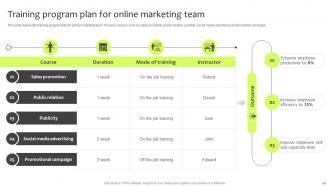
Slide 54: This slide portrays the Training program plan for online marketing team.
Slide 55: This slide depicts the Heading for the Contents discussed in the upcoming template.
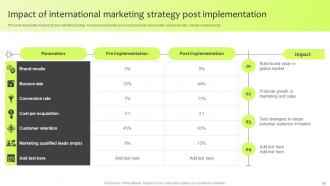
Slide 56: This slide talks about the Impact of international marketing strategy post implementation.
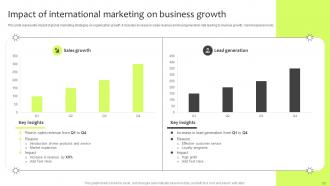
Slide 57: This slide reveals the impact of global marketing strategies on organization growth.
Slide 58: This slide displays the Title for the Components to be discussed next.
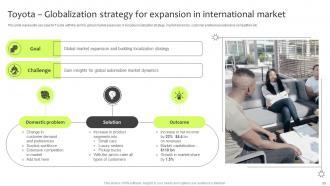
Slide 59: This slide represents use case for Toyota with the aim for global market expansion.
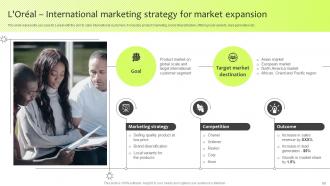
Slide 60: This slide showcases the use case for Loreal with the aim to cater international customers.
Slide 61: This is the Icons slide containing all the Icons used in the plan.
Slide 62: This slide is used for depicting Additional information.
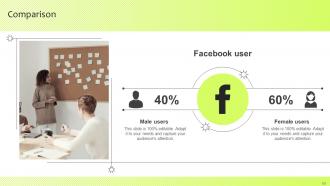
Slide 63: This slide is used for the purpose of Comparison.
Slide 64: This is Our target slide. State your comapny targets here.
Slide 65: This slide presents the organization's vision, mission, and values.
Slide 66: This is Our team slide. State the information related to your team members here.
Slide 67: This slide contains the Post it notes for reminders and deadlines.
Slide 68: This is the Idea generation slide for encouraging innovative ideas.
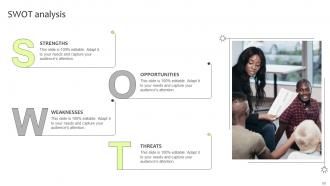
Slide 69: This slide elucidates the SWOT analysis.
Slide 70: This is the Puzzle slide with related imagery.
Slide 71: This is the Venn diagram slide.
Slide 72: This is the 30 60 90 Days plan slide for efficient planning.
Slide 73: This slide reveals the Mind map of the firm.
Slide 74: This is the Thank You slide for acknowledgement.
Guide For International Marketing Management Powerpoint Presentation Slides MKT CD with all 79 slides:
Use our Guide For International Marketing Management Powerpoint Presentation Slides MKT CD to effectively help you save your valuable time. They are readymade to fit into any presentation structure.





















FAQs for Guide For International Marketing Management Powerpoint Presentation
Key components include market research and segmentation, cultural adaptation strategies, competitive analysis, pricing frameworks, and distribution channel optimization. These elements work together by identifying local consumer preferences, adapting messaging and products accordingly, and establishing efficient market entry approaches, with many multinational corporations finding that strategic cultural integration ultimately delivers enhanced customer engagement and sustainable competitive advantage.
Cultural differences significantly impact international marketing through varying consumer behaviors, communication styles, purchasing patterns, religious considerations, and social norms that require tailored approaches for each market. These cultural nuances influence product positioning, messaging strategies, and distribution channels, with companies like McDonald's adapting menus regionally and Coca-Cola localizing campaigns, ultimately enabling more authentic customer connections and competitive market penetration.
Market research enables global marketing decisions by providing cultural insights, competitive intelligence, regulatory understanding, consumer behavior analysis, and market size assessments across different regions. Through comprehensive research, companies streamline their international expansion strategies, minimize costly missteps, and enhance localization efforts, with many multinational organizations finding that data-driven insights ultimately deliver competitive advantage and sustainable growth in diverse markets.
Companies can effectively adapt their branding by conducting thorough cultural research, localizing visual elements and messaging, adjusting brand positioning to match regional preferences, and maintaining core brand values while allowing flexible execution. Through strategic localization, businesses in sectors like retail and consumer goods successfully navigate cultural nuances, language differences, and local competition, ultimately delivering authentic customer connections and sustainable market penetration across diverse international landscapes.
International pricing challenges include currency fluctuations, varying purchasing power, local competition, regulatory restrictions, and different consumer price sensitivities across markets. These complexities require strategic pricing approaches that balance profitability with market penetration, with many multinational companies finding that localized pricing strategies, dynamic currency hedging, and competitive analysis ultimately deliver sustained market share and optimal revenue across diverse global markets.
Digital marketing techniques adapt to international audiences through localized content creation, culturally-sensitive social media campaigns, targeted SEO optimization, region-specific influencer partnerships, and multi-language advertising strategies. These approaches streamline global reach by addressing local preferences, cultural nuances, and market behaviors, with many multinational brands finding that personalized regional campaigns ultimately deliver higher engagement rates and stronger market penetration across diverse international markets.
International marketing requires navigating diverse legal frameworks including data protection laws, advertising regulations, consumer rights legislation, and intellectual property protections that vary significantly across jurisdictions. Companies must also address ethical considerations like cultural sensitivity, fair labor practices, environmental responsibility, and transparent pricing, with many multinational organizations finding that proactive compliance strategies ultimately deliver competitive advantage and sustainable market access.
Distribution channels in international markets involve additional intermediaries like export agents, freight forwarders, and local distributors, while domestic channels typically use direct retailer relationships. International distribution requires navigating customs regulations, currency fluctuations, and cultural preferences, with companies like automotive manufacturers and consumer electronics brands finding that localized channel partnerships ultimately deliver better market penetration and customer reach.
Understanding local consumer behavior is crucial for international marketing success, as it enables companies to tailor products, messaging, and strategies to specific cultural preferences, purchasing patterns, and decision-making processes. This knowledge helps multinational corporations avoid costly missteps, enhance brand resonance across diverse markets, and deliver personalized experiences that drive customer loyalty, ultimately providing competitive advantage in an increasingly globalized marketplace.
Companies leverage social media for international marketing by utilizing platform-specific strategies, localized content creation, targeted advertising, influencer partnerships, and cross-cultural engagement tactics. Through strategic combinations of Facebook, Instagram, LinkedIn, and regional platforms, organizations enhance brand visibility, reduce customer acquisition costs, and build authentic connections across diverse markets, ultimately delivering scalable global reach and competitive advantage.
Businesses can enter foreign markets through joint ventures, direct investment, licensing agreements, strategic partnerships, and acquisitions, each offering different risk-reward profiles. While joint ventures provide local market knowledge and shared costs, direct investment delivers greater control, with many multinational companies finding that strategic combinations of these approaches enable faster market penetration, enhanced competitive positioning, and ultimately sustainable international growth.
The political and economic environment shapes international marketing through regulatory frameworks, trade policies, currency fluctuations, and market stability factors. These conditions directly impact pricing strategies, distribution channels, and promotional approaches, with companies in sectors like automotive and pharmaceuticals adapting their market entry strategies, ultimately enabling competitive positioning while managing risks across diverse international markets.
Globalization significantly transforms international marketing through increased market access, standardized consumer preferences, intensified competition, digital connectivity, and regulatory harmonization across borders. While this enables companies to leverage economies of scale and streamlined campaigns, it also demands greater cultural sensitivity and agility, with many multinational corporations finding that successful strategies balance global consistency with local adaptation to maintain competitive advantage.
Companies can measure international marketing campaign success through key performance indicators like conversion rates, brand awareness metrics, market share growth, customer acquisition costs, and return on investment across different regions. Through localized analytics platforms and cultural adaptation assessments, businesses in sectors like retail and technology track engagement patterns, sales performance, and competitive positioning, ultimately delivering data-driven insights that enhance global market penetration and strategic expansion.
International marketers should monitor artificial intelligence integration, sustainability-driven consumer preferences, cross-border e-commerce expansion, personalization technologies, and emerging market digitalization. These trends revolutionize customer engagement by enabling real-time localization, predictive analytics, and seamless omnichannel experiences, with companies increasingly finding that adaptive strategies deliver competitive advantage in dynamic global markets.
-
I had them make a presentation for an office retirement party. They were very helpful in understanding what we wanted and delivered the perfect presentation. Highly recommended!
-
I was never satisfied with my own presentation design but SlideTeam has solved that problem for me. Thank you SlideTeam!