Hackathon understanding the problem statement ppt professional slides

Rating:
90%
Hackathon understanding the problem statement ppt professional slides
Slide 1 of 6
Favourites Favourites

Try Before you Buy Download Free Sample Product

Audience Impress Your
Audience
Editable 100%
Editable
Time Save Hours
of Time
The Biggest Sale is ending soon in
0
0
:
0
0
:
0
0
Rating:
90%
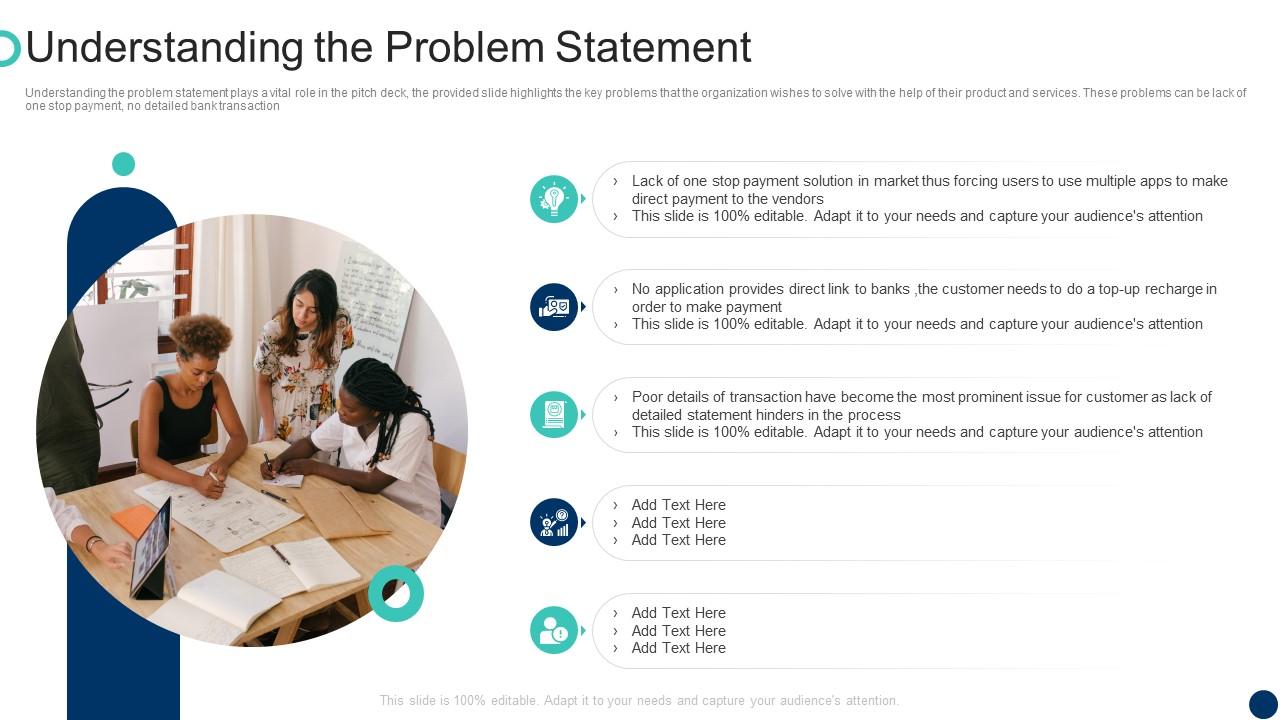
Understanding the problem statement plays a vital role in the pitch deck, the provided slide highlights the key problems that the organization wishes to solve with the help of their product and services. These problems can be lack of one stop payment, no detailed bank transaction. Increase audience engagement and knowledge by dispensing information using Hackathon Understanding The Problem Statement Ppt Professional Slides. This template helps you present information on five stages. You can also present information on Payment, Application, Customer using this PPT design. This layout is completely editable so personaize it now to meet your audiences expectations.

FAQs for Hackathon understanding the problem statement

Okay so you need four main things for a good hackathon problem. First, write the problem so people actually get what you're asking - I've seen teams waste hours just being confused lol. Set clear goals they can hit, mention any tech constraints or specific APIs/datasets upfront. The scope thing is huge though - make it doable in the time you've got but still interesting enough that they're not bored. Honestly, I'd write it like you're explaining to a buddy, then have someone totally fresh read it. If they're scratching their head, you'll know to simplify it more.

Go with the 70-30 rule - pick something that'll stretch you guys but has a solid 70% shot at working. Break your idea down into must-haves vs cool extras, then cut everything that's not absolutely core. Think bare minimum that actually works, not some polished masterpiece. Honestly, most teams bite off way more than they can chew. Here's my test: can you build, test AND present this using only 80% of your time? You'll need that buffer when stuff breaks (and it will). Focus on proving the concept works - you can always add the fancy bits later if there's time.

Honestly, getting feedback on your problem statement is a game changer. I've watched so many hackathons where teams picked problems that sounded cool but were either super vague or way too ambitious. You'll want to run yours by 3-4 people first - maybe some potential participants or mentors. They catch stuff you totally missed, like confusing wording or unrealistic scope. Plus they'll tell you straight up if the problem actually makes people want to jump in and solve it. Trust me, that reality check saves you from those awkward moments where teams just stare at your prompt looking lost.

Honestly, mixed teams are a game changer for this stuff. You'll get way better problem statements when you have designers, engineers, business people, and domain experts all weighing in. Engineers might nail the technical side but completely miss what users actually want - been there! Having different backgrounds means people catch blind spots you'd never see otherwise. Your problem definition ends up way more solid when it's been through all those different lenses. Plus the back-and-forth usually makes the whole thing more realistic. I'd shoot for at least three different types of expertise on your team.

First thing - grab the hackathon's core values and figure out what they actually care about. Frame your problem around those exact focus areas. Like if it's sustainability-themed, your challenge needs to scream environmental impact, not just mention it as an afterthought. I've watched so many teams bomb because they went off on weird tangents that had nothing to do with the theme. Honestly, judges can spot irrelevant projects from a mile away. Keep the theme description open while you're writing. Use their keywords. Make it sound like your problem was literally born from what they're trying to accomplish.

Honestly, keep your language super clear and ditch the jargon. Don't assume everyone has fancy hardware or knows what "build an AI model" actually means - I've watched so many hackathons accidentally lock people out with stuff like that. Offer different approaches for various skill levels. Maybe suggest team formation tips so people can mix expertise? Define your technical terms and throw in some example solutions. Oh, and definitely tell people that creative, low-tech solutions count too. You'd be surprised how many participants think they need to code everything from scratch when sometimes the best ideas are way simpler.

Don't be vague or way too complex - that's the kiss of death. People need to get it right away, not scratch their heads for an hour figuring out what you even want. Skip the jargon since hackathons get all kinds of skill levels. But here's the thing - don't make it super narrow either where there's only one "correct" answer. Creativity needs some room to breathe. Honestly, just test it on someone first. If they look lost after reading it, simplify more. Oh, and definitely include clear success criteria so teams actually know what winning looks like.

Honestly, storytelling changes everything when you're writing problem statements. Instead of boring technical specs like "build an app that does X," you give them a real person with real problems. Picture this: "Sarah's a busy mom who panics every morning trying to..." See? Way more engaging. Teams actually *get* what they're solving for when there's a face attached to it. Stories stick in your brain better than random bullet points too. Once you add specific characters and actual emotional stakes, people can visualize their solution's real impact. Seriously, try starting with a concrete user scenario next time - you'll see how much sharper everyone gets.

Honestly, just follow tech news and funding announcements - that's where you'll find the real problems companies are scrambling to fix. When remote work blew up, everyone suddenly needed better collaboration tools, right? I'm always checking Product Hunt too (maybe too obsessively lol). The sweet spot is finding trends that are hot but not completely overdone yet. Look for stuff where the tech exists but the user experience is still garbage. Or when new regulations create fresh headaches. I subscribe to like 3-4 industry newsletters and you start seeing the same pain points everywhere. That's your goldmine right there.

Oh man, context is everything! I've watched so many hackathons where teams waste like half their time just figuring out what problem they're even supposed to solve. Pretty painful to watch honestly. You gotta tell people why this matters, who's actually affected by it, what sucks about the current situation. Without that background, teams either build something totally off-base or they create cool tech that looks impressive but doesn't fix the real issue. Give them enough info so they can make smart choices about their approach. Trust me, it makes such a difference.

Honestly, focus on three main things: does your solution actually work, does it solve the right problem, and can you explain why it matters? I've watched so many teams bomb because their demo breaks or they built something cool but totally missed the point. Make sure you're hitting the specific requirements they asked for - judges notice when you go off track. Oh and if there's a user component, that experience better be solid. Here's what I'd do: write up a quick scoring sheet beforehand so you can check yourself before you present. Sounds nerdy but it works.

Honestly, visuals are a game-changer for hackathons. Throw in some mockups, flowcharts, or even rough sketches so teams can actually see what you want built. Screenshots from existing apps work too. I've watched so many teams get stuck for hours just trying to decode a wall of text - it's painful to watch lol. Wireframes help people visualize the end goal fast. If you're dealing with data stuff, maybe add some before/after scenarios. The whole point is making your problem statement super scannable. Teams should be able to glance at it, get it immediately, and jump straight into building.

Honestly, lead with the real-world problem first - way more engaging than diving into tech specs right away. Break everything down into chunks people can actually digest. Use analogies! I've read so many problem statements that might as well be engineering manuals. Nobody wants that. Focus on what users need to do, not how the backend magic happens. Throw in specific scenarios and examples of what success looks like. Diagrams help clarify things without being overwhelming. Define your jargon clearly and maybe add some resources for the curious folks. Test it on someone outside your team first though - they'll catch the confusing bits.

Honestly, get mentors with real experience in whatever problem you're tackling. I've watched so many teams waste hours going down dead ends that someone with expertise could've spotted immediately. Set up rotating "mentor rounds" throughout the day - not just at kickoff. They're amazing at helping teams figure out what's actually doable in your timeframe and what's just wishful thinking. Quick check-ins work better than long sessions too. The right mentor can spot those sneaky pitfalls before they derail everything. Trust me, it's worth the extra coordination effort.

Look, the best hackathon problems hit real pain points with specific constraints. Remember TechCrunch Disrupt 2019? Winners tackled "How might we help blind users navigate indoor spaces independently?" That's way better than vague prompts. NASA's Space Apps had another solid one: "Design a solution for astronauts to grow food in zero gravity using limited resources." Both define the user AND the constraints - that's key. Honestly, most teams just pitch another food delivery app because their problem statement was too broad. You want judges thinking "yeah, that's definitely broken and needs fixing" within seconds.

Ratings and Reviews

90% of 100
Write a review
Most Relevant Reviews
  1. 100%

    by Eduardo Greene

    Excellent products for quick understanding.
  2. 80%

    by Jones Adams

    Wonderful templates design to use in business meetings.

2 Item(s)

per page: