

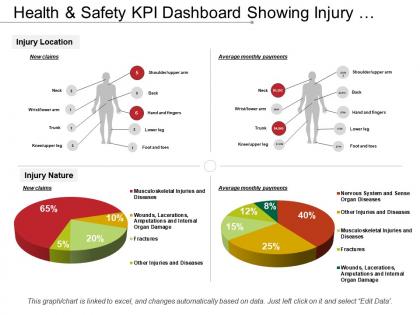
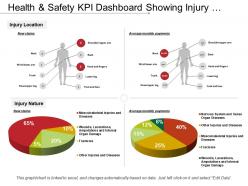
Health and safety kpi dashboard showing injury location and injury nature




Try Before you Buy Download Free Sample Product
 Impress Your
 Audience
 100%
100% Editable
 Save Hours
 of Time


The KPI dashboard PPT slide is a simple professional presentation template which can be used for KPI dashboard presentations. This is a single slide template is useful in quantifying Key Performance Indicators or KPIs. The dashboard components in this creative dashboard presentation template are data-driven. This means that the presenter can edit the values using excel. The template charts will calculate the figures as soon as the presenter includes the business content in the template. On the main slide of the template, you can see pie charts with human body structures. The user can use this PowerPoint graphics to showcase the health and safety of two persons. This pie chart PPT template is perfect for the health and protection department. This business dashboard slide comes with editable objects through which the user can change the appearance of the template easily. This slide uses high-quality graphics to ensure the modern look and feel of the presentation. Download this KPI dashboard PPT slide to aware the business audience about the health and safety. Confidence begins to build up again due to our Health And Safety Kpi Dashboard Showing Injury Location And Injury Nature. Feelings of inferiority will disappear.
People who downloaded this PowerPoint presentation also viewed the following :
Health and safety kpi dashboard showing injury location and injury nature with all 6 slides:
The basic concepts become easy to assimilate due to our Health And Safety Kpi Dashboard Showing Injury Location And Injury Nature. It contains instructive images.


FAQs for Health and safety kpi dashboard showing injury location
So you'll definitely want to track incident rates like TRIR and DART - those are pretty standard. Near-miss reporting is huge too, plus safety training completion rates. Lost time injuries hit your operations the hardest, so don't skip that one. Honestly, I think leading indicators are way more useful than just counting accidents after they happen. Things like safety audit scores and how often employees actually submit safety suggestions. Oh and PPE compliance during random spot checks - that one's easy to measure. Start with these basics, then add whatever makes sense for your specific facility and what your bosses actually care about tracking.
Make it stupid easy for people to report stuff anonymously - digital forms work great. Nobody wants to look like a snitch, you know? Track which departments report what and how fast you actually fix things. Monthly dashboards showing trends help build trust. Here's the thing though - most people will just ignore near-misses unless you make reporting feel worth it. Actually celebrate teams that report MORE incidents instead of punishing them. Sounds backwards but it works. Focus on response time and showing real changes happened because of reports.
Look, training is honestly what makes or breaks your safety numbers. Without it, people just wing it and accidents happen - your injury rates stay high, workers' comp costs pile up. But when you actually teach people the right way to handle hazards? Those KPIs start moving in the right direction. Can't expect someone to follow protocols they've never learned, right? The trick is keeping training fresh and relevant to what they're actually doing on the job. Oh, and make sure it doesn't suck so people remember it afterward. Start by figuring out where your gaps are.
OSHA and NSC publish those benchmark reports you need - TRIR, DART rates, all that good stuff. Trade publications have tons of data too, honestly they're underrated for this. Don't just compare against industry averages though, find companies your size since that makes a huge difference in the numbers. Your insurance carrier probably has current benchmarking data sitting around - mine always did. Set up quarterly check-ins to see how you're tracking. Oh and focus on where you're actually behind, not just the wins.
Keep it simple - bar charts for incident rates, line graphs for trends. Those red/yellow/green dashboards? Executives eat that stuff up because it's brain-dead easy to read. Always throw in some context like industry benchmarks so your data doesn't just float there meaninglessly. Skip the fancy 3D nonsense that just confuses everyone. Here's the thing though - don't bury your bad news. Start with your worst metrics first since sugar-coating defeats the whole point of safety reporting. Oh, and make one summary slide with your top 5 KPIs side by side for quick comparison.
So basically, leading indicators are like getting a heads up before shit hits the fan. Track stuff like near-misses, how many people actually finished safety training, how often hazards get reported - that kind of thing. Way better than waiting for someone to get hurt and then scrambling to figure out what went wrong. I'd probably start with maybe 3 or 4 that actually matter for your specific job. Check them weekly if you can. The patterns you'll see are pretty telling - they show you trouble spots before they become real problems. Then you can actually do something about it instead of just playing damage control later.
Oof, high injury rates are a nightmare - you're basically watching money drain everywhere. Workers comp claims pile up. Insurance premiums skyrocket. You're paying overtime constantly because people are out injured, and honestly, morale just tanks when everyone's stressed about getting hurt. The worst part? You end up with inexperienced workers filling gaps or everyone else getting burned out from extra shifts. It's like a domino effect that kills your whole operation's flow. I'd start tracking where these injuries actually happen - there's usually patterns you can spot that'll show you exactly what needs fixing first.
Honestly, wearables are game-changers for tracking safety metrics. Instead of relying on people to manually report stuff (which let's be real, doesn't always happen), you get automatic data collection. Heart rate spikes during dangerous tasks, how long workers spend in hazardous zones, even falls detected through motion sensors. The beauty is it just runs in the background - no one has to remember anything. You'll catch patterns and close calls that would've flown under the radar otherwise. I'd say start with something simple like fatigue monitoring first, then add more once everyone's cool with wearing the devices.
Make your KPIs super specific - like "safety training completion rates" instead of just "number of incidents." Those leading indicators actually prevent problems before they blow up. Someone needs to own each metric too, otherwise it's just pretty numbers on a dashboard (honestly, I've seen way too many of those collecting dust). The real magic happens when you're sitting with your team going "okay, what are we gonna do differently based on this?" Short meetings work better btw. Focus on near-miss reporting frequency, stuff like that. Review regularly and actually change behavior - that's where you'll see results.
Quarterly reviews are the bare minimum, but monthly is way better if you can pull it off. Regulations shift constantly - you don't want to get blindsided by new rules or miss red flags early. Near-miss reports and incident rates need frequent check-ins to catch patterns before they blow up. I learned this the hard way at my last job. Annual reviews? Forget it, that's useless for safety stuff. Just block out time each month with your safety team. Treat it like you would any other critical business meeting because honestly, it is.
Oh totally, there's definitely a connection there. Engaged employees follow safety rules way more consistently - they actually care instead of just clocking in. Near-miss reporting goes up too because people aren't worried about getting in trouble. It's kinda like when you're invested in something, you naturally protect it better? Plus they'll actually speak up during safety meetings rather than zoning out. Honestly, I'd check your engagement numbers first if safety metrics are tanking. Sometimes fixing that underlying issue makes everything else fall into place without you having to micromanage every protocol.
Get your executives talking about safety numbers in actual meetings - that's when people start paying attention. Put those dashboards somewhere everyone sees them daily, not buried in some folder. Celebrate the wins too! Scrap those awful safety meetings nobody shows up to anyway. Instead, work it into regular performance reviews and recognition stuff. Your managers need training on how to bring this up naturally, not just after something goes wrong. Oh, and start small - maybe focus on one department first to build some momentum, then expand from there. Much easier that way.
So I'd definitely check out SafetyCulture (iAuditor) or SafetySync first - way better than dealing with spreadsheets all day. Mobile apps are clutch since your crew can report stuff right when it happens. If you need something more robust, Cority or VelocityEHS handle everything from injury tracking to compliance metrics. But honestly? Pick whatever your team will actually use. I've seen fancy systems fail because nobody wanted to mess with them. Start simple - make reporting super easy for the frontline guys, then worry about building out dashboards later.
Start with the overlap stuff - waste from safety incidents, how much energy your safety equipment uses, PPE disposal impact. Honestly just pick whatever's easiest to track right now. Green chemistry rates are good, plus where you're sourcing safety gear from. Carbon footprint of training programs too, though that one's kinda niche. The sweet spot is finding metrics where going greener actually makes things safer, not just more paperwork. I'd pilot maybe 2-3 integrated ones first. Don't try to change everything - you'll burn out your team and probably mess something up.
Honestly, the worst mistake is only tracking stuff like injury rates - you're just measuring how badly things went after the fact. Mix in some forward-looking metrics too, like training completion rates or how many near-misses people actually report. And don't set impossible targets that make everyone lie about incidents (learned that one the hard way). Your metrics should push people toward safer habits, not just make executives happy. I'd start by figuring out what safety outcomes actually matter for your specific situation, then figure out what daily activities prevent those problems from happening.
-
Excellent products for quick understanding.
-
Professional and unique presentations.