

Helpdesk dashboard illustrating first response time and current open ticket status powerpoint template





Try Before you Buy Download Free Sample Product
 Impress Your
Audience
 100%
Editable
 Save Hours
of Time


Our Helpdesk Dashboard Illustrating First Response Time And Current Open Ticket Status Powerpoint Template are topically designed to provide an attractive backdrop to any subject. Use them to look like a presentation pro.
People who downloaded this PowerPoint presentation also viewed the following :
Content of this Powerpoint Presentation
Description:
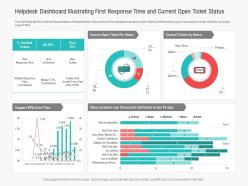
The image represents a comprehensive Helpdesk Dashboard designed to provide an overview of key performance indicators (KPIs) related to helpdesk operations and customer support. The slide features a combination of graphs, charts, and metrics that offer insights into various aspects of customer service performance. Here's a breakdown of the key elements on the slide:
1. % Handled Tickets:
The left-hand side of the slide displays the "% Handled Tickets" metric, showing an actual performance of 88.50% compared to a goal of 76%. This indicates that the helpdesk has exceeded its target in handling customer tickets.
2. First Response Time and Time to Resolve:
Below the "% Handled Tickets" section, the slide provides data on first response time, time to resolve, and the number of new tickets. Additionally, it includes median response and resolution times, along with the growth percentage compared to the previous quarter. These metrics help in evaluating the efficiency of ticket handling and customer inquiry resolution times.
3. Donut Charts:
Current Open Tickets and Created Tickets by Nature: The central and right sections of the slide feature two donut charts. The first one, labeled "Current Open Ticket Per Status," visualizes the distribution of ticket statuses, providing an overview of the current workload. The second donut chart, titled "Created Tickets by Nature," highlights the reasons for ticket creation, categorizing them by nature or type.
4. Support KPIs Over Time:
The bottom left graph, "Support KPIs Over Time," presents a trend analysis of KPI metrics across several quarters. This allows for tracking performance trends and identifying areas of improvement or concern over time.
5. Noisy Customer :
Top 10 Accounts by Tickets in Last 30 Days: The bottom right bar chart ranks customer accounts based on the volume and severity of their tickets within the last 30 days. This can help identify high-impact customers and their support needs.
Use Cases:
This Helpdesk Dashboard is versatile and applicable across various industries that aim to maintain and enhance their customer service quality and efficiency. Here are the industries, use cases, presenters, and target audiences where this dashboard can be beneficial:
1. Information Technology:
Use: Monitoring and improving helpdesk operations and response times.
Presenter: Customer Support Manager.
Audience: Support Team Members, IT Staff, Management.
2. Telecommunications:
Use: Evaluating support service levels and identifying issues in customer technical support.
Presenter: Service Operations Manager.
Audience: Customer Service Representatives, Operational Directors.
3. E-commerce:
Use: Tracking customer service performance for online transactions and inquiries.
Presenter: E-commerce Support Coordinator.
Audience: Customer Service Agents, E-commerce Managers.
4. Healthcare:
Use: Management of patient support services and inquiry resolution times.
Presenter: Patient Services Administrator.
Audience: Healthcare Providers, Support Staff.
5. Financial Services:
Use: Assessing response times and ticket resolution efficiency for customer financial inquiries.
Presenter: Customer Service Lead.
Audience: Financial Advisors, Customer Relations Staff.
6. Education:
Use: Tracking and improving support services for students and faculty members.
Presenter: IT Support Team Lead.
Audience: Educational Administrators, Support Staff.
7. Retail:
Use: Monitoring customer service queries and product-related issues.
Presenter: Retail Support Manager.
Audience: Store Managers, Customer Support Teams.
Helpdesk dashboard illustrating first response time and current open ticket status powerpoint template with all 2 slides:
Use our Helpdesk Dashboard Illustrating First Response Time And Current Open Ticket Status Powerpoint Template to effectively help you save your valuable time. They are readymade to fit into any presentation structure.

FAQs for Helpdesk dashboard illustrating first response time and current open ticket
Honestly, start with the basics that'll actually show you what's happening. Ticket volume and response times are clutch - plus how long it takes to actually solve stuff. First contact resolution is probably the most important one because customers hate repeating themselves (learned that the hard way). Keep an eye on your backlog size and customer satisfaction scores too. Oh, and definitely track agent workload so you can tell if someone's getting buried under tickets. I'd stick with those core ones first, then you can always add more weird metrics later if you need them.
Honestly, visual dashboards are a game changer for helpdesk stuff. Heat maps show you ticket patterns instantly - way better than scrolling through endless spreadsheet rows. Color-coded indicators help spot bottlenecks fast, and trend lines track how your resolution times are doing. Bar charts work really well for comparing agents too. I'd start with your main KPIs first, then just mess around with different chart types until something clicks. Trust me, once you see the story pop out from your data visually, you'll never want to go back to those boring number tables.
Okay so real-time data is like having eyes on everything happening in your helpdesk right now. When ticket volumes suddenly spike, you'll catch it early instead of scrambling later. Quick staffing adjustments become way easier too - move agents around when certain queues get slammed. Honestly, there's nothing worse than customers telling you about outages before your own team knows. You can also jump on small problems before they blow up into major headaches. Set up some smart alerts though, otherwise you'll just burn out watching dashboards all day. It's pretty much the difference between being proactive and constantly playing catch-up.
So basically your helpdesk dashboard shows all incoming tickets and helps you catch patterns. Like if the same bug keeps hitting different teams, you'll see it right away. Filter by issue type or keywords to find what's breaking most often. Those visual charts are honestly way better than digging through ticket lists - you can spot spikes in complaints super easily. I'd set up alerts for when certain problems hit a threshold so you can fix the actual root cause before everything goes sideways. Oh and watch for recurring keywords in descriptions, that's usually where the real issues hide.
Okay so definitely prioritize high contrast colors and adjustable text sizing - those are non-negotiable. Alt text for all your icons too. Keyboard navigation is critical since tons of people can't use a mouse effectively. Honestly, screen reader support should be built in from day one, not slapped on later (learned that the hard way). Skip links are clutch for letting users jump around quickly. Clear focus indicators help too so people know where they are. Oh, and throw in proper heading structure while you're at it. Start with these and you'll blow most dashboards out of the water.
Dude, integrations are what make your helpdesk actually useful instead of just another boring dashboard. Connect your CRM so you can see customer history right away. Hook up monitoring tools to auto-create tickets when stuff breaks - saves so much time. Your knowledge base integration helps agents find answers without digging around forever. I'd start with whatever tools your team uses most, like Slack or Jira. Don't go crazy at first though. Pick one or two that fix your biggest headaches, then add more later. Trust me, it's worth the setup hassle.
So for mobile helpdesk stuff - definitely go with single-column layout, everything stacked vertically. Touch buttons need to be 44px minimum or people will hate you when they're trying to update tickets quickly. I'd put the most important actions like status updates right at the top where they're obvious. Collapsible sections work great for detailed info without cluttering everything up. Oh and add swipe gestures for common things like marking resolved - makes it feel way smoother. Don't just test in browser responsive mode either, actual phones behave totally different.
Honestly, the trick is asking each group what numbers actually matter to them first. Then build around that. Executives want the big picture stuff, team leads care about queue depths and response times, managers need agent performance data. Instead of sending everyone the same boring generic reports, you can create views that make sense for each role. Real-time data that's relevant gets people to actually pay attention and do something about it. It's basically like having different TV channels - why would your CEO want to see the same dashboard as a team lead? Start with what drives their decisions and work backwards from there.
Look, user feedback is literally your roadmap for dashboard improvements. People complain they can't find ticket statuses fast enough? Time to redesign the layout. Reporting workflows driving them crazy? You'll need to streamline that mess. Those "minor" complaints that seem nitpicky at first? Trust me, they usually point to way bigger usability issues lurking underneath. I'd set up monthly surveys or quick pulse checks - beats making wild guesses about what to fix next. Otherwise you're just throwing darts in the dark hoping something sticks.
Honestly, the worst thing you can do is cram everything onto one screen - nobody wants to stare at 20 different charts. Skip the vanity metrics too. Like, who cares if you're tracking page views when your response time is garbage? Focus on stuff that actually matters: response times, how fast you're solving issues, customer satisfaction. Keep it real-time so people can act on it. Oh, and make sure everyone can access it easily - sounds obvious but you'd be surprised. Start with maybe 4-5 metrics max, then build from there once people are hooked.
Your helpdesk dashboard is actually perfect for this! Check which ticket types take forever to resolve or get escalated the most - that's where your team's struggling. Resolution times and customer satisfaction scores will show you exactly who needs help with what. First-contact resolution rates are huge too, honestly they tell you everything. After training sessions, track if those numbers actually improve (sometimes they don't and you'll know the training sucked). I'd pull these reports weekly. Makes your team meetings way more focused when you've got real data instead of just guessing what people need help with.
Start with your ticketing system - that's where all the good stuff lives. Volume, resolution times, customer satisfaction scores. Your knowledge base analytics are clutch too since they show which articles people actually read (aka your biggest headaches). CRM data gives you customer context, and honestly? Those two things - tickets and CSAT - will cover like 80% of what you need to know. Agent performance metrics from workforce tools help if you want to get fancy. Oh, and basic financials if you're tracking cost per ticket, but that's more of a nice-to-have. Build on the foundation first, then add the bells and whistles later.
Looking at your helpdesk data from the past 6-12 months is honestly a game changer. You'll start seeing patterns everywhere - like how password reset tickets always explode after long weekends (people are the worst at remembering stuff). Resolution times tell you which team members might need extra training. Plus you can spot seasonal trends and figure out where you're burning resources for no good reason. I always check which issues spike at certain times so I can staff up accordingly. Use what you find to build better self-help resources and plan training programs. Trust me, those reports will show you exactly where your biggest headaches are coming from.
Dude, the visual stuff actually matters way more than people think. Your team will straight up ignore a confusing dashboard, even if the data's good. I've watched this happen so many times - gorgeous design but nobody could find what they needed. Red for urgent tickets, clean groupings for related stuff. Makes agents way faster at spotting problems. Short sentences help too. When people can scan quickly without getting lost, they'll actually use it and mess up less. Test it with real users though - what looks obvious to you might be total chaos to them.
Honestly, automation is a game changer for response times. It handles all the boring stuff - auto-assigns tickets based on keywords, sends those instant "we got your message" replies, bumps urgent stuff up the chain. No more playing email tag about who should take what ticket. Your team gets things routed based on their skills and how swamped they are. Start with basic rules like sorting common issues automatically. I swear you'll notice faster responses pretty much right away. Your agents can actually fix problems instead of just moving tickets around all day.
-
Use of icon with content is very relateable, informative and appealing.
-
Enough space for editing and adding your own content.
-
Great designs, really helpful.
-
Visually stunning presentation, love the content.
-
Use of different colors is good. It's simple and attractive.