Honda motor co ltd swot analysis 2017-2018

Honda motor co ltd swot analysis 2017-2018
Slide 1 of 2
Favourites Favourites

Try Before you Buy Download Free Sample Product

Audience Impress Your
Audience
Editable 100%
Editable
Time Save Hours
of Time
The Biggest Sale is ending soon in
0
0
:
0
0
:
0
0
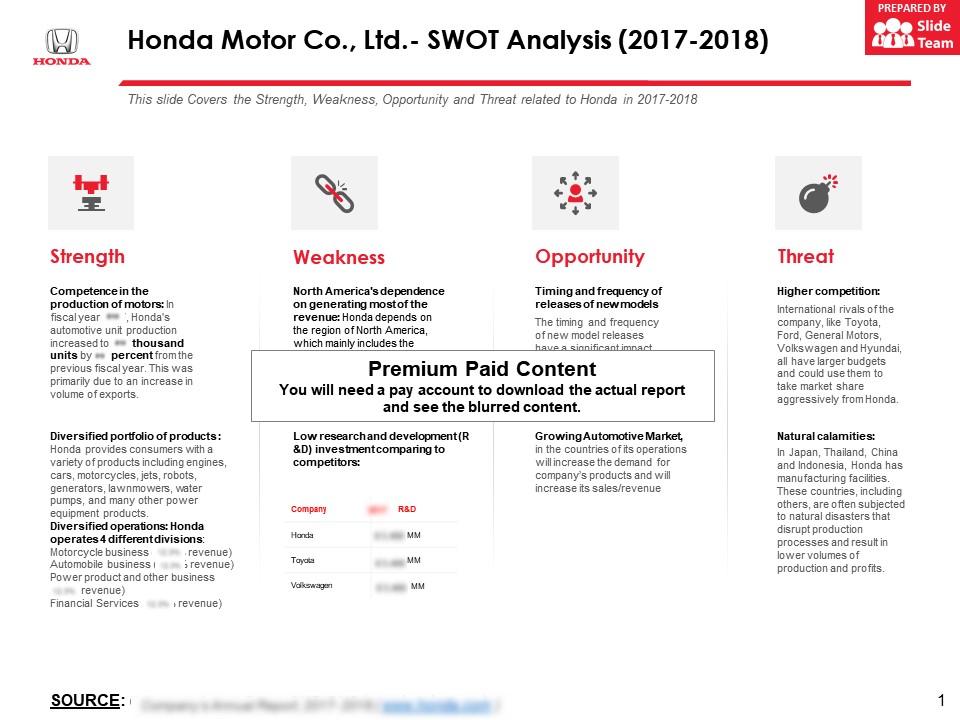
The information presented in this slide has been researched by our team of professional business analysts. This is part of our Company Profiles products selection, and you will need a Paid account to download the actual report with accurate data and sources. Downloaded report will be in Powerpoint and will contain the actual editable slides with the actual data and sources for each data. This slide Covers the Strength, Weakness, Opportunity and Threat related to Honda in 2017 to 2018. Download it immediately and use it for your business.
People who downloaded this PowerPoint presentation also viewed the following :

FAQs for Honda motor co ltd

Honda's key strengths in 2017-2018 included strong brand reputation, innovative R&D capabilities, efficient manufacturing processes, diverse product portfolio, and global market presence across automotive and motorcycle segments. These competitive advantages enabled Honda to maintain market leadership through technological innovation, cost-effective production, and strategic diversification, ultimately delivering consistent performance and customer loyalty in increasingly competitive markets.

Honda's strong brand reputation during 2017-2018 enhanced its market position through trusted reliability, innovative engineering excellence, and consistent customer satisfaction across automotive and motorcycle segments. This reputation enabled Honda to maintain competitive advantages in global markets, with many consumers choosing Honda vehicles over competitors, ultimately delivering sustained market share growth and premium pricing power in an increasingly crowded automotive landscape.

Honda's key weaknesses in 2017-2018 included limited electric vehicle portfolio, heavy dependence on traditional combustion engines, and slower adaptation to autonomous driving technologies compared to competitors. These challenges impacted market positioning in increasingly eco-conscious markets, with many automotive analysts finding that Honda's conservative approach to electrification limited growth opportunities in emerging sustainable mobility segments.

Emerging technologies presented Honda with significant opportunities through electric vehicle development, autonomous driving systems, connected car platforms, and advanced manufacturing processes. These innovations enabled Honda to diversify beyond traditional automotive markets, enhance fuel efficiency, improve safety features, and streamline production costs, while positioning the company competitively in an increasingly technology-driven automotive landscape.

External threats highlighted in Honda's 2017-2018 SWOT analysis include intensifying competition from electric vehicle manufacturers, fluctuating currency exchange rates, rising raw material costs, stringent environmental regulations, and economic uncertainties in key markets. These challenges present both risks and strategic opportunities, with many automotive companies finding that proactive adaptation through innovation, supply chain optimization, and market diversification ultimately delivers competitive resilience and sustained growth.

Honda's global presence in 2017-2018 drove strategic initiatives including electrification expansion, regional manufacturing optimization, autonomous vehicle partnerships, and emerging market penetration strategies. Through localized production facilities and market-specific product development, Honda streamlined operations while enhancing competitive positioning across Asia, Europe, and North America, ultimately delivering cost efficiencies and accelerated innovation cycles.

Honda leveraged its R&D capabilities by investing heavily in hybrid and electric vehicle technologies, autonomous driving systems, and fuel-efficient engine designs to meet evolving consumer preferences and regulatory requirements. Through strategic partnerships with tech companies and expanded research facilities, Honda accelerated innovation in connectivity features, safety technologies, and alternative powertrains, ultimately delivering competitive advantages in increasingly demanding automotive markets.

Regulatory changes significantly influenced Honda's strategic planning through emissions standards tightening, safety regulation updates, and fuel efficiency mandates across global markets. These regulatory shifts accelerated Honda's investment in hybrid technology, autonomous driving capabilities, and manufacturing process improvements, with the automotive industry increasingly finding that proactive compliance delivers competitive advantage and market positioning benefits.

Honda's supply chain management significantly enhanced operational efficiency through streamlined supplier relationships, just-in-time inventory systems, and strategic global sourcing partnerships. These integrated approaches enabled faster production cycles, reduced operational costs, and improved quality control across manufacturing facilities, with many automotive analysts finding that Honda's supply chain optimization ultimately delivered competitive advantage in an increasingly complex automotive landscape.

Emerging market expansion, growing demand for fuel-efficient vehicles, increasing adoption of hybrid technology, and rising interest in autonomous driving features presented significant opportunities for Honda during this period. These trends enabled Honda to leverage its engineering expertise and environmental focus, particularly in Asian markets and among eco-conscious consumers, ultimately delivering competitive advantage through strategic product positioning and technological innovation.

Competitive pressures drove Honda to accelerate innovation in hybrid and electric vehicle technologies, enhance fuel efficiency across model lines, and strengthen partnerships with technology companies for autonomous driving capabilities. These strategic responses enabled Honda to maintain market share in increasingly competitive automotive segments, particularly against Tesla's electric vehicle dominance and traditional rivals' aggressive pricing strategies, ultimately positioning the company for sustainable growth.

Honda identified significant opportunities in electric vehicles, autonomous driving technology, mobility services, and emerging market expansion during 2017-2018. These strategic diversification areas enabled Honda to leverage its engineering expertise while entering high-growth sectors, with the automotive industry increasingly shifting toward electrification and smart mobility solutions, ultimately positioning Honda for long-term competitive advantage.

Honda implemented strategic partnerships with technology companies, accelerated R&D investments in electric and autonomous vehicles, expanded manufacturing in emerging markets, and enhanced digital customer experiences to counter competitive pressures. Through these initiatives, Honda strengthened its position in evolving automotive segments while leveraging its engineering expertise and global manufacturing scale, ultimately delivering improved market responsiveness and sustainable competitive advantage.

Honda's customer engagement strategies evolved through enhanced digital platforms, personalized marketing campaigns, improved dealer relationships, and expanded social media presence to strengthen brand loyalty. During 2017-2018, these initiatives enabled Honda to better connect with younger demographics, streamline customer service experiences, and leverage data analytics for targeted outreach, ultimately delivering improved customer satisfaction and competitive positioning in an increasingly digital automotive landscape.

Honda's 2017-2018 financial performance revealed strong revenue growth driven by diversified product portfolios and global market presence, while highlighting vulnerabilities in regulatory compliance costs and competitive pressure from electric vehicle pioneers. These insights demonstrate how traditional automotive strengths can sustain profitability during industry transitions, with many manufacturers finding that strategic diversification ultimately delivers resilience against market disruptions and technological shifts.

Ratings and Reviews

0% of 100
Write a review
Most Relevant Reviews

No Reviews