HR Analytics Implementation Best Practices For Business Intelligence Implementation

Rating:
90%
HR Analytics Implementation Best Practices For Business Intelligence Implementation
Slide 1 of 6

or

Favourites Favourites

Try Before you Buy Download Free Sample Product

Audience Impress Your
Audience
Editable 100%
Editable
Time Save Hours
of Time
The Biggest Sale is ending soon in
0
0
:
0
0
:
0
0
Rating:
90%
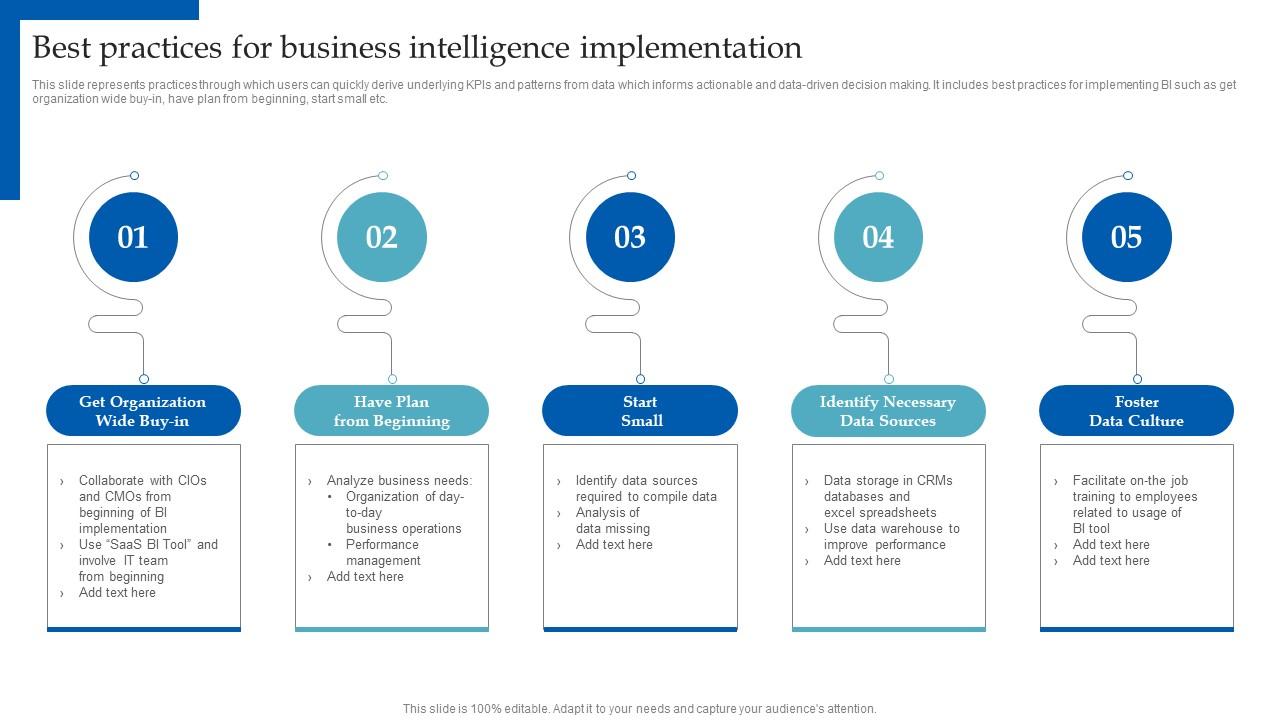
This slide represents practices through which users can quickly derive underlying KPIs and patterns from data which informs actionable and data driven decision making. It includes best practices for implementing BI such as get organization wide buy in, have plan from beginning, start small etc. Introducing HR Analytics Implementation Best Practices For Business Intelligence Implementation to increase your presentation threshold. Encompassed with five stages, this template is a great option to educate and entice your audience. Dispence information on Get Organization Wide Buy In, Have Plan From Beginning, Start Small, using this template. Grab it now to reap its full benefits.

FAQs for HR Analytics Implementation Best Practices For

Essential HR analytics KPIs include employee turnover rates, time-to-hire, employee engagement scores, performance ratings, training effectiveness metrics, and cost-per-hire. These indicators enable organizations to streamline recruitment processes, enhance retention strategies, and optimize workforce productivity, with many companies finding that strategic KPI tracking ultimately delivers improved talent management and competitive operational efficiency.

HR analytics enhances employee retention by identifying turnover patterns, predicting flight risks through engagement data, and analyzing exit interview trends to address root causes. Through predictive modeling and sentiment analysis, organizations can proactively implement targeted retention strategies, optimize compensation packages, and improve workplace culture, ultimately reducing recruitment costs and maintaining institutional knowledge.

Effective HR analytics tools include Workday, BambooHR, Tableau, Power BI, and SAP SuccessFactors, each offering specialized capabilities for workforce data management and visualization. These platforms streamline talent acquisition, performance tracking, and predictive modeling, with many organizations finding that integrated solutions deliver enhanced decision-making, reduced turnover costs, and ultimately stronger competitive advantage through data-driven HR strategies.

HR analytics enhances recruitment by analyzing candidate sourcing effectiveness, predicting job performance through skills assessments, tracking time-to-hire metrics, and identifying successful employee profiles. Through predictive modeling and data-driven screening, organizations streamline candidate evaluation, reduce hiring costs, and improve quality of hire, with many companies finding that analytics-based recruitment delivers faster placements and better long-term retention rates.

Employee engagement serves as a critical performance indicator in HR analytics, influencing productivity, retention, turnover rates, and overall organizational success. Through pulse surveys, performance metrics, and sentiment analysis tools, organizations can measure engagement levels, identify trends across departments, and predict retention risks, with many companies finding that engaged employees deliver significantly higher performance and lower recruitment costs, ultimately providing competitive advantage in talent management.

Organizations ensure data privacy and security in HR analytics by implementing encryption, access controls, anonymization techniques, regular audits, and compliance frameworks like GDPR. These measures streamline protection while enabling insights, with many companies finding that strategic data governance ultimately delivers enhanced employee trust and operational efficiency without compromising analytical capabilities.

Common pitfalls include relying on incomplete datasets, ignoring contextual factors, making correlation-causation errors, overlooking data quality issues, and applying one-size-fits-all interpretations across different departments. These analytical mistakes can lead organizations to implement misguided policies, misallocate resources, and make strategic HR decisions based on flawed insights, ultimately undermining workforce optimization and employee satisfaction initiatives.

Predictive analytics in HR forecasts workforce trends by analyzing historical data, employee performance patterns, market conditions, and demographic shifts to identify future talent gaps and turnover risks. Through machine learning algorithms, organizations can anticipate hiring needs, skill shortages, and retention challenges, enabling proactive recruitment strategies and workforce planning that ultimately reduces costs while maintaining optimal staffing levels.

HR analytics contributes to diversity and inclusion by measuring representation across demographics, identifying bias in recruitment and promotion processes, tracking pay equity gaps, and analyzing retention patterns among underrepresented groups. Through predictive modeling and sentiment analysis, organizations can proactively address workplace barriers, optimize inclusive hiring strategies, and create data-driven accountability measures that ultimately enhance organizational culture and competitive advantage.

HR professionals can effectively communicate analytics findings through clear visualizations, executive summaries with key metrics, and storytelling that connects data to business outcomes. By presenting findings in leadership-friendly formats like dashboards and scorecards, focusing on actionable insights rather than raw data, and linking HR metrics to organizational goals, professionals enable strategic decision-making that drives performance improvements.

HR professionals should develop statistical analysis, data visualization, business intelligence tools proficiency, critical thinking, and storytelling capabilities to effectively leverage analytics. These competencies enable teams to interpret workforce trends, create compelling dashboards, and translate complex metrics into actionable insights, with many organizations finding that upskilled HR analysts drive better talent decisions and strategic workforce planning.

Machine learning and AI enhance HR analytics by automating pattern recognition, predicting employee behavior, and processing vast datasets in real-time. These technologies enable organizations to forecast turnover, optimize recruitment strategies, and personalize employee experiences through predictive modeling, with many companies finding that AI-driven insights significantly improve talent retention and reduce hiring costs.

HR analytics ROI can be evaluated through cost-benefit analysis comparing implementation expenses against measurable outcomes, productivity metrics tracking employee performance improvements, and time-to-hire reductions. These methods enable organizations to quantify strategic value by measuring decreased turnover costs, enhanced recruitment efficiency, and improved workforce planning accuracy, ultimately delivering competitive advantage through data-driven talent decisions.

Organizations create data-driven HR cultures by establishing clear metrics frameworks, training HR teams on analytics interpretation, integrating data insights into daily workflows, and ensuring leadership consistently models evidence-based decisions. Through regular data storytelling sessions, automated reporting dashboards, and cross-functional collaboration, companies like Netflix and Google demonstrate measurable improvements in talent acquisition, retention strategies, and employee engagement, ultimately delivering competitive advantage through strategic workforce optimization.

Best practices for integrating HR analytics with business intelligence systems include establishing unified data governance frameworks, implementing standardized metrics across departments, ensuring real-time data synchronization, creating cross-functional dashboards, and developing automated reporting workflows. These integrations streamline decision-making by connecting workforce insights with financial performance, operational efficiency, and strategic planning, with many organizations finding that comprehensive BI integration delivers faster insights and competitive advantage.

Ratings and Reviews

90% of 100
Review Form
Write a review
Most Relevant Reviews
  1. 80%

    by Chauncey Ramos

    I downloaded some of the presentations for work. They were simple to modify and saved me a lot of time and effort.
  2. 100%

    by Dong Santos

    Editable templates with innovative design and color combination.

2 Item(s)

per page: